Most label suppliers are silent killers of your ROI. They promise low prices but deliver production-stopping errors and inconsistent brand colors. If your current partner feels like a liability, this guide will show you exactly how to vet them for high-speed manufacturing success.
To choose a label supplier, evaluate their technical standards instead of just unit price. A professional partner must guarantee machine compatibility, provide rigorous pre-press audits, and use scientific color monitoring to maintain Delta E < 2, effectively preventing costly production downtime.
But identifying these red flags is only the first step. Read on to see the real-world data and expert checklists you need to protect your brand equity and stop overpaying middlemen.
Supplier Audit Checklist: Red Flags vs. Factory Standards
| Supplier Red Flag (Risk) | Professional Factory Standard | Core Business Benefit |
|---|---|---|
| Technical Silence: Prints blindly without asking technical questions. | Rigorous Pre-press Audit: Proactively intercepts design and file errors. | Prevents 100% of avoidable printing accidents. |
| Machine Jamming: Ignores applicator specs and unwind directions. | 100% Machine-Ready: Verified compatibility with your specific production line. | Eliminates $39,000/hr unplanned downtime losses. |
| Visual Drifting: Matches color by human eye or “subjective” experience. | Delta E < 2 Standards: Scientific color monitoring via spectrophotometer. | Protects brand trust and visual shelf consistency. |
| Label Peeling: Uses “standard” glue for all storage environments. | Industrial Stress Testing: Adhesives matched to cold-chain or oily environments. | Supports 11-28% brand price premium. |
| Communication Gap: Middleman feedback is slow and lacks technical depth. | Expert Factory-Direct: Transparent, direct access to production engineers. | Saves 30% in cost and reduces risk by 90%. |
Technical Silence During the Onboarding Process

The first sign that you might need to fire your current partner is what I call “technical silence,” particularly when they bypass the critical technical steps for approving label runs before mass production.
When you are evaluating a new partner or working with your current one, pay attention to the questions they don’t ask.
A supplier that acts as a mere “order taker”—simply printing exactly what you send without a second thought—is a liability, which is why savvy buyers now perform a remote factory audit to verify technical depth before placing bulk orders.
In my nine years running a B2B factory, I have seen how this silence leads to disaster. True experts will perform a free pre-press audit before a single drop of ink hits the substrate.
As Sarah Knibb, a Senior Account Manager at Pulse Media, points out, a huge issue in packaging is “the drift”—that gradual movement away from brand guidelines that eventually results in something that just isn’t right for the brand.
They should be challenging your design files, checking for bleed issues, and ensuring font legibility. If your supplier isn’t actively preventing that drift through technical oversight, they are costing you money.
Ignoring Machine Compatibility and Unwind Directions
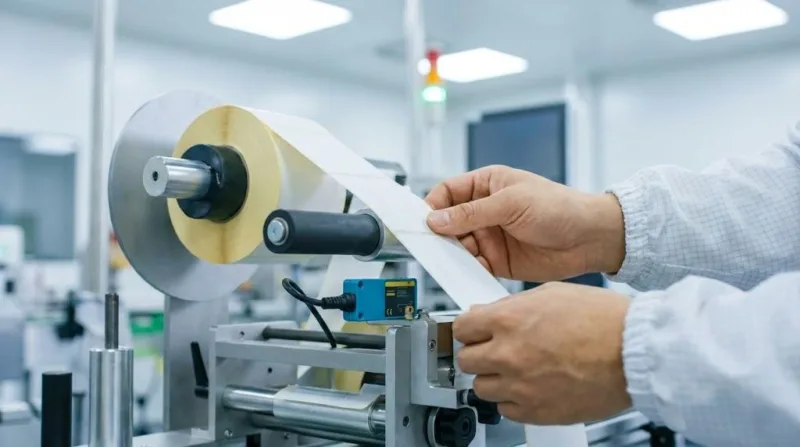
If your supplier doesn’t ask about your specific labeling equipment, they are essentially handing you a timed bomb. Automated production requires precision.
If the unwind direction is wrong, or if the core size has even a 2mm deviation, your 100% automated line becomes a 0% manual nightmare.
I once worked with a brand that had previously used a middleman to find a “budget” factory. They ordered 50,000 labels and checked a few hand-applied samples. They looked great. However, when the rolls hit the high-speed applicator, the production line “died.”
The previous supplier had ignored the #4 position (Left Side Out) requirement of their specific machine and printed them in the #3 position. The resulting cost of unplanned downtime and the need for expedited shipping to fix the error cost ten times more than the labels themselves.
To avoid this, you need a partner who guarantees 100% machine-ready rolls. This means verifying technical specs like:
- Unwind Positions (#1–#8)
- Standard Core Sizes (1″ or 3″)
- High-tensile Liners to prevent tearing under tension.
Ready to Secure Your Production Efficiency?
Don’t let technical errors halt your production. Get 100% machine-ready labels and save 30% with our direct factory expertise.
Relying on Subjective Human Eyes for Color Consistency

Have you ever seen your products sitting side-by-side on a shelf where one label looks vibrant and the other looks dull? That color drifting is a silent killer of brand equity. If your current supplier tells you, “It looks close enough to the eye,” you are looking at a major red flag.
Human eyes are subjective and tire easily; they are not a quality control standard. In 2026, professional color management requires scientific precision, specifically when utilizing the Master File Strategy for solving color variance during multi-year reorders.
You should expect your partner to use digital Pantone calibration and spectrophotometers to ensure that every batch is identical.
The industry gold standard is a Delta E value of less than 2. Any deviation higher than this becomes visible to the consumer, signaling a lack of professional care that can lead to a 45% drop in brand trust.
As Darren Cocks, Senior Designer at Pulse Media, notes, consistency is all about giving comfort and confidence to the consumer.
When your labels look identical across every SKU, you aren’t just printing paper—you are building a fortress of reliability around your brand.
Ignoring Adhesive Performance in Extreme Conditions
There is nothing more frustrating than a premium product that arrives at a customer’s door with a peeling label, often the result of failing to implement professional hand labeling standards.
This often happens because a supplier provided a “standard” adhesive without understanding the final environment, a mistake that results in labels peeling off bottles once the product hits the supply chain.
Whether your goods face the freezing temperatures of a cold chain (-20°C), the high heat of a candle jar, or the oily surfaces of essential oils, the chemistry of the glue matters.
A professional factory doesn’t guess; they perform industrial stress testing. If your supplier hasn’t asked whether your bottles are glass or plastic, or if they will be submerged in ice buckets, they are ignoring the risk of delamination.
High-quality custom roll labels are an investment that supports price premiums of 11% to 28%. To protect that investment, you need surface-matched, high-tack adhesives verified through laboratory-grade testing. If your labels are curling at the edges, it is time to stop accepting excuses and start switching label suppliers.
The Technical Communication Gap with Middlemen
The final, and perhaps most frustrating, red flag is the “middleman gap.” Many label suppliers are actually brokers or middlemen who don’t own the machines they print on.
While they might have a slick website, they are often just a “pass-through” for information. When a technical issue arises—like a barcode failing a scan test or a substrate reacting poorly to a new bottle material—the response you get is usually, “Let me check with the factory.”
This “game of telephone” is a major risk to your production timeline, often hindering the execution of data-driven label budget safeguards that require direct factory transparency.
When you work through a middleman, you lose the direct technical oversight required for high-speed production, which is why strategic vendor consolidation has become a top priority for modern procurement leaders.
By switching label suppliers and partnering directly with a specialized industrial manufacturer, you typically realize an average cost saving of 30%.
But the real value isn’t just the price—it is the 90% reduction in risk. You get to speak directly to the engineers who handle the ISO 9001 and FDA compliance standards, ensuring that your brand’s technical requirements are met with total transparency and zero filtering.
Your Path to Professional Labels
If you have recognized even one of these red flags in your current partnership, it is time to reassess. Remember, the true cost of your labels isn’t the number on the invoice; it is the Total Cost of Labeling (TCL). You have to account for the downtime, the rework labor, and the expedited shipping fees that occur when things go wrong.
To help you audit your current situation, here is a quick “Green Flag” checklist of what a professional partner should provide:
- Mandatory Pre-press Audit: They challenge your files to prevent errors before they happen.
- Equipment Calibration: They ask for your applicator specs and guarantee 100% machine compatibility.
- Scientific Color Control: They use spectrophotometers and guarantee a Delta E < 2.
- Verified Stress Testing: They match substrates and adhesives to your specific environment.
- Factory-Direct Transparency: You have a direct line to the production team.
Don’t let a “silent killer” of a supplier erode your brand equity. You have worked too hard to build your brand to let it be undermined by inconsistent colors or production halts. Protect your efficiency and simplify your growth by choosing a partner that treats your labels as a precision-engineered component of your product.