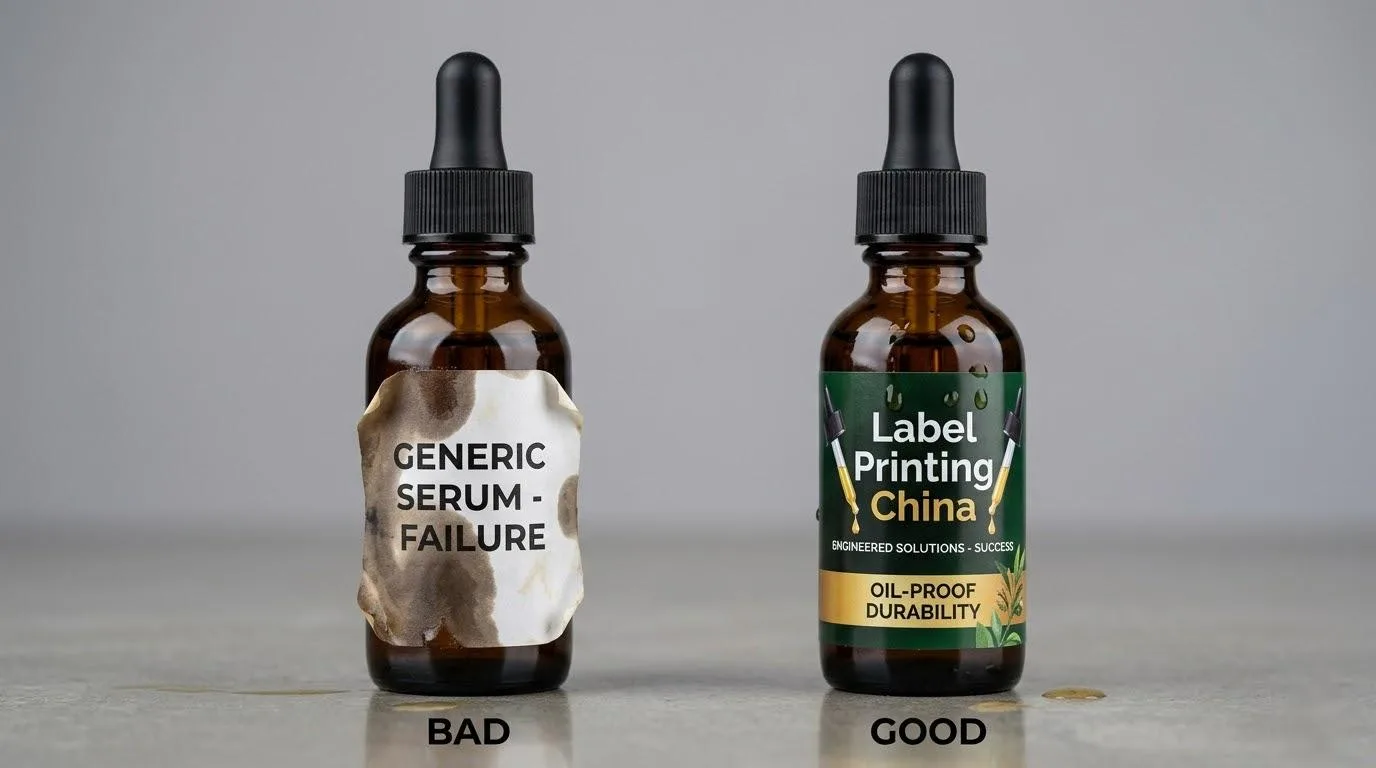
If you’ve ever walked into your warehouse to find a sea of peeling labels, you’re not alone. I’ve spent the last 9 years solving these exact “ghost” failures for major brands. This guide will show you exactly how to fix the problem—and keep it from ever happening again.
Labels peel off bottles after 48 hours primarily due to low surface energy (low dyne levels), chemical plasticizer migration, or the “Mandrel Effect.” This delayed failure happens when the material’s internal memory exceeds the bond strength before the adhesive completes its 72-hour molecular wet-out process.
But there’s a secret to stopping this that most vendors won’t tell you. Keep reading to see the specific data points and technical “材質专家” (Material Expert) hacks you need to secure your supply chain today.
Molecular Bridge
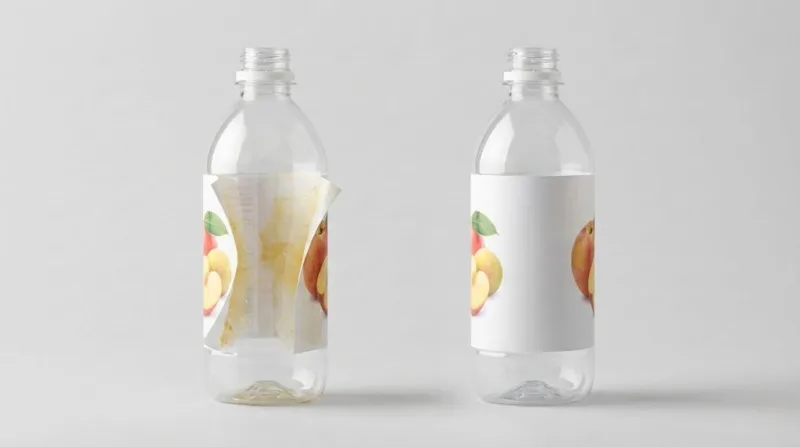
The most common mistake production teams make is assuming that once a label is applied, the bond is permanent. In reality, pressure-sensitive adhesives (PSA) are visco-elastic materials.
They don’t just “stick”; they flow. To understand why Labels Peel Off Bottles, you must first understand the concept of Dwell Time. When a label first contacts a bottle, it achieves Initial Tack. This is a superficial, physical grip.
To achieve a permanent bond, the adhesive must “wet out,” a process where the polymer chains physically flow into the microscopic valleys and pores of the bottle surface. We call this building the Molecular Bridge.
- First 20 Minutes: You only have initial tack. The bond is fragile.
- 24 Hours: The adhesive has reached roughly 80-90% of its Ultimate Adhesion.
- 48 to 72 Hours: The molecular bridge is fully established.
The “48-hour failure” window is critical because this is when the adhesive is in its most vulnerable transition state. If the internal “material memory” of the label is stronger than the bond forming at that moment, the edges will snap back.
“The most common reason for label failure is not the adhesive itself, but the failure to match the adhesive’s rheology to the substrate’s surface energy. You cannot use a general-purpose adhesive for a low-surface-energy plastic like HDPE and expect it to survive a 48-hour warehouse cycle.”
How Manufacturing Process Determines Success
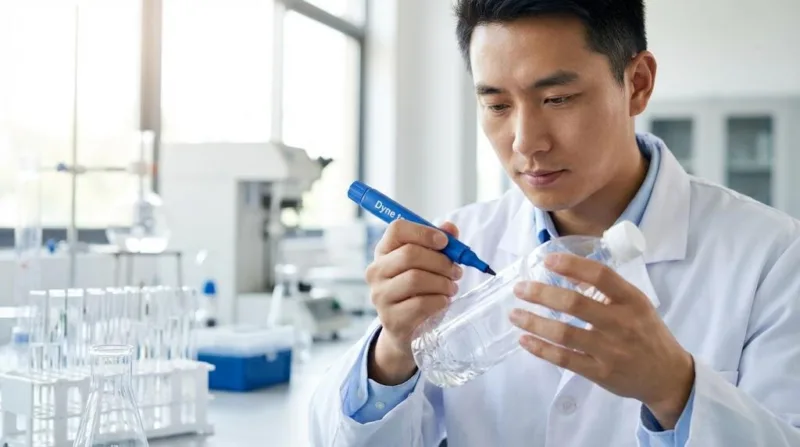
Your bottle surface might look clean to the naked eye, but at a molecular level, it might be actively repelling your label. This is the science of Surface Energy, measured in Dyne levels.
For a label to achieve a successful permanent bond, the bottle surface should ideally sit between 38-42 dynes/cm.
In my 9 years of running Custom Roll Labels production at Label Printing China, I have seen millions of dollars in inventory saved by a simple 10-second test.
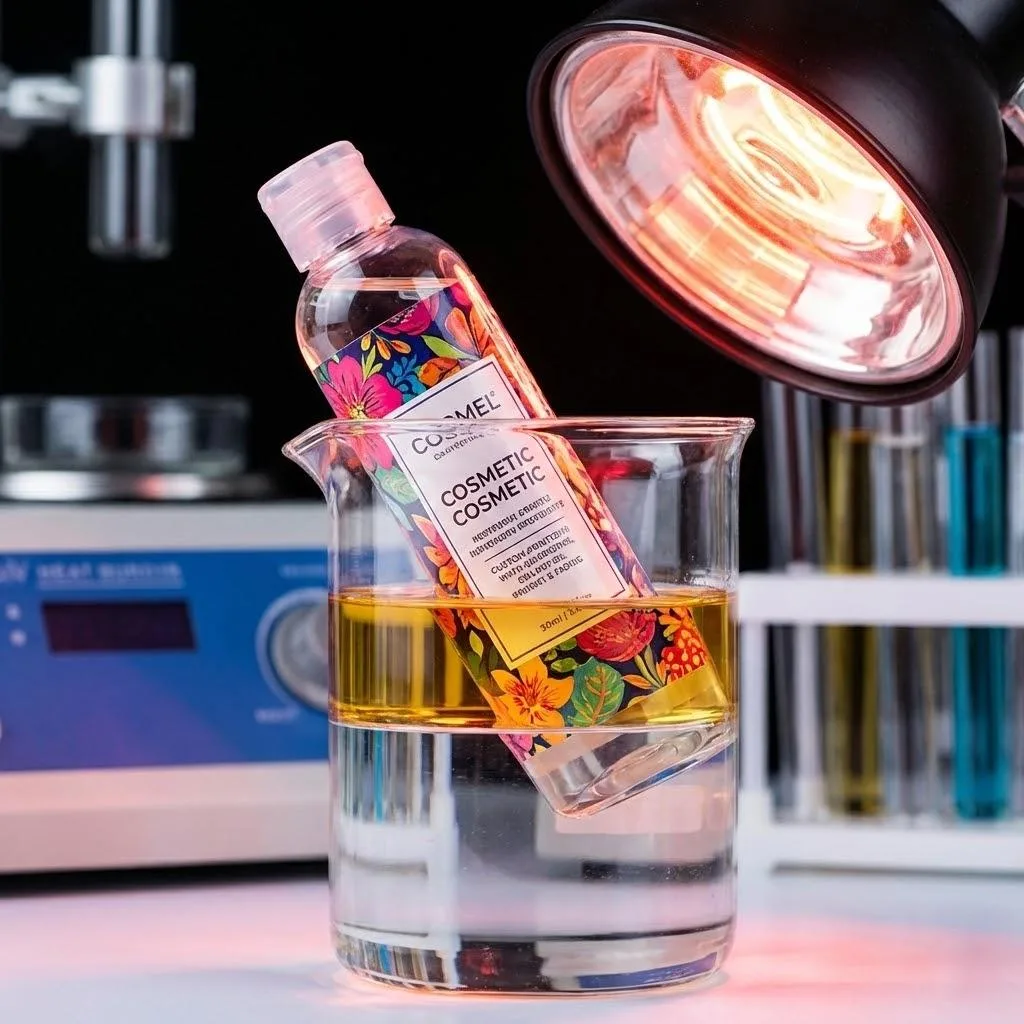
We once worked with a premium cosmetics brand using matte black PET bottles. Every test run was a success, but 48 hours after the first mass-production batch, 30% of the labels began to lift.
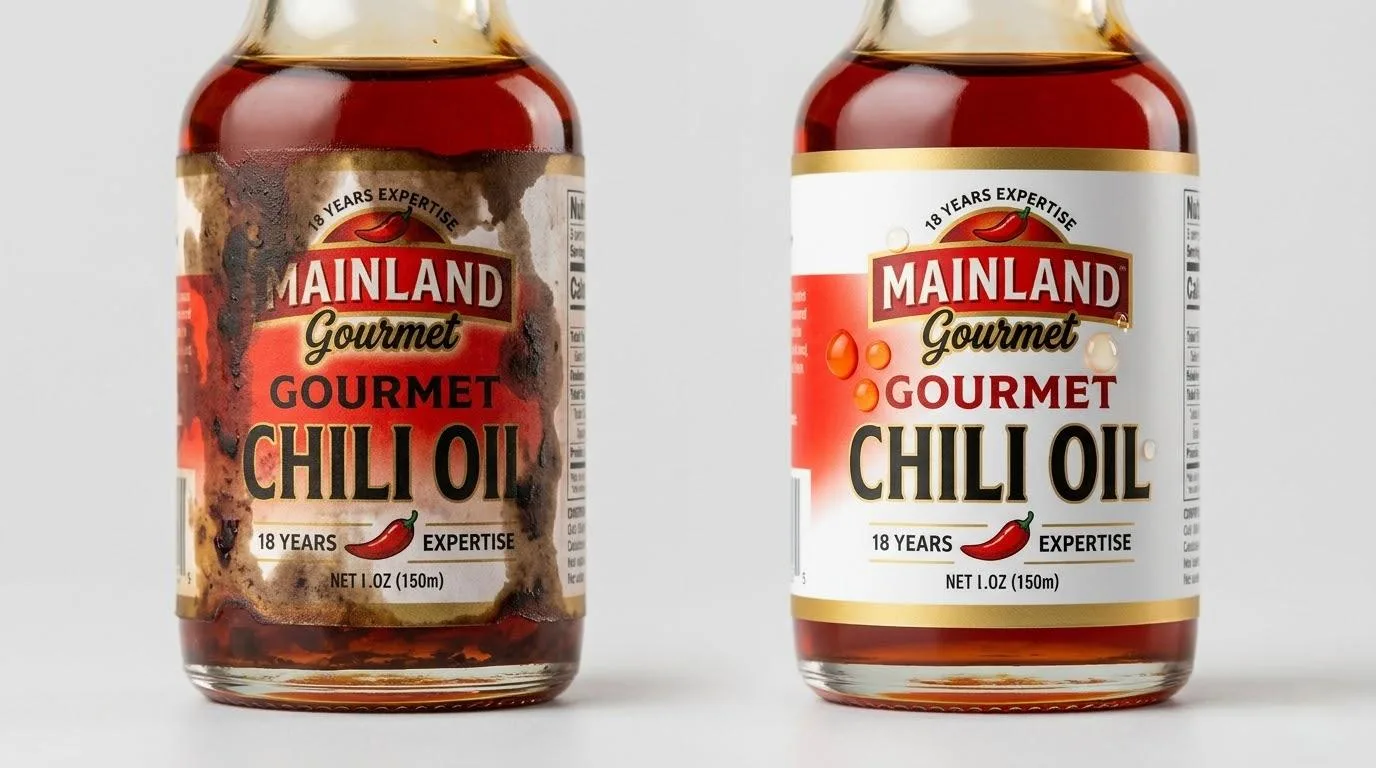
We performed a Water Break Test. When we dropped pure water on the bottle, it beaded up into perfect spheres. This was the “smoking gun”: Mold Release Agent residue.
During the bottle’s injection molding process, excess silicone-based lubricants were used, leaving an invisible, oily film that dropped the surface energy below 30 dynes. No adhesive in the world can fight a surface that repels liquid.
The Solution: We moved the client away from a standard acrylic glue to a high-tack rubber-based adhesive designed for Low Surface Energy (LSE) substrates and added an in-line Corona Treatment step to oxidize the bottle surface, raising the dyne level to 42.
When Physics Defeats Chemistry
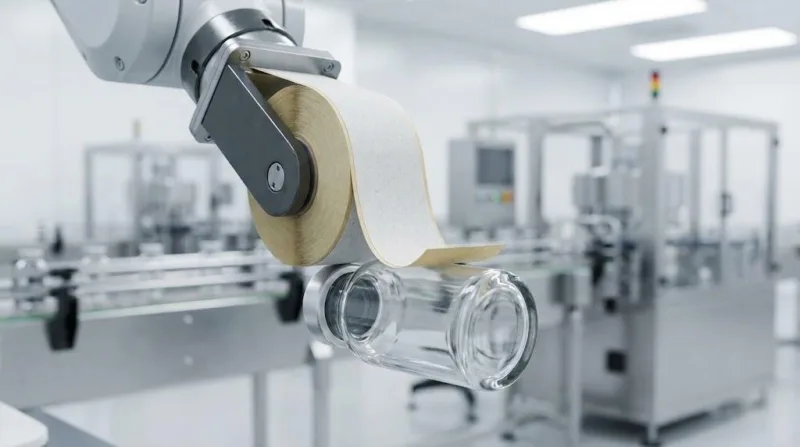
If you are labeling small-diameter containers (vials, tubes, or small beverage bottles), you are fighting the Mandrel Effect. Every label material has a “memory”—a natural tendency to return to its original flat state.
When you wrap a label around a curve, that memory creates constant outward tension. You can actually calculate this stress using the following formula: $Stress \propto \frac{E \cdot t^3}{R}$.
- E: Elastic modulus (material stiffness).
- t: Material thickness.
- R: The radius of the bottle.
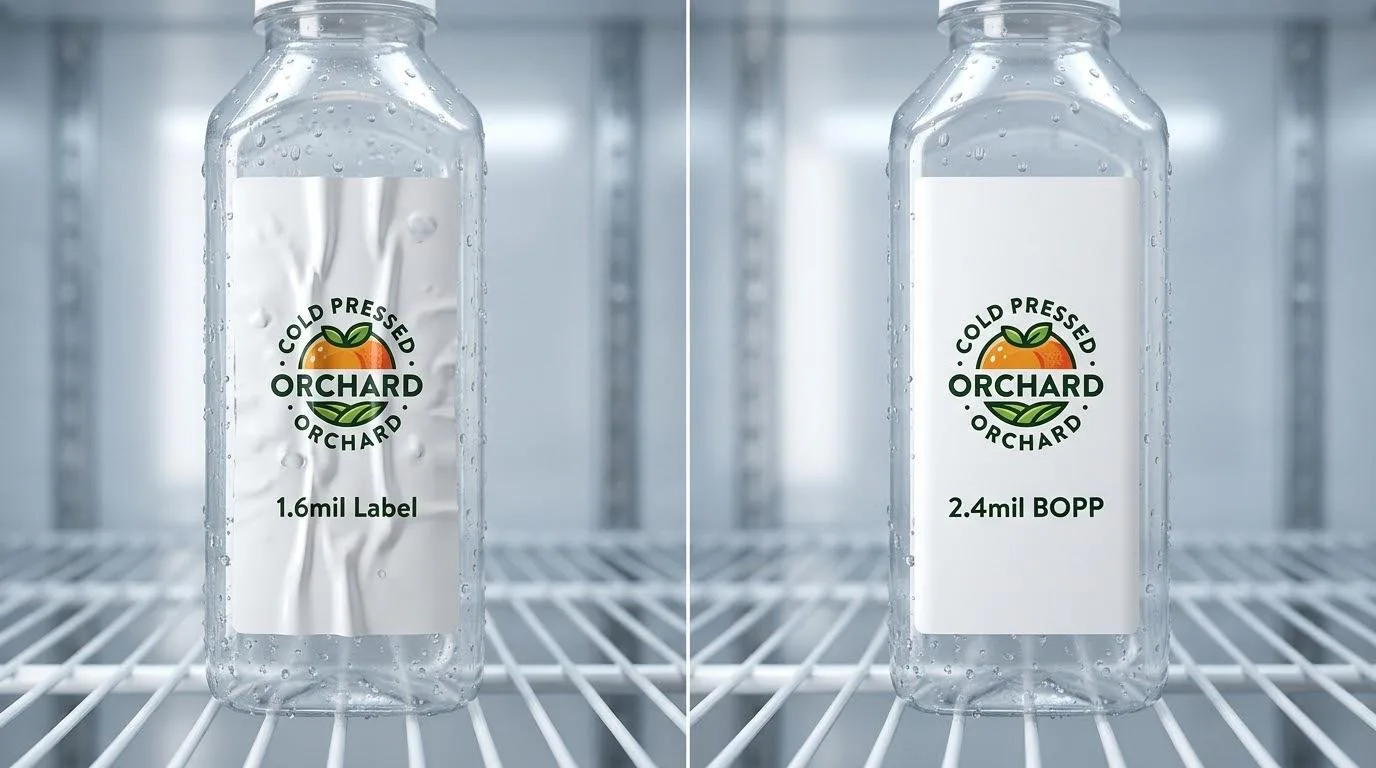
For containers with a diameter of less than 50mm, the mechanical leverage of a thick, 2.0 mil BOPP label can easily exceed the adhesive’s grip before the 48-hour “Molecular Bridge” is complete.
If you don’t match your material thickness to your bottle’s curvature, the physics will eventually defeat the chemistry.
Ready to Stop the Flagging Nightmare?
Don’t let unverified materials kill your brand equity. Get custom labels engineered for your specific bottle substrate and environment.
The 10°C Rule and Micro-Condensation
In the United States, logistics often involve moving products from a climate-controlled labeling room to a non-insulated warehouse or a refrigerated truck. This is where the 10°C Rule comes into play.
If the temperature difference between the application environment and the storage environment exceeds 10 degrees, your risk of failure triples.
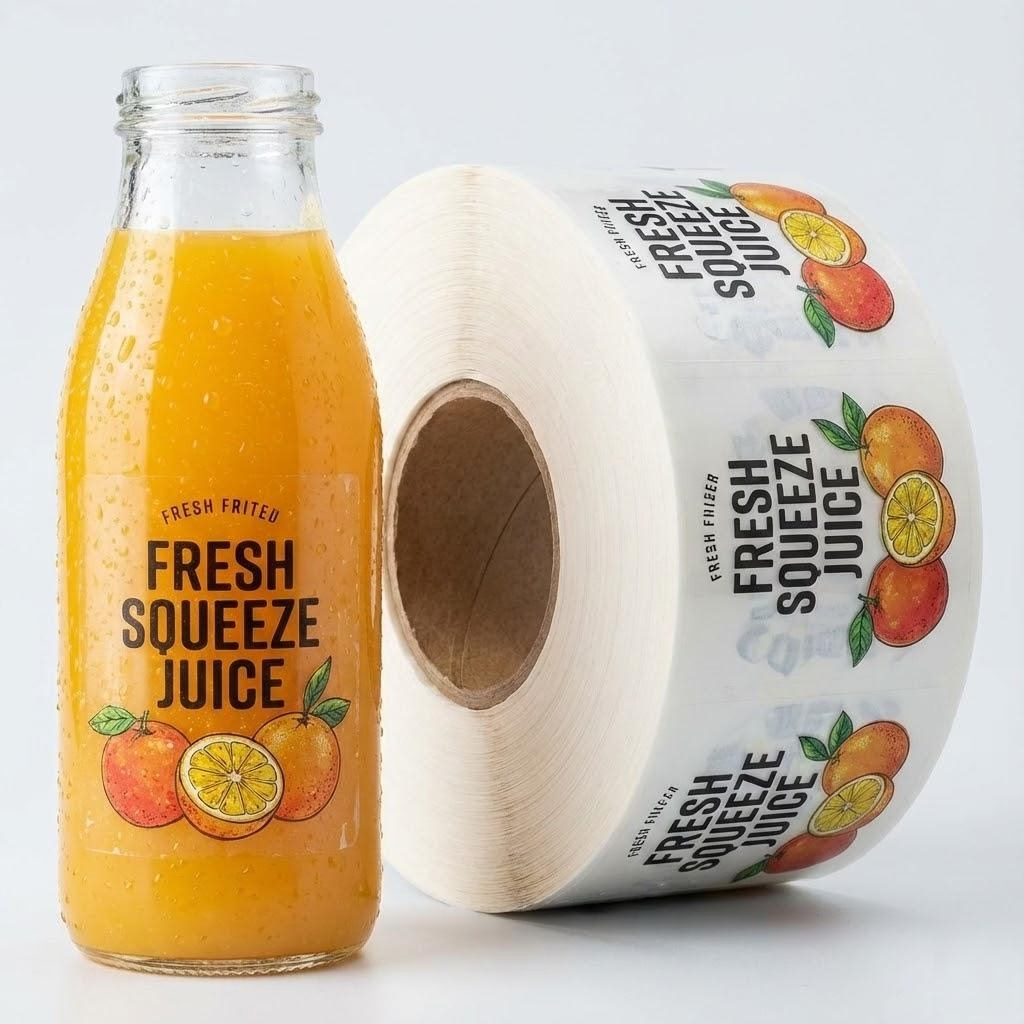
I recall a client in the cold-press juice industry. They labeled their glass bottles at 25°C and moved them immediately into a 4°C cold room. Even though they used “Cold Temperature Adhesive,” the labels failed within 24 hours.
The Hidden Culprit: Micro-condensation. To prevent these common application failures, brands should implement a rigorous fridge condensation test. As the bottle chilled, a nano-layer of moisture formed between the label and the glass before the adhesive could “wet out.”
This moisture acted as a lubricant, allowing the label’s internal stress to pull the edges away.
The Professional Fix: We implemented a 24-hour Acclimatization Protocol. By letting the bottles and labels reach a temperature equilibrium before application and allowing them to rest for 24 hours after application before entering the cold chain, we eliminated the condensation barrier and secured the bond.
The Plasticizer Migration Trap
For those using flexible PVC or “soft-touch” plastics, your biggest threat is a process called Plasticizer Migration. To make these plastics flexible, manufacturers add oils called plasticizers.
Over the course of 48 to 72 hours, these oils can migrate out of the bottle and into your label’s adhesive. Michael J. Moore, Technical Director at the Pressure Sensitive Tape Council (PSTC), warns:
“Adhesion is a dynamic process… In many soft plastic containers, oils migrate into the adhesive, softening it and causing what we call ‘ghosting’ or edge lift. This is a dynamic failure that no initial quality check can detect.”
If you are using squeeze bottles, you must specify a plasticizer-resistant acrylic adhesive. Standard rubber-based adhesives, while great for initial tack, will turn into a gooey, non-sticky mess when exposed to these migrating oils.
Calculating the Total Loss
When you are reviewing your labeling budget, it is tempting to look only at the “cost per thousand.” However, as a Production Director, you must look at the Total Loss of a 48-hour failure.
Use this formula to justify your quality spend: Total Loss = (L · n) + (M · n) + S
- L: Rework labor cost (manually peeling and reapplying labels is often 5x the cost of the initial application).
- M: Wasted packaging and label materials.
- S: “Soft Costs”—this includes retailer chargebacks and the long-term damage to your brand’s shelf presence.
In one case we audited, a “savings” of $0.005 per label resulted in a $12,000 rework bill for a single pallet. High-quality labeling isn’t an expense; it is a specialized insurance policy for your inventory.
The Production Manager’s Quality Audit Checklist
| Test Parameter | Standard Target | Purpose |
|---|---|---|
| Surface Energy | 38 – 42 Dynes/cm | Ensures the adhesive “wets out” correctly. |
| Mandrel Stress | Low-Stiffness Facestock | Critical for bottles with diameter < 50mm. |
| Dwell Time | 48 Hours Isolation | Prevents shock during bond formation. |
| Temp Delta | < 10°C | Prevents micro-condensation traps. |
| Adhesive Type | Acrylic Base | Protects against plasticizer migration. |
Moisture-Displacement Adhesives
As we move toward more sustainable and complex packaging, the industry is shifting toward Moisture-Displacement Adhesives. These are specifically engineered for the high-humidity and cold-chain environments common in the US market.
These adhesives contain specialized polymers that can “push” microscopic water droplets away from the substrate, allowing for a secure bond even on damp bottles.
Furthermore, we are seeing the rise of PET Barrier Facestocks. Unlike traditional paper labels that absorb moisture and expand—creating a mechanical force that rips the adhesive away—PET barriers stay dimensionally stable.
This is a “Unique Insight” that we frequently provide to our high-volume clients at Label Printing China to ensure their 2026 product lines are future-proof.
Mastering the Science of the Surface
Solving the mystery of why Labels Peel Off Bottles requires moving past surface-level observations. You must treat the 48 hours following production as a critical chemical phase.
By auditing your Dyne levels, respecting the physics of the Mandrel Effect, and guarding against Plasticizer Migration, you transform your labeling from a point of failure into a pillar of quality.
Your professional reputation and your company’s bottom line depend on these technical details. Don’t settle for a vendor who just sells “stickers.”
Partner with a Material Expert who can provide laboratory-grade peel strength tests, forensic reports, and the insight needed to keep your products looking perfect from the warehouse to the consumer’s hand. If you are facing a persistent “flagging” issue, start with a Dyne test today—it is the first step in moving from “guessing” to “knowing.”