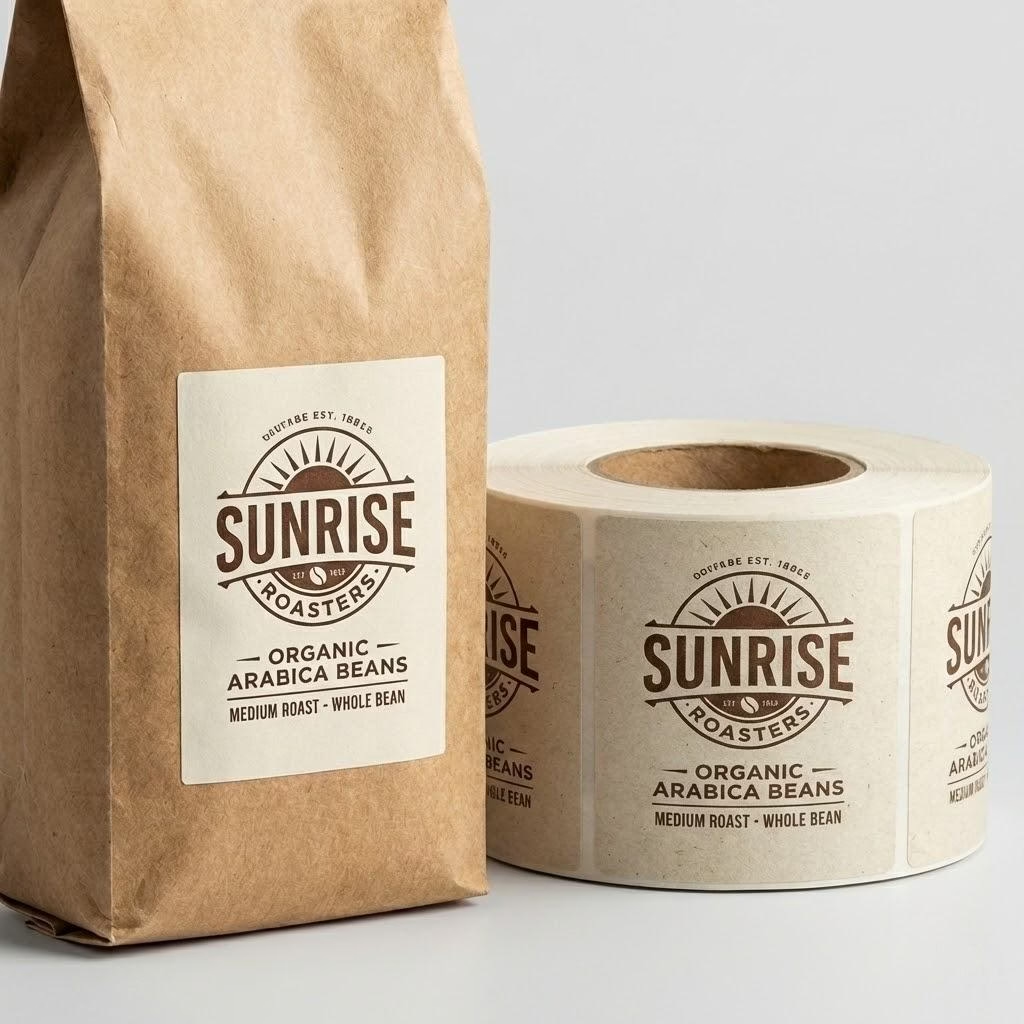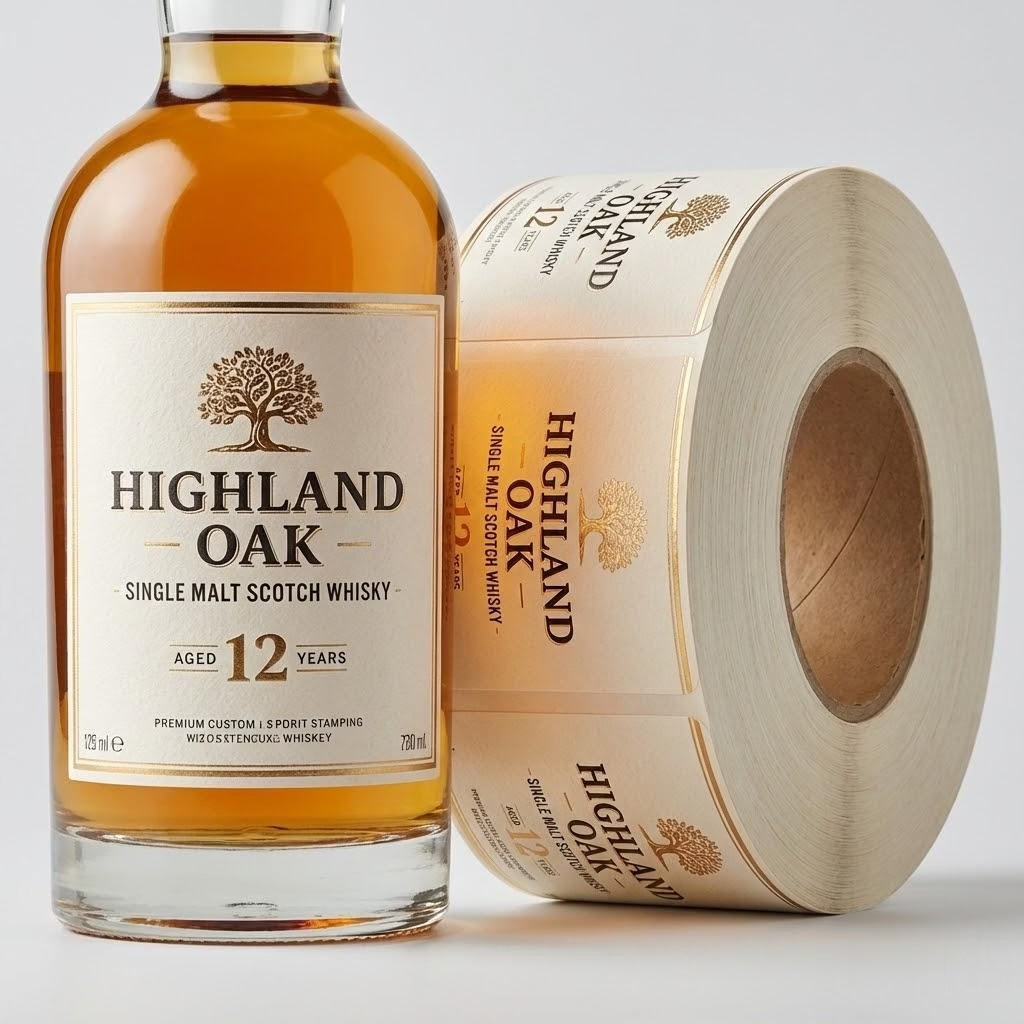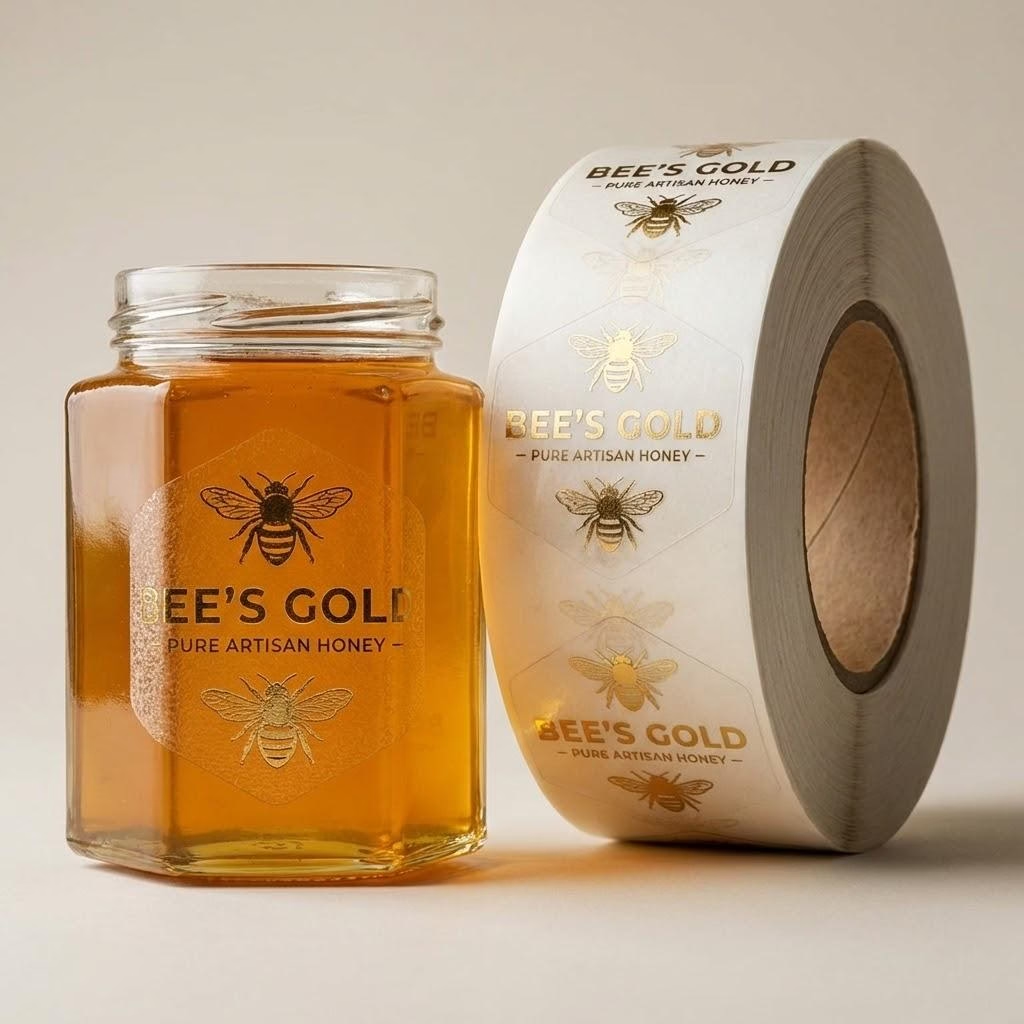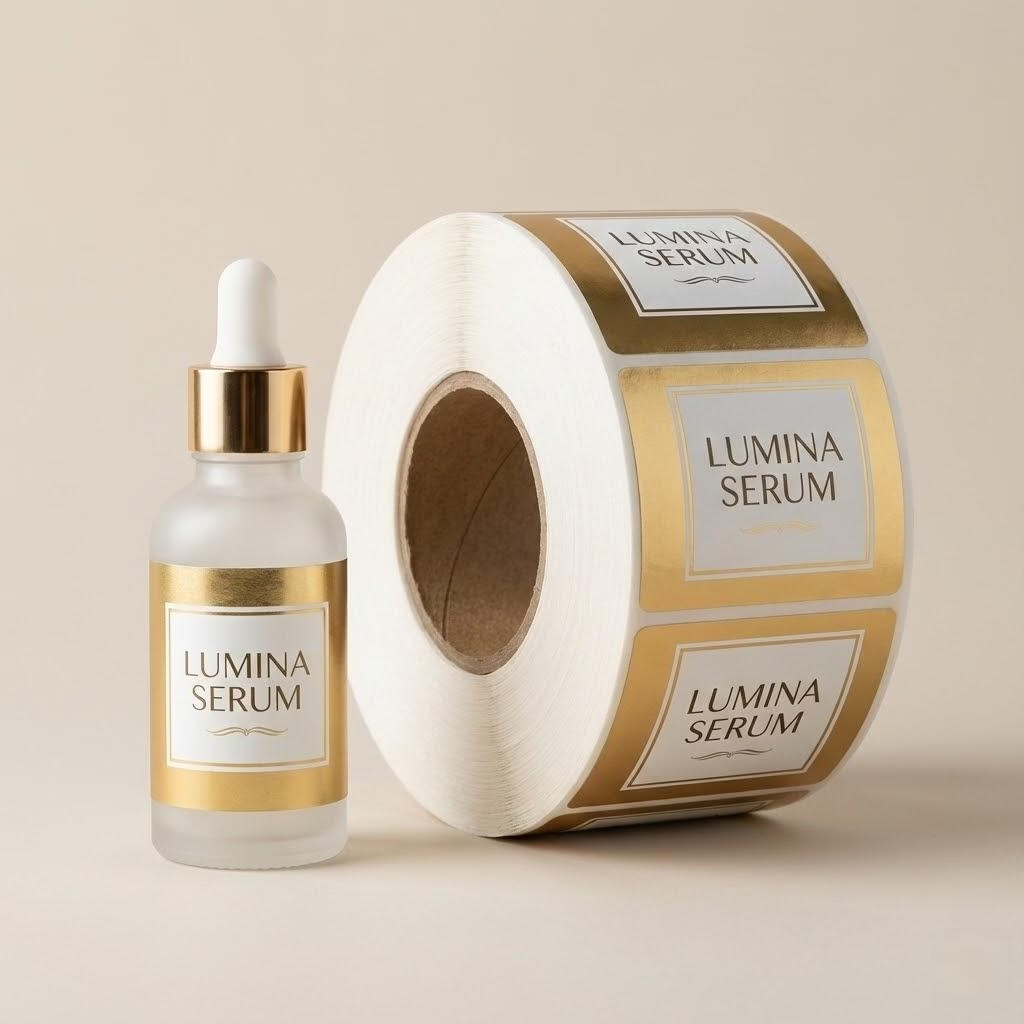
Importing custom labels doesn’t have to be a guessing game that puts your profit margins at risk. This guide provides the exact framework you need to calculate every hidden fee and secure a transparent, factory-direct supply chain.
To calculate the landed cost when importing labels, you must sum the product price, international freight, and insurance with US customs duties and processing fees like MPF and HMF. This total represents your final price per unit delivered to your door, accounting for all international trade costs.
But the raw numbers are only half the story. Read on to discover the specific HTS code traps that can double your tax bill and how to leverage a DDP model to lock in 30% factory-direct savings.
Label HTS Classification
In the world of international trade, your HTS code isn’t just a string of numbers; it is the “death line” of your budget.
One of the most common mistakes you can make when using a generic landed cost calculator is assuming that all labels are taxed equally. They aren’t. In fact, the difference between a paper label and a plastic one can be the difference between a successful product launch and a financial disaster.
To understand how this works, you need to look at the “stepped” cost model. Most labels fall into two main categories:
- Paper Labels (HTS 4821): These generally have a base duty rate of 0% to 2.5%.
- Plastic/Vinyl Labels (HTS 3919): These carry a much higher base rate of 5.8%.
When you stack the Section 301 tariffs (which can range from 7.5% to 25%) on top of these base rates, the total duty for plastic labels can easily soar past 30%.
Many procurement managers focus only on the 301 tariffs and forget that the 5.8% base rate exists, leading to a massive gap in their budget.
| Label Material | HTS Code | Base Duty Rate | Section 301 Tariff (China) |
|---|---|---|---|
| Paper-Based | 4821.10 / 4821.90 | 0% – 2.5% | 7.5% – 25% |
| Plastic/Vinyl | 3919.90.50 | 5.80% | Up to 25% |
Amy Magnus, Director of Customs Affairs at A.N. Deringer, warns that “a single mistake in an HTS code—like misclassifying a plastic label as a paper one—can lead to severe penalties that far outweigh any initial savings from a low-cost supplier.”
I recently worked with a client whose 25% profit margin completely vanished because of this very mistake. They ordered “synthetic” labels for their waterproof packaging and estimated their costs based on the lower paper tax rate.
When the shipment hit Long Beach, customs correctly identified the material as plastic. The sudden jump in duty rates didn’t just eat their profit—they actually lost money on every unit sold.
If you want to stay safe, you must define your HTS classification before you finalize your material choice. As an experienced China manufacturer, we always provide our clients with a formal HTS pre-classification suggestion so there are no surprises at the border.
Revealing Hidden Customs Fees
Have you ever looked at a freight quote and thought, “Okay, this is manageable,” only to be blindsided by a “black box” of extra charges on your final invoice?
When you are importing, the price you see on an Alibaba checkout page or a basic freight estimate is rarely the price you actually pay. Beyond the headline duties, there is a layer of government-mandated fees and administrative costs that can turn a “cheap” order into a budget-breaker.
Let’s talk about the two biggest “invisible” participants in your landed cost:
- MPF (Merchandise Processing Fee): This is a mandatory fee for almost all US imports. Currently, it sits at 0.3464% of your cargo value. While that sounds small, there is a catch: the minimum fee is roughly $32.71 and the maximum is $634.62.
- HMF (Harbor Maintenance Fee): If your labels are coming in by sea, you’ll pay an additional 0.125% of the cargo value to help maintain the ports. Detailed rates can be found on the official CBP fee schedule.
The real danger for you, especially if you are a growing brand, lies in the “minimums.” I recently saw a case where a customer ordered a small batch of labels worth $500. They expected a tiny tax bill.
However, because they had to pay the minimum MPF of $32.71 plus a $150 customs brokerage fee, their total “extra” costs jumped by nearly 40% of the product value. This is the “Post-De Minimis” reality—small orders now carry the same administrative weight as large ones.
So, how do you avoid these “bill surprises”? The answer is simple: DDP (Delivered Duty Paid).
When you work with a supplier like us under DDP terms, we handle the “black box” for you. We consolidate shipments, which allows us to spread those fixed brokerage and processing fees across thousands of orders.
Ready to Lock in Your Landed Cost?
Stop guessing about tariffs and brokerage fees. Our all-inclusive DDP service provides one transparent price from our factory to your door.
Understanding the Total Cost of Ownership (TCO)
If you have ever been tempted by a “bottom-dollar” quote that saves you $500 on customs duties, you need to look at the “shadow” following that price tag: Downtime Risk.
In a high-speed production environment, the true cost of your labels isn’t just what you pay to get them to your warehouse. It’s what happens when you try to put them on your product.
For a mid-to-large scale brand in the U.S., the average cost of a labeling line stopping is between $10,000 and $25,000 per hour. This is why understanding Total Cost of Ownership (TCO) is critical for procurement managers.
If your “cheap” labels arrive with the wrong unwind direction—we support all #1–#8 positions to prevent this—or if the adhesive seeps and gums up your sensors, that $500 you saved on shipping just became a $20,000 nightmare.
To calculate your real budget, you should use the Total Cost of Ownership (TCO) formula:
True Landed Cost = (FOB Price + Logistics + Duties) + (Downtime Risk x Hourly Production Value)
At Label Printing China, our competitive edge isn’t just low prices; it is our 100% Machine-Ready guarantee. We use engineered substrates and industrial-strength adhesives that are stress-tested against moisture, heat, and oil to ensure zero peeling and zero machine jams.
By focusing on technical accuracy—like precision die-cutting and Delta E < 2 color matching—we help you achieve that 30% average cost saving by keeping your machines running at full speed.
Four Steps to Accurate Cost Estimation

Now that you understand the risks, how do you actually build a reliable budget? Estimating your total expense doesn’t have to be a guessing game if you follow a structured industrial workflow.
- Confirm Material and HTS Classification: Don’t wait until the labels are printed to think about customs. Start by matching substrates to your specific application environment. Once you know if you are using paper or plastic, confirm the HTS code (4821 vs. 3919) to lock in your base duty rate.
- Calculate All-Inclusive Fees: Go beyond the 301 tariffs. You must include the 0.3464% MPF (keeping in mind the $32.71 minimum) and the 0.125% HMF for sea shipments. Because the $800 “De Minimis” exemption is effectively ending in 2026, you should assume every shipment will incur these fixed clearing charges.
- Evaluate DDP vs. FOB Risk Premiums: Compare a “cheap” FOB price against the certainty of DDP. While FOB might look better on paper, DDP eliminates the need for a 3% to 5% risk buffer and protects you from surprise brokerage invoices.
- Verify Equipment Compatibility: Before committing to mass production, perform a physical proofing stage to verify material stability. Check that the roll’s unwind direction and core size are 100% compatible with your applicator to avoid those $25,000-per-hour downtime losses.
By following these steps, you aren’t just buying stickers; you are securing an efficient supply chain. This professional approach is how leading brands achieve their 30% factory savings while maintaining total peace of mind.
Securing Your Efficiency and Growth
Ultimately, importing labels shouldn’t feel like a gamble. When you transition from a “sticker price” mindset to a Landed Cost Calculator When Importing Labels strategy, you are choosing professionalism over luck.
You are ensuring that the 30% cost savings you’ve planned actually reach your bank account rather than being siphoned off by misclassified HTS codes or unexpected port fees.
As we’ve seen, the true cost of a label includes its ability to perform under pressure. Whether you need oil-proof films for cosmetics or heat-resistant adhesives for industrial machinery, the goal is total technical accuracy.
By partnering with an ISO-certified manufacturer that understands both the physics of printing and the nuances of international trade, you protect your brand from the “hidden invoices” that haunt so many procurement managers.
Get Your Factory-Direct Quote Today
Are you ready to stop overpaying middlemen and start securing your profit margins? At Label Printing China, we make the process simple. We handle the engineering details, from free pre-press audits to 100% machine-ready roll verification, so you can focus on growing your brand with total peace of mind.
When you inquire today, you get more than just a price; you get:
- 30% Average Cost Savings through direct factory partnership.
- 12-Hour Expert Response to keep your project moving fast.
- 18 Years of Export Expertise serving over 50 countries.
- Secure DDP Delivery that eliminates surprise customs duties and fees.
Don’t let your next shipment be a source of anxiety. Reach out for a transparent, all-in quote based on our specialized Landed Cost Calculator When Importing Labels model. Let’s work together to ensure your labels arrive flat, flawless, and ready for immediate production.
Frequently Asked Questions About Label Importing
Even with a perfect calculator, you likely still have a few questions keeping you up at night. After all, when you are responsible for a production line that costs $25,000 an hour to run, “pretty sure” isn’t good enough.
What is the “real” lead time for a DDP order?
A common fear is that “China means slow.” In reality, our standard production takes only 5–7 business days after you approve the final artwork. When you factor in our 7–12 day DDP delivery, you are often looking at a total window that is competitive with many local US printers who are currently backlogged.
Can I actually trust the color consistency from an overseas factory?
We know your brand identity is non-negotiable. To ensure your labels look identical across every batch, we use digital Pantone matching and spectrophotometers to keep color deviation (Delta E) invisible to the human eye. We don’t just “eye-ball” it; we calibrate our presses to your specific brand standards.
What if the labels don’t stick or they peel off in the fridge?
This is where the “Landed Cost” of a cheap label becomes very expensive. We match specialized substrates to your product’s specific environment. Whether your labels need to survive -20°C freezing, high-heat candle environments, or chemical exposure from essential oils, we stress-test the adhesion in our in-house lab before we ship.
How do I know the rolls will fit my machine?
We don’t just print; we engineer. During our free pre-press audit, our experts manually review your file to fix resolution and bleed errors. We also verify your specific unwind direction (#1–#8) and core size (1″ or 3″) to guarantee 100% machine compatibility.
| Feature | Label Printing China Factory Standard | Why It Matters for Your Landed Cost |
|---|---|---|
| Minimum Order (MOQ) | Starts at 100 units | Low risk for new product testing and scaling. |
| Response Time | Within 12 hours | No 3-day wait times while your project is on hold. |
| Expert Audit | Manual file & technical review | Prevents the $20,000+ loss from machine downtime. |
| Proofing | Physical & digital options | Eliminates the “surprise” factor before mass production. |
If you are ready to stop guessing and start growing, remember that the most successful brands don’t just look for the lowest price—they look for the most transparent partner. By choosing a factory that takes the “mystery” out of customs and the “risk” out of production, you aren’t just saving 30%; you are investing in your brand’s future.