Managing different labels printers often leads to a “hidden tax” of high administrative costs and inconsistent branding. I have spent nine years helping companies streamline their manufacturing, and this guide reveals the exact framework to fix your fragmented supply chain for good.
Managing different labels printers involves coordinating multiple production workflows, which often leads to brand inconsistency and high overhead. To manage effectively, companies should consolidate vendors into a single-source partner that utilizes G7-certified color standards and integrated digital compliance data.
But that is just the tip of the iceberg. Keep reading to see the data-backed formula for reducing your costs and a few “hidden traps” I have discovered as a factory owner.
Moving from Pantone to Spectral Management

Have you ever looked at your product on a retail shelf and felt a pang of frustration? Even though you provided the exact same Pantone matching numbers, the labels from different batches just don’t match.
If you are currently managing different labels printers, you are likely discovering that “eyeballing it” is a recipe for a quality disaster. The physical reality is that printing is a complex science.
When you split your orders, you aren’t just dealing with different companies; you are dealing with vastly different ink trapping rates and dot gain parameters. For example, Factory A might use an older offset press while Factory B uses a high-speed digital inkjet.
The physical interaction between the ink layers and the substrate varies wildly between these technologies. This leads to “color drift,” which can alienate your loyal customers. In their eyes, inconsistent packaging is a red flag for counterfeit goods or a lack of quality control.
| Metric | Multi-Vendor (5+) | Single-Source Partner |
|---|---|---|
| Admin Costs (Annual) | ~$9,000+ | ~$1,800 |
| Color Variance (Delta E) | > 3.5 (Visible) | < 2.0 (Consistent) |
| 2026 Compliance | Data Silos / Risk | Unified API / Secured |
To take back control of your brand integrity, you need to move beyond simple color swatches and embrace Spectral Management. This technical approach focuses on three core pillars:
- Locking in Lab Values: Stop using vague color names. Instead, use precise spectral data to define your brand colors as a mathematical constant.
- Enforcing Delta E < 2.0: This is the gold standard of professional printing. Industry research by X-Rite shows that without a single-source partner, the variance between vendors often exceeds a Delta E of 3.5—which is easily noticed by the human eye. Consolidation allows you to stabilize this below 2.0.
- G7 Certification: Ensure your partner is G7 certified to maintain gray balance and tonal consistency across different printing technologies.
“In 2026, the label is no longer just decoration; it is a data carrier. Managing five different printers means attempting to harmonize five different streams of quality data. For the modern Brand Owner, a consolidated vendor who can provide verified spectral reports is a critical asset.” — Jules Lejeune, Managing Director of FINAT.
PPWR and DPP
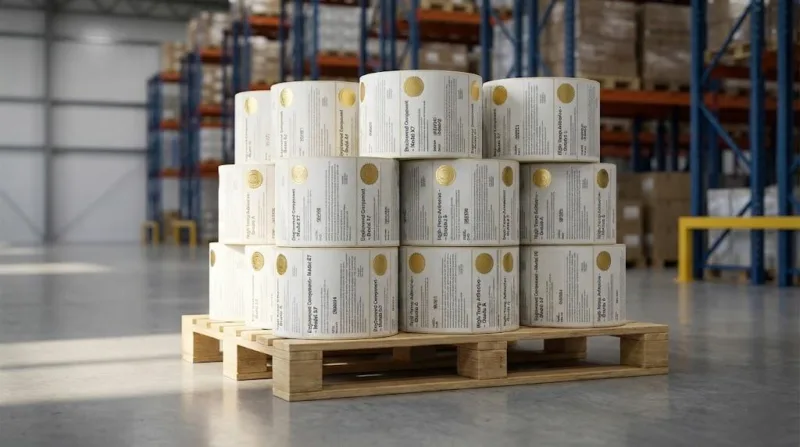
The global trade environment of 2026 has introduced a new “survival of the fittest” metric: compliance. Specifically, the Packaging and Packaging Waste Regulation (PPWR) and the Digital Product Passport (DPP) are now mandatory legal requirements. You are now required to track and report the carbon footprint and recyclability of every single label.
If you are managing different labels printers right now, you are likely staring down a “data disaster.” You have to collect, verify, and harmonize five different sets of environmental reports in five different formats.
Under current regulations, if even one of your suppliers fails to provide accurate data, your company could face fines as high as 4% of your total annual turnover.
By consolidating with a single-source partner, you can integrate a unified API directly into your ERP system, such as SAP or Oracle. This architectural shift provides three massive advantages:
- Real-Time Sustainability Data: You get automated reports for ESG compliance, removing the manual labor of chasing down spreadsheets.
- UID (Unique Identifier) Integrity: In a multi-vendor setup, the risk of duplicate or logically flawed serial numbers is roughly 0.5%. That might sound small until you realize that on a high-speed automated line, a 0.5% error rate can cause massive logistics delays or even customs seizures.
- Smart Label Synchronization: A single partner ensures that the “Quiet Zone” and physical parameters of your RFID or QR codes are 100% consistent, ensuring a perfect scan rate across your entire global supply chain.
Based on my nine years of experience as a factory owner, I’ve seen that the procurement managers who thrive in 2026 are those who stop “buying stuff” and start building a digital supply chain architecture.
Ready to Ensure 100% Brand Consistency?
Stop managing five different standards. Get your G7-certified, machine-ready labels from a single expert source and save 30% on your TCO.
Strategic Steps for a Seamless Transition
Transitioning from a fragmented supplier base to a single-source partner can feel like a high-stakes maneuver, but it is the only way to eliminate the risks we have discussed.
If you are currently managing different labels printers, you don’t have to switch everything overnight. Success lies in a structured, three-step migration that prioritizes stability.
- Audit and Selection: Start by evaluating your current vendors based on their digital maturity rather than just their price list. Ask to see their Label Management System (LMS) and their VDA (Verified Printing Automation) protocols. In the 2026 landscape, a partner who cannot provide a digital defect map for every roll of labels is a liability.
- Standardize Your “Digital Master”: Before moving any high-volume SKU, you must establish a Color and Process Whitepaper. This document should define your Delta E thresholds and technical specifications. Instead of sending physical samples—which fade and vary—distribute a digital file containing your spectral data. This ensures that whether a label is printed in January or July, the output remains identical.
- Phased Migration: Begin by consolidating your most complex, multi-SKU product lines. These are the areas where you likely face the highest administrative burden and the most frequent quality errors. Once these are stabilized under a single expert partner, the operational relief will provide the momentum needed for the rest of your inventory.
Learning from the “Data Silo” Trap

During my nine years as a factory owner, I have seen even the most seasoned procurement managers fall into the “Data Silo” trap. One industrial client split their QR-coded traceability labels between two small vendors to save on unit costs. On paper, it looked like a win.
However, once the products reached the logistics center, the automated scanners began failing at a rate of 30%. Why? While both labels looked “clear,” the vendors used different QR code Error Correction Levels and inconsistent Quiet Zones.
One vendor’s “standard” was another vendor’s “failure.” This single oversight paralyzed their logistics for a week, costing far more than the pennies saved on printing.
The lesson here is simple: Readability is more valuable than clarity. A consolidated partner acts as your data gatekeeper, ensuring every barcode and RFID tag is verified against a central database before it even leaves the factory floor.
The transition from a price-focused buyer to a supply chain architect is a significant professional milestone. By moving away from the chaos of managing different labels printers, you are choosing a path of precision and control. You are no longer just buying paper and ink; you are securing the integrity of your brand and the efficiency of your global operations.
As we look toward the requirements of 2026, the brands that thrive will be those that prioritize vendor consolidation and technical depth. When you consolidate your labels with a partner who understands the physics of color and the rigors of digital compliance, you gain more than just a lower TCO.
You gain the “Administrative Zen” of knowing that every SKU, in every region, is exactly as it should be.
Choosing a single-source expert ensures your brand remains consistent, compliant, and ready for whatever the 2026 market brings.
Transitioning from Buyer to Supply Chain Architect
At this point, you might realize that your role is evolving. You are no longer just a procurement manager; you are becoming a supply chain architect. By choosing to step away from the chaos of managing different labels printers, you are building a resilient foundation for your company’s future.
The financial upside is clear. Beyond the peace of mind, strategic vendor consolidation typically yields a 12% to 18% reduction in total costs. While only a small fraction of that comes from unit price negotiations, the bulk of your savings is reclaimed from eliminated administrative waste, reduced inventory obsolescence, and the prevention of costly quality recalls.
As you look toward the regulatory hurdles of 2026, remember that a high-quality partner doesn’t just print labels—they manage your data sovereignty. They ensure that your brand remains consistent across global markets and that your compliance reports are ready at the click of a button.
Ultimately, the goal is to achieve “Administrative Zen.” This is the state where you no longer worry about color variances or data silos because your standards are hard-coded into a single, trusted production flow. By simplifying your vendor list, you are not losing options—you are gaining the velocity and precision needed to lead your industry.
If you find yourself currently managing different labels printers and feeling the strain of fragmented quality, now is the time to audit your TCO and reclaim your brand’s integrity.
Becoming a Strategic Supply Chain Architect
Moving away from the daily friction of managing different labels printers is the definitive step toward professionalizing your procurement strategy. By viewing your supply chain as an integrated digital asset rather than a series of disconnected transactions, you transition from a reactive “buyer” to a proactive “supply chain architect.” This shift isn’t just about better-looking packaging; it’s about bottom-line results.
The financial incentive is undeniable. As we’ve explored, the total cost of ownership (TCO) is a composite of the unit price, administrative overhead, inventory waste, and the price of quality failures. When you consolidate, you typically see a 12% to 18% reduction in total costs.
These savings are reclaimed by eliminating the $9,000 annual “paperwork tax” and slashing the 15% wastage rate typical of fragmented inventories.
In the high-stakes environment of 2026, where PPWR compliance and Digital Product Passports are non-negotiable, having a single-source partner is your strongest defense against regulatory fines and market exclusion. You gain the “Administrative Zen” of knowing that your brand consistency is protected by spectral data and that your data streams are synchronized.
Ultimately, the choice is yours. You can continue the exhausting cycle of managing different labels printers, chasing pennies on unit costs while losing dollars in efficiency. Or, you can choose a strategic partnership that offers the transparency, consistency, and digital readiness required for the future.
By simplifying your vendor list, you are not losing options—you are gaining the velocity and precision needed to lead your industry into the next era of manufacturing.