If your cosmetic or food tubes are suffering from “winging” edges or permanent creases, you are likely using the wrong material for a flexible container. Most brands default to standard films that lack the mechanical “memory” needed to survive a consumer’s squeeze, leading to high rejection rates and brand erosion.
Standard BOPP labels fail on squeeze tubes because their high elastic modulus (2,500–3,500 MPa) makes them too rigid to conform to flexible LDPE or PCR surfaces. Unlike MDO (Machine Direction Oriented) films, which possess “molecular memory” to snap back after compression, rigid BOPP creates permanent stress whitening and “flagging” at the edges when the container is squeezed.
The gap between a premium shelf presence and a “clearance bin” look often comes down to a single engineering choice: material modulus. Keep reading to discover the 2026 cost-audit data and the “2mm Crimp Rule” that separates industry leaders from those wasting 5% of their production budget on failed labels.
1. The “BOPP Trap”: Why Rigid Labels Are a Liability
Most brands fall into the same trap: they choose Standard BOPP Labels because they are cost-effective, crystal clear, and waterproof. On a rigid glass bottle or a stiff HDPE detergent jug, BOPP is a hero. But the moment you apply that same rigid film to a squeeze tube, you are setting a timer on a visual disaster.
The Physics of Failure: Modulus Mismatch
The core issue isn’t aesthetic; it’s mechanical. Under the ASTM D882 testing standard, standard BOPP carries a high “Modulus of Elasticity”—usually between 2,500 and 3,500 MPa.
Definition: Modulus measures a material’s resistance to being deformed. The higher the number, the stiffer the material.
When you apply a 3,000 MPa film to an LDPE tube (which is designed to be soft and yielding), the label refuses to “move” with the container. This results in Modulus Mismatch.
- The “Winging” Effect: The label’s internal stiffness fights the curve of the tube, causing the edges to pop up.
- Stress Whitening: Permanent white “scars” or creases form in the film where it has been pinched.
- Adhesive Fatigue: The constant “fight” between the stiff film and the soft tube eventually exhausts the adhesive, leading to total delamination.
2. Technical Comparison: MDO vs. Standard BOPP vs. PE
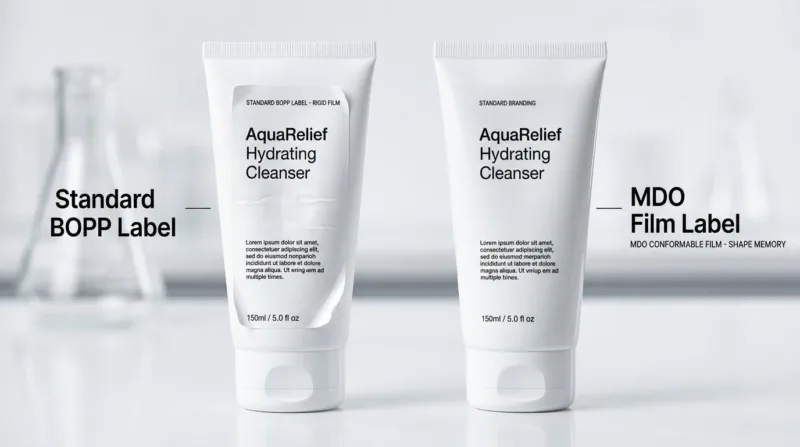
To make an informed decision for your 2026 product line, you need to see the numbers side-by-side. Choosing the right film ensures your brand survives the rigors of the supply chain and the pressure of a consumer’s thumb.
Table 1: Material Performance Comparison
| Technical Metric | Standard BOPP | MDO (PE/PP Blend) | Traditional PE Film |
|---|---|---|---|
| Elastic Modulus | 2,500 – 3,500 MPa (Rigid) | 800 – 1,200 MPa (Flexible) | 400 – 600 MPa (Very Soft) |
| MD Elongation | ~150% | 400% – 600% | >600% |
| Shape Recovery | Low (Permanent Creasing) | High (Self-Healing) | Low (Stretches Out) |
| Visual Clarity | Excellent | Excellent | Hazy / Translucent |
| Caliper (Thickness) | 60 micron (2.4 mil) | 50 micron (2.0 mil) | 85 micron (3.4 mil) |
| Recyclability | Mixed (Contaminant) | High (Mono-material) | High (Mono-material) |
3. The Science of Shape Recovery: “Molecular Memory”
What makes MDO the “Gold Standard” for 2026? It’s all in the manufacturing. Unlike BOPP, which is stretched in two directions (Bi-axially), MDO film is oriented in a single direction—the Machine Direction.
How “Molecular Springs” Work
During production, the polymer chains are aligned like a series of microscopic springs. This orientation is crucial for Squeezability and Conformability in modern packaging.
- Compression: When a consumer squeezes the tube, the MDO label stretches along its aligned chains.
- Memory: Once the pressure is released, the “Molecular Memory” kicks in, pulling the film back to its original flat state.
- The Result: No creases, no air bubbles, and a label that looks brand new after 100 uses.
“The beauty of MDO technology lies in its ‘hybrid’ performance. It provides the high stiffness required for high-speed automated dispensing, yet possesses the conformability of a PE film. For squeeze tubes, this balance is non-negotiable; you need a label that stands up on the line but yields under the thumb.”— Renae Kulis, Global Segment Director for Personal Care, Avery Dennison.
4. Engineering Audit: The “2mm Death Zone”

In our extensive experience with global supply chains, we have seen more projects fail at the Crimp Line than anywhere else. The crimp is where the tube is heat-sealed after filling.
The Industry Secret: Thermal Stability
Standard BOPP has poor thermal stability. When the sealing jaws hit the tube, the heat radiates. A BOPP label sitting too close to that heat will shrink unevenly, causing the corners to “flag” or curl like an elephant’s ear. MDO film acts as an insurance policy for your brand’s reputation by maintaining thermal integrity.
- The 3mm Rule for BOPP: If you use BOPP, you must leave at least a 3mm safety gap from the crimp. This wastes valuable branding real estate.
- The 1.5mm Edge for MDO: Because MDO is pre-heat-stabilized, it allows for a much tighter 1.5mm margin. This creates a “Full-Wrap” luxury look that consumers associate with high-end medical-grade skincare.
Ready to Stop the Label Flagging Nightmare?
Don’t let rigid materials ruin your premium squeeze tubes. Switch to high-performance MDO labels that are 100% machine-ready and engineered for perfect conformability.
5. The Business Case: ROI Beyond the Unit Price
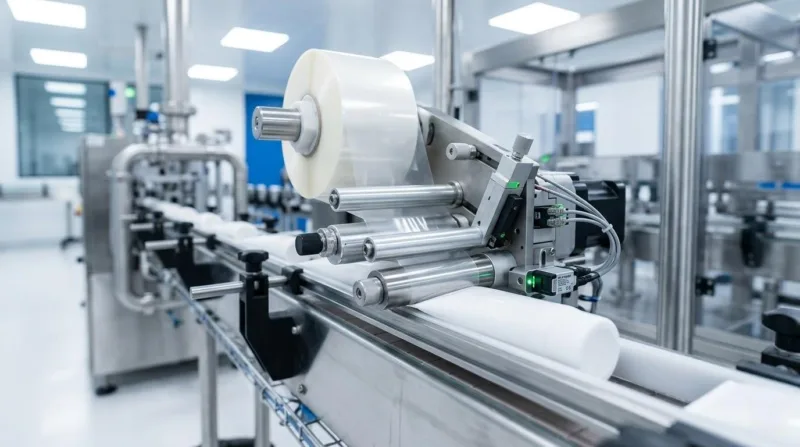
If you only look at the “Price Per Thousand” (CPT), you are missing 90% of the cost. Procurement managers often get trapped by a slightly lower unit price on Standard BOPP Labels, only to lose ten times that amount in production waste. Master Label Printing Cost Analysis to uncover these hidden expenses.
Calculating the True Cost (TCO)
- Rejection Rates: On high-speed lines (>120 bpm), BOPP’s rigid nature leads to a 3%–5% rejection rate due to air bubbles and flagging. MDO typically performs at <0.5% waste.
- OEE (Overall Equipment Effectiveness): Because MDO is thinner (Down-gauging), a single roll can hold 20% more labels. Improving Overall Equipment Effectiveness (OEE) is key to production security.
- Result: Fewer roll changes.
- Result: Less machine downtime.
- Result: Higher yield per shift.
6. Real-World Case Study: The 80,000-Unit Disaster
The Client: A US-based premium organic sunblock brand.
The Mistake: They chose a 2.4 mil Gloss BOPP for their LDPE (Low-Density Polyethylene) tubes to save $0.004 per label.
The Fallout: The tubes were filled and shipped to a warehouse in Arizona. The heat and the “softness” of the LDPE tubes caused the rigid BOPP labels to fight the container. By the time the product reached retailers, 18% of the inventory had visible “winging” at the edges.
- The Cost: The brand had to pay for manual “re-labeling” labor and eventually scrapped 5,000 units where the adhesive had failed completely.
- The Solution: We transitioned them to a 2.0 mil MDO-PE blend. The thinner, more flexible material moved with the tube during shipping and consumer use. The rejection rate dropped to zero.
The Lesson: In B2B packaging, “cheap” materials are the most expensive mistake you can make.
7. 2026 Sustainability: The Mono-Material Mandate
By 2026, the “Plastic Tax” and Extended Producer Responsibility (EPR) laws are no longer optional. Brands are being audited on their Recyclability Index. Follow the APR Design Guide for Recyclability to stay compliant.
The Problem with Mixed Materials
If you put a PP (Polypropylene) label (BOPP) on a PE (Polyethylene) tube, you have created a “Mixed-Material” package. During the recycling sort, these are often flagged as contaminants and sent to landfills. MDO-PE labels enable a 100% recyclable mono-material stream, critical for 2026 global standards.
The MDO Solution
- PE-to-PE Compatibility: Using an MDO-PE label on a PE tube creates a “Mono-material” stream.
- 100% Recyclable: This combination is recognized by 2026 global standards as fully circular.
- PCR Friendly: MDO film’s flexibility is essential when working with PCR (Post-Consumer Recycled) tubes, which often have slight surface irregularities that rigid BOPP cannot mask.
8. Master’s Guide: The “Mandrel Test”
Don’t take a supplier’s word for it. Before you sign a contract for 10,000+ labels, follow our “Machine-Ready” Protocol and perform this simple 24-hour audit in your facility.
How to Conduct a Mandrel Test
- The Substrate: Find a cylinder or tube that is 10% smaller in diameter than your actual product.
- The Application: Apply the sample MDO and BOPP labels with standard hand pressure.
- The Stress Test: Place the samples in a 40°C (104°F) environment for 24 hours.
- The Verdict: Look for “Edge Creep.” If the label has moved more than 0.5mm from its original position, it will fail on the retail shelf.
Rigid BOPP almost always fails this test on small-diameter tubes; MDO holds firm.
Conclusion: Engineering Your Brand’s Success
In 2026, the “Standard BOPP Label” is no longer enough for the flexible packaging market. To survive the rigors of the supply chain, the pressure of a consumer’s thumb, and the scrutiny of recycling audits, your material must be as flexible as your brand.
MDO film slashes production waste and ensures your product looks premium from the first squeeze to the last.
MDO film isn’t just a material upgrade; it’s an insurance policy for your brand’s reputation. It eliminates the “BOPP Trap,” slashes production waste, and ensures your product looks as premium on the 100th squeeze as it did on the first.
Next Steps for Your Project
Are you currently experiencing “winging” or “flagging” on your production line? Don’t wait for a retail rejection to take action.
- Would you like me to send you a technical PDF of our “MDO vs. BOPP Squeeze-Test” data?
- Or should we schedule a 15-minute “Material Audit” to look at your current tube-to-label compatibility? Let’s build a package that lasts.