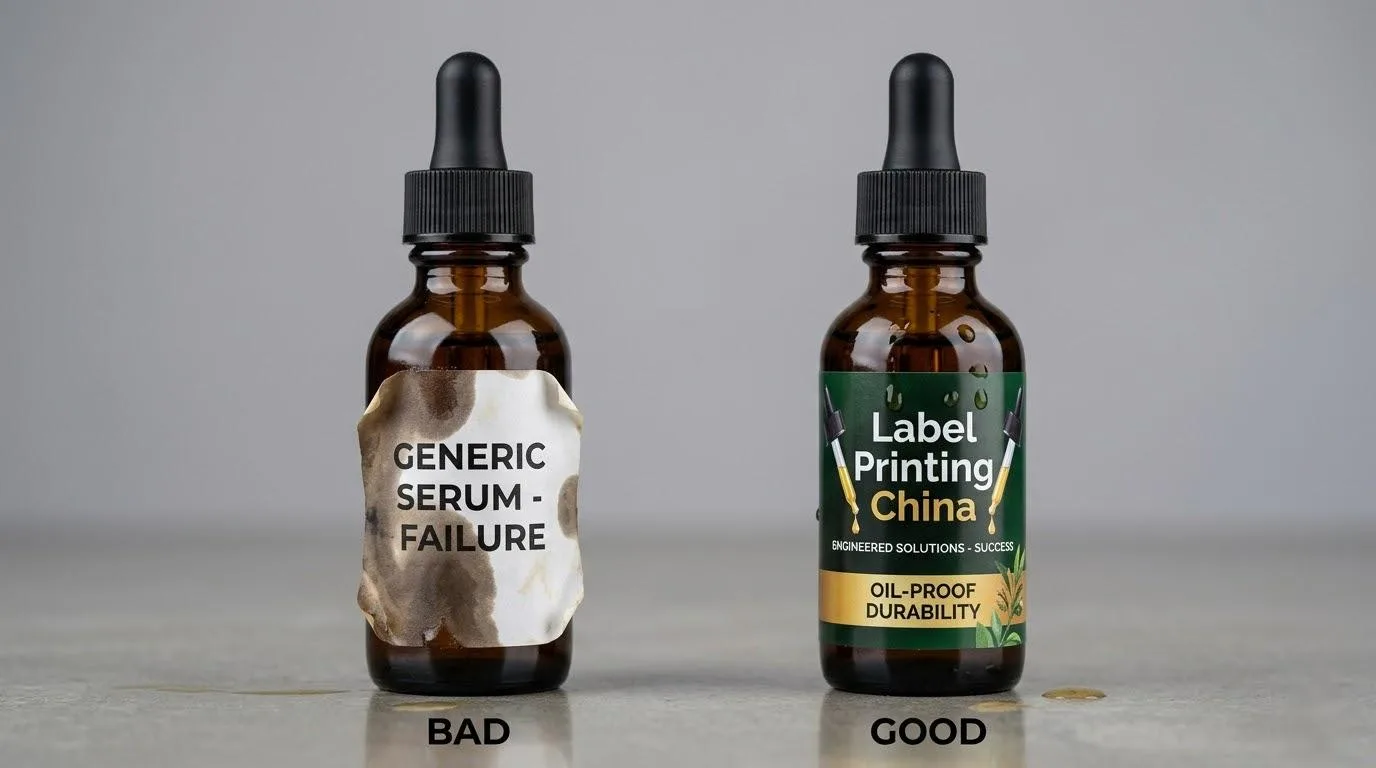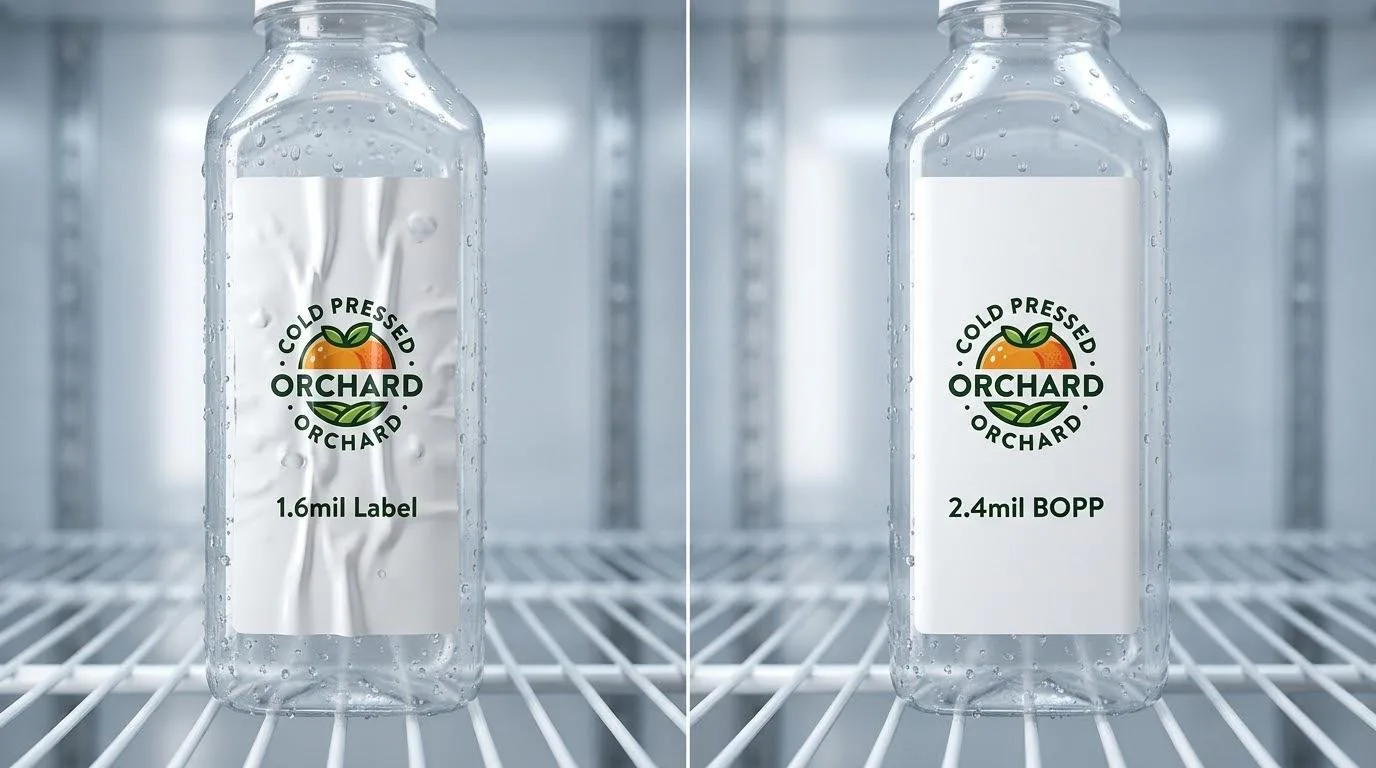
Picking the wrong label finish is a one-way ticket to a “greasy” brand image and a rejected shipment. This guide gives you the exact framework to select a custom protective coating that keeps your sauce packaging pristine on the shelf and compliant with 2026 regulations.
The primary distinction between oil-proof and oil-resistant coatings is their molecular barrier density. Oil-resistant finishes repel brief surface contact, whereas oil-proof custom protective coatings employ a specialized top-coat to block long-term lipid migration and ink blackening in sauce packaging.
But here is the problem: choosing the “strongest” protection often leads to massive failures on high-speed labeling lines. Read on to discover the “Lamination Trap” and how to optimize your production for maximum efficiency.
1. Why Your Labels Look Dirty
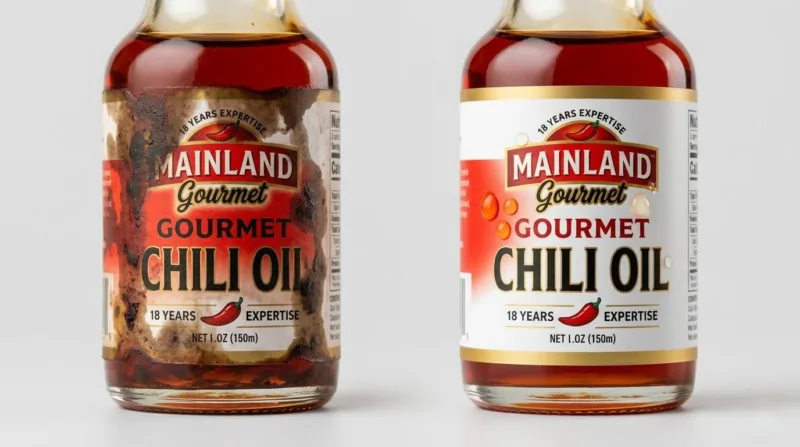
If your labels are turning dark or “wet” over time, it’s rarely an ink quality issue. You are likely a victim of the Optical Refraction Trap.
Condiment oils (like chili, olive, or sesame oil) have a refractive index of approximately 1.47, while air is 1.0. Standard overprint varnishes have microscopic pores. When oil migrates through these pores, it replaces the air between the ink and the substrate.
This physical shift changes how light reflects, making the colors look muddy, saturated, and ultimately black.
“In the condiment industry, the most common failure point isn’t the ink, but the lack of a molecular-level barrier. Oils don’t just sit on the label; they migrate through the micro-pores of standard finishes. Once lipids reach the ink layer, they alter optical refraction. A specialized Top-coat is a structural necessity to seal those pores and preserve brand integrity.”
— Dr. Dieter J. Finna, Packaging Technology Consultant at Label-Consulting
By using a Specialized Top-coat, you aren’t just adding a layer of shine; you are performing “molecular grouting.” This process reduces the Oil Transmission Rate (OTR) to near 0 g/m²/24h, ensuring your color difference (Delta E) stays below 2.0 throughout the product’s shelf life.
2. Top-coat vs. Lamination vs. Varnish
Choosing the “strongest” protection isn’t always the smartest move for B2B operations. You must balance protection with Machine Compatibility. Selecting the wrong material can lead to hidden label printing cost analysis issues that impact your overall margins.
Strategic Comparison: Varnish vs. Lamination vs. Top-coat
| Feature | Standard Varnish | High-Gloss Lamination | Specialized Top-coat |
|---|---|---|---|
| Oil Barrier | Low (Porous) | Highest (Physical) | High (Molecular Seal) |
| Machine Speed | Excellent | Poor (Static/Ooze Risk) | Excellent (Tunable COF) |
| 2026 Compliance | Often contains PFAS | Varies | Guaranteed PFAS-Free |
| Ink Blackening | High Risk | Zero Risk | Zero Risk |
| Total Cost (TCO) | High (Rejections) | Medium (Downtime) | Lowest (Optimal Balance) |
3. Why Your Production Line is Stopping
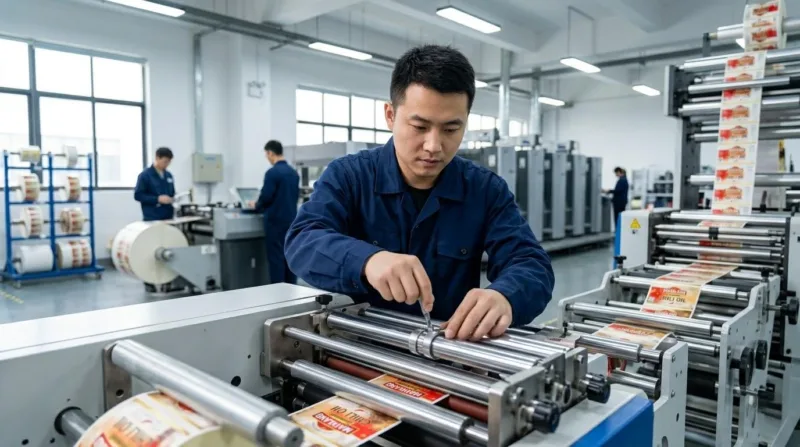
Many procurement managers pivot to lamination thinking it’s the ultimate shield. However, on a high-speed production line running at 300+ bottles per minute, lamination is often a “ticking time bomb.”
The Danger of Adhesive Ooze
Lamination adds rigidity. When those labels pass through the peel plate of a high-speed labeling machine, the mechanical friction generates heat. This heat softens the adhesive. Because the lamination film is non-breathable and stiff, the adhesive has nowhere to go but out the sides.
- Result: Sticky residue builds up on the machine rollers.
- Consequence: The line must stop every 30-60 minutes for cleaning.
- Financial Impact: Every hour of downtime on a professional condiment line can cost $5,000 or more in lost labor and throughput.
Ready to Secure Your Food Brand’s Shelf Presence?
Don’t let oil migration or smudged ink compromise your product’s professional look. Whether you apply by hand or use high-speed machinery, get durable, FDA-compliant food labels with factory-direct savings.
The Solution: Tunable Coefficient of Friction (COF)
The beauty of a Custom Top-coat is that we can “tune” it. We don’t just make it oil-proof; we adjust the COF to between 0.22 and 0.28. This is the “Goldilocks zone” for automated labeling. It’s slick enough to move through the machine without static but textured enough for the sensors to track accurately.
4. The 2026 Compliance Cliff: The End of “Old” Greaseproof Materials
The US regulatory landscape is shifting. States like California (AB 1200) and New York are implementing strict bans on PFAS (Per- and polyfluoroalkyl substances) in food packaging—including labels—by 2026.
“By 2026, compliance will no longer be a voluntary marketing claim. It will be a mandatory legal requirement. Manufacturers using ‘old-school’ greaseproof papers that rely on PFAS are risking their entire supply chain’s eligibility for the US market.”
— Dr. Maricel Maffini, Researcher in Food Contact Chemicals
If your current “Oil-Resistant” label relies on chemical treatments within the paper pulp, you are likely using PFAS. Transitioning to a Top-coated BOPP (Polypropylene) is the safest “future-proof” move. It relies on a physical polymer barrier rather than controversial chemicals.
5. Thinking Beyond the “Price per 1,000”
We often talk about the Total Cost of Ownership (TCO). But let’s put the complicated formulas aside and look at it through the eyes of a business owner.
Why “Cheap” Labels are the Most Expensive
When you buy a label that is 10% cheaper but lacks a specialized Top-coat, you aren’t saving money—you are taking a high-interest loan from your future profits. Here is how the “cheap” label actually costs you more:
- The “Hidden” Rejection Cost: If 1% of your bottles are rejected by a major retailer like Walmart because the labels look “greasy” or “spoiled,” that cost is 10x higher than what you saved on the printing. You lose the label, the bottle, the sauce, and the shipping—not to mention your reputation with the buyer.
- The Labor Leak: If your labeling machine jams twice a day because of adhesive ooze (from poor lamination) or static (from cheap varnish), you are paying technicians to clean rollers instead of shipping products.
- The “Relabeling” Nightmare: I have seen clients forced to manually peel and relabel 50,000 bottles because the ink started smearing in a humid warehouse. The labor cost for that one mistake wiped out three years of “savings” from their cheap supplier.
Professional procurement isn’t about finding the lowest price; it’s about finding the lowest risk.
A high-performance Custom Protective Coating provides a “Machine-Ready” guarantee. By spending a fraction of a cent more per label, you protect the $5.00+ retail value of the entire bottle. That is the only business logic that matters.
6. The Florida Warehouse Disaster
As the owner of Label Printing China, I remember a client who produced a premium extra virgin olive oil. They insisted on a standard UV varnish because “it looked fine during the sample stage.”
The samples were tested in an air-conditioned office at 22°C. But the actual product was shipped to a distribution center in Florida during July.
Inside a shipping container, temperatures can hit 45°C – 50°C. At these temperatures, oil molecules become highly active. They bypassed the standard varnish within 72 hours. By the time the pallet reached the retailer, the white labels had turned a “transparent, dirty gray.”
We stepped in and replaced the order with a Top-coated BOPP specifically engineered for high-lipid environments. We also implemented a 60°C / 72-hour Stress Test in our lab to simulate those “Florida conditions” before the labels ever left our factory. The client saved their contract with the retailer, but the initial “cheap” mistake cost them $15,000 in wasted stock.
7. The Procurement Checklist: Hard Questions for Your Supplier

Before you sign your next purchase order for Sauce and Condiment Packaging, ask your supplier these four questions. If they can’t answer them with data, they aren’t a partner; they are just a vendor.
- Question 1: Dyne Levels. “What is the surface energy of the substrate before coating?” (It should be 38-42 dynes/cm for proper ink anchoring.)
- Question 2: COF Specs. “Can you provide the static and dynamic Coefficient of Friction for this coating?” (Crucial for machine compatibility.)
- Question 3: PFAS Certification. “Do you have a third-party lab report confirming this coating is PFAS-Free for 2026 compliance?”
- Question 4: The Lipid Test. “What is the Delta E (color change) of this label after 72 hours of exposure to my specific oil at 60°C?”
Conclusion: Is Your Label an Asset or a Liability?
In the competitive world of B2B food exports, your packaging is your silent salesman. Don’t let oil migration or machine downtime eat into your margins.
By choosing a factory-direct partner like Label Printing China, you gain access to ISO-certified processes that focus on TCO—Total Cost of Ownership. We don’t just print labels; we engineer barrier solutions that ensure your product looks as premium on the shelf as it did in your vision.
Ready to stop the “Ink Blackening” on your shelves?
Contact our engineering team today for a Free 60°C Oil-Penetration Stress Test of your current labels. We’ll show you exactly how a specialized Top-coat can protect your brand and your bottom line.