Tired of your “Brand Red” looking different every time you hit the reorder button? You aren’t alone, but at Label Printing China, we have engineered a data-driven protocol to ensure your labels stay consistent from your first batch to your thousandth.
The Master File Strategy eliminates Pantone batch variance by replacing physical swatches with digital CxF spectral data. This protocol involves measuring substrate whiteness for every run and applying dynamic ink compensation to maintain a Delta E consistency of less than 2.0 across all lots.
But there is a hidden reason why even the “same” digital file often fails in the pressroom. Let’s dive into the technical “vault” that keeps your brand integrity safe and your colors locked in forever.
1. The Myth of the “Same File”

Why Your Labels Drift Even When the Artwork Doesn’t
Many procurement managers believe that as long as they send the same high-resolution vector file, the output should be identical. In a perfect world, that would be true.
In the physical world of industrial printing, it’s a dangerous assumption. The primary culprit behind Pantone Batch Variance isn’t usually the file—it’s the Substrate Fingerprint.
Understanding the total impact of these shifts is critical for long-term procurement, especially when performing a Label Printing Cost Analysis, where hidden quality failures can double your actual expenditure.
The Hidden Variable: Paper Whiteness
Even top-tier material suppliers like Avery Dennison have a physical tolerance for paper production. A single grade of semi-gloss paper can have a CIE Whiteness fluctuation of ±3% between batches.
- The Physics: If the base paper is 3% “yellower” this month, that yellow tint acts as a filter under your ink. Your “Cool Blue” suddenly leans “Teal.”
- The Humidity Factor: A 10% shift in factory humidity changes how the substrate absorbs ink, potentially shifting your Delta E (ΔE) by 0.5 to 0.8 without a single change to the artwork.
FACTORY INSIGHT: The “Fading Reference” Trap
Most factories rely on a “Golden Sample” taped to a wall. But physical samples are organic. They oxidize. They fade under UV light. If your printer is matching today’s run to a sample printed two years ago, they are matching a “ghost.”
This is why digital spectral data is the only reliable truth. This level of precision is exactly what we check during our 3-Step Machine-Ready Protocol to avoid costly recalls.
2. Comparing the Standards: Traditional vs. Master File Strategy
To help you understand the ROI of switching to a data-driven supplier, we’ve broken down the differences in technical execution.
| Feature | Traditional Printing Factory | Label Printing China (Master File Strategy) |
|---|---|---|
| Color Target | Visual match to physical swatch. | CxF/X-4 Spectral Data. |
| Success Metric | “Looks close enough” (Subjective). | Delta E (ΔE) < 2.0 (Objective). |
| Substrate Calibration | None. Same ink formula used. | Dynamic Negative Compensation. |
Ready to Lock in Your Brand Colors?
Stop worrying about color drift. Get “Machine-Ready” custom roll labels with a guaranteed Delta E < 2.0 and save 30% with factory-direct precision.
3. The Master File Strategy: A Three-Tiered Defense
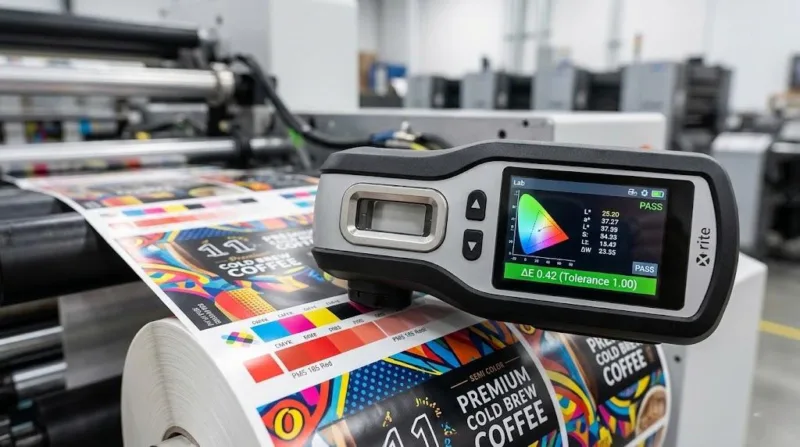
The Master File Strategy isn’t just a file-saving method; it’s a rigorous quality control protocol designed to eliminate human error and safeguard your professional reputation—a critical step if you want to avoid being one of the Red Flags Killing Your Brand Equity.
Tier 1: The Digital Spectral Fingerprint (CxF)
We don’t just “save a PDF.” We extract the CxF (Color Exchange Format) data for your brand colors.
- Ed Hattenberger, Senior Color Scientist at X-Rite Pantone, notes: “To ensure multi-year consistency, brands must move to Digital Color Standards. By using spectral data as the ‘Master File,’ a brand ensures the target remains identical whether it’s printed today or five years from now.”
Tier 2: Substrate Baseline Compensation
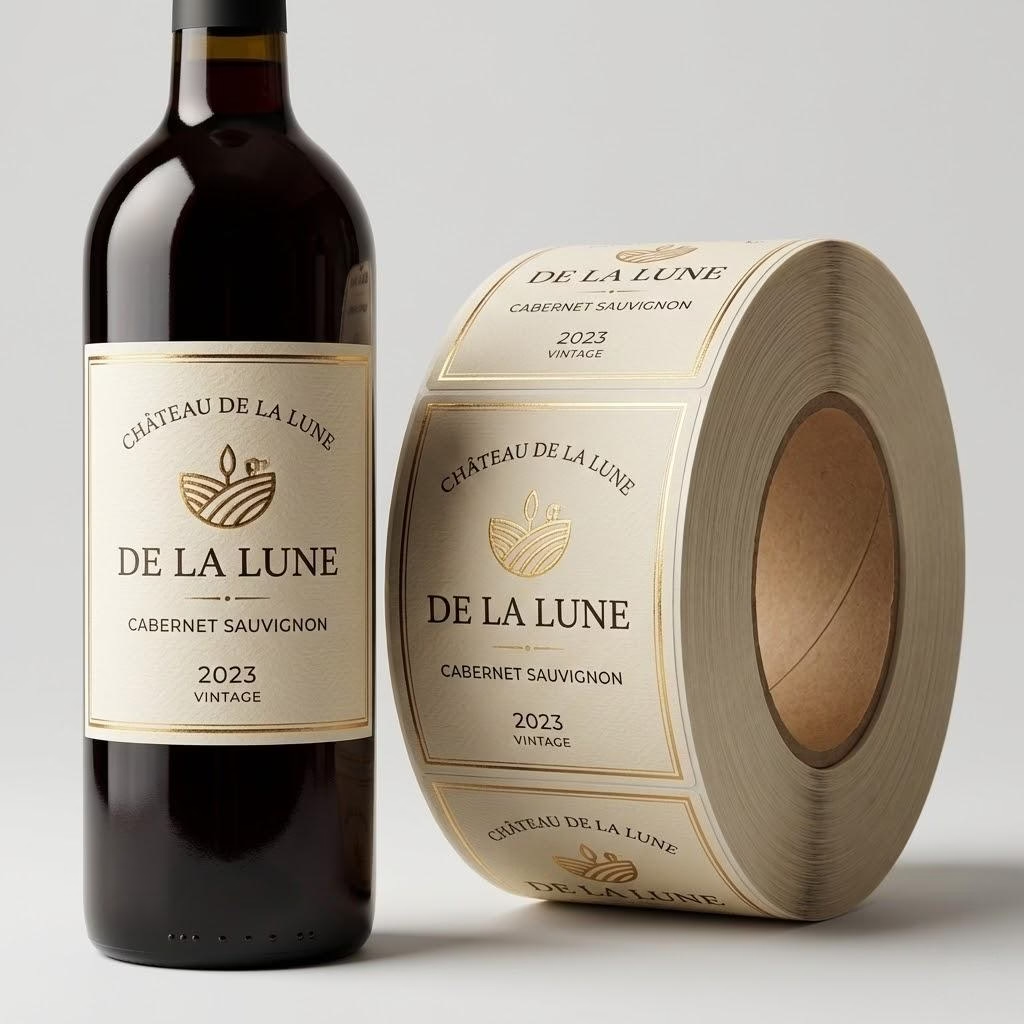
Before we pull the trigger on a 50,000-unit Custom Roll Label Reorder, we measure the raw material.
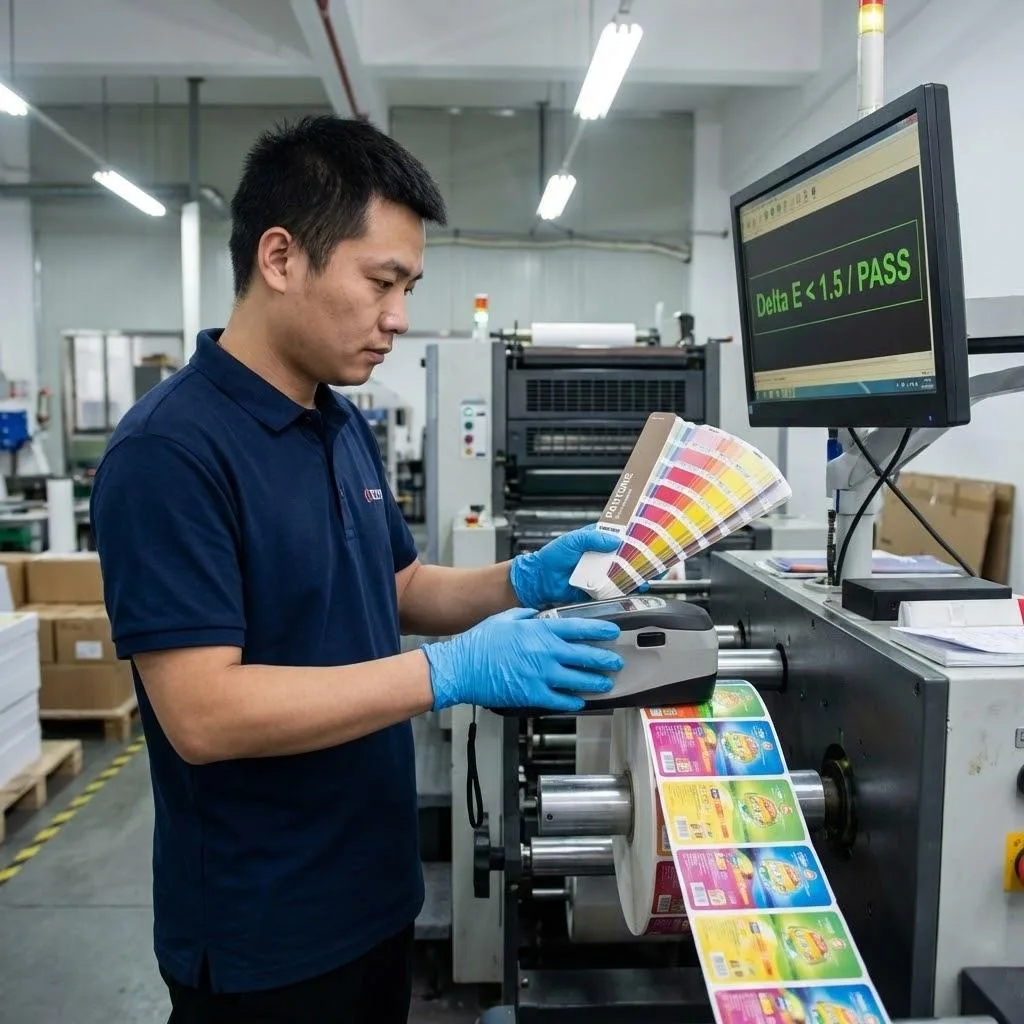
- We use a spectrophotometer to find the “LAB” coordinates of the unprinted paper.
- If the paper is slightly off-white, our servers calculate a “Negative Compensation Formula.” We adjust the ink mix to neutralize the paper’s tint, forcing the final result back to the original brand standard.
Tier 3: Master Asset Vaulting
This is where we protect you from your own design team. Over years of brand growth, designers change, agencies are swapped, and “Version 2_Final_v3.pdf” happens.
- We strip the brand colors from the artwork and lock them in a Digital Safe.
- Regardless of what “version” your designer sends, our system automatically overlays the “Master Spectral Value” onto the print plates. This prevents accidental shifts caused by transparency blending or incorrect Pantone assignments in the artwork.
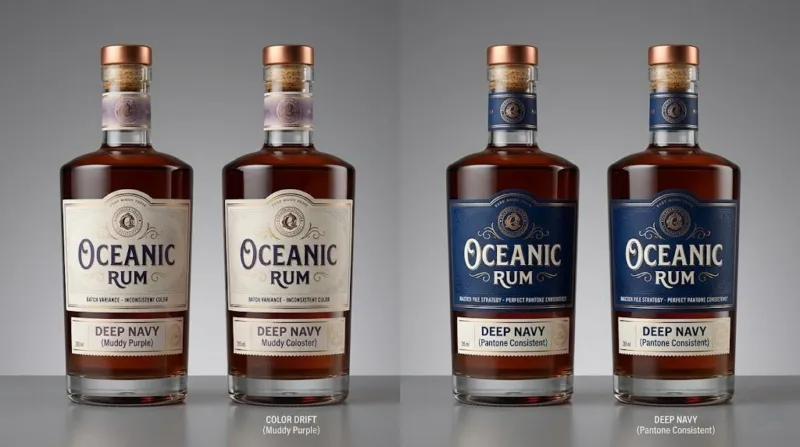
The Client: A high-growth functional beverage brand with 12 SKUs.
The Problem: The client moved their production to a “cheaper” local printer. By the third reorder, their signature Navy Blue—the core of their brand identity—had drifted into a muddy purple. The printer claimed the file was at fault.
The Label Printing China Intervention: When the client came to us, we didn’t ask for a sample of the “bad” labels. We asked for their original brand guidelines.
- We identified that the “cheaper” printer was using a generic ink profile that didn’t account for the high-absorbency paper they had switched to.
- We established a Digital Master File with a locked Delta E target of 1.2.
- During the first production run, our X-Rite eXact 2 detected a substrate drift in the paper roll. We applied a 2% reduction in Magenta ink to compensate.
The Result: The client achieved 100% Shelf Consistency across all 12 SKUs. Their reorder process, which used to take two weeks of “back-and-forth” proofing, was reduced to a 48-hour “one-click” workflow.
5. The Procurement Manager’s Audit Checklist
How to Verify if Your Supplier is “Master File” Ready
If you are currently evaluating your label supplier for Pantone Batch Variance, ask these four “Hardcore” questions. Their answers will tell you if they are a professional partner or just a “print shop.”
- “What is your Delta E (ΔE) tolerance for reorders?”
- The Red Flag: “We match as closely as possible.”
- The Standard: “We guarantee a ΔE of less than 2.0 against the digital master.”
- “Do you measure substrate whiteness before every run?”
- The Red Flag: “We use the same high-quality paper every time.” (This ignores the reality of manufacturing drift).
- The Standard: “Yes, we calibrate our ink curves to the specific LAB values of each paper lot.”
- “Can you provide a spectral measurement report with my shipment?”
- The Red Flag: “We can send you a physical sample.”
- The Standard: “Yes, we can provide a PDF data log showing the spectral scan of the run.”
- “How do you store my brand assets?”
- The Red Flag: “In a folder on our server.”
- The Standard: “In a Digital Asset Management system with locked CxF color standards.”
6. Conclusion: Investing in Certainty
In the B2B world, price is what you pay, but consistency is what you earn. A label that is 5% cheaper but 10% “off-color” is an expensive mistake. It damages your brand equity and creates a “communication black hole” that consumes your team’s time.
By implementing the Master File Strategy, you are buying more than just labels; you are buying Brand Integrity Insurance.
Don Hutcheson, the creator of the G7 methodology, said it best: “A true professional partner manages the data, not just the ink.”
At Label Printing China, we’ve spent 18 years becoming those data managers. We don’t just print your labels; we guard your colors. Are you ready to lock in your brand’s future?