Scaling your DTC brand requires a bulletproof supply chain you can trust. This expert guide gives you the precise framework to verify quality, compliance, and production capacity without ever catching a flight to Asia.
To vet a China-based label factory, verify their Unified Social Credit Code and perform spontaneous video audits of their ERP systems. Use spectral data to confirm color consistency (Delta E < 2.0) and conduct mass balance audits to validate FSC traceability and raw material authenticity.
But checking a business license is only the first step. Read on to discover the “reverse reconnaissance” secrets that help you spot shadow factories and “sample traps” before you wire a single dollar.
Moving Beyond Paperwork to Digital Audits

You might think a PDF certificate on a wall proves a factory is legitimate, but in the modern manufacturing landscape, paperwork is often just a starting point. To truly vet a China-based label factory, you must look past the static documents and seek digital proof.
In 2026, a “Valid” status on a screen is far more valuable than a framed certificate that may be years out of date. This is why understanding How to Choose a Label Supplier involves moving beyond surface-level aesthetics to operational substance.
Start by verifying the factory’s Unified Social Credit Code on official Chinese government portals. This unique identifier is the bedrock of their legal identity. It allows you to confirm if the company is registered as a manufacturer or merely a trading company. Why does this matter? Because a middleman adds a layer of cost and a “black box” of communication that can lead to the very quality issues you are trying to avoid.
The most effective tool in your arsenal is the spontaneous video audit. Global assurance experts at LRQA state that remote auditing is now a core competency that delivers transparency through real-time data sharing. By requesting a video call without a week’s notice, you catch the factory in its natural state.
During the call, ask to see their ERP production schedule. A professional facility will have a digital dashboard showing active job orders, machine status, and timelines. If they can’t show you a live schedule, they are likely managing your project with spreadsheets—or worse, outsourcing it to a third party.
By demanding this level of interactive transparency, you move from being a “tourist” to a “data auditor.” This shift in perspective is what separates successful supply chain managers from those who deal with constant delays.
Auditing Color Consistency via Spectral Data

Do you ever worry about your labels arriving with the wrong shade of red? You should.
Visual samples are often ‘hand-tuned’ by a supervisor to look perfect for your approval, but achieving clear BOPP label precision during mass production is where that consistency can fall apart.
If a factory relies on a worker’s “good eye” or “years of experience” to match ink during a midnight shift, your brand is at risk, making it critical to establish technical recovery protocols for when a shipment arrives out of spec.
This often leads to hidden expenses discovered during a Label Printing Cost Analysis.
“Supply chain is no longer just about cost—it is the heart and soul of the manufacturing company.” — Rosemary Coates, Executive Director of the Reshoring Institute
I once worked with a client who ordered 50,000 cold-foil labels for a premium supplement line. The samples were flawless. However, the final batch was a disaster: the first 10,000 units had a warm undertone, while the remaining 40,000 shifted toward a cool blue.
The factory claimed this was a “normal tolerance” in the printing industry. It wasn’t. They simply were not tracking the spectral data during the run.
To prevent this, you need to move from visual approval to a data-driven color audit.
Instead of looking at a photo over a video call—which can be distorted by camera lenses and lighting—ask the factory to show their X-Rite eXact 2 spectrophotometer in action. You want to see the Delta E values recorded during production. This number represents the mathematical distance between your target color and the actual printed result.
You should hold your supplier to these specific benchmarks:
- Standard Commercial Quality: Delta E < 2.0
- High-End Beauty or Medical Brands: Delta E < 1.5
If a factory cannot provide a report showing they monitored these values every 2,000 yards of material, they aren’t managing your quality—they are guessing.
By requiring a closed-loop color control system, you ensure your labels look the same whether they were printed on a Monday morning or a Friday night. This level of technical detail protects your brand integrity and ensures your products look consistent on the retail shelf.
Verifying Material Traceability and Compliance
If your brand is aiming for shelf space at retailers like Whole Foods, sustainability isn’t just a marketing buzzword—it is a legal requirement.
By 2026, over 75% of high-end DTC brands in the U.S. will require FSC certification.
For FDA food labels, ensuring the adhesive is 175.105 compliant is just as critical as the paper stock to avoid a “compliance time bomb.”
“Regulations are no longer a cost of doing business; they are a strategic terrain.” — Ron Keller, FINAT Supply Chain Strategist
I recall a DTC supplement brand that prided itself on being eco-friendly. They checked the factory’s FSC certificate, which was perfectly valid.
But when we performed a deep dive, we found a “paper trail” trap. The factory was using FSC-certified paper for the face stock but secretly substituted a non-certified, low-grade liner to save 15% on costs. Legally, that entire label was no longer compliant.
To avoid this, you must perform what we call a “Mass Balance Audit” during your remote inspection:
- Request the Inward Goods Log: Ask the warehouse manager to show you the log for the specific batch of paper being used for your order.
- Match the Square Footage: If you ordered 100,000 labels, the factory should have a matching purchase invoice for FSC-certified raw materials.
- Verify the Lot Numbers: Have them point the camera at the raw material rolls in the warehouse. Check the Chain of Custody (CoC) batch numbers against their internal tracking system.
Ready to Achieve Consistent Label Quality?
Avoid the risks of remote sourcing. Work with a factory that provides spectral data, FSC transparency, and machine-ready precision for every batch.
By verifying the “bloodline” of your materials through their ERP system, you ensure that your sustainability claims are backed by hard evidence, not just a salesperson’s promise. This level of scrutiny ensures your labels are a safe asset for your brand, rather than a liability waiting to explode.
Identifying Red Flags in Production and Logistics

Have you ever walked through a virtual tour and thought, “This place looks too perfect”? You are right to be skeptical. In the printing world, a polished showroom is easy to build, but a functional, safe, and efficient production floor is much harder to fake.
To truly vet a China-based label factory, you need to practice what I call “Reverse Reconnaissance.”
The most common trap is the “shadow factory”—a professional-looking office that secretly outsources your order to a low-end workshop with no quality controls. To spot this, ask your guide to turn the camera away from the shiny machines and toward the chemical waste and solvent storage area.
High-end UV flexographic printing involves complex chemicals and strictly regulated disposal protocols. If the waste bins are empty or the storage area looks like an afterthought, it is a massive red flag. It likely means the factory isn’t actually running the jobs they claim to.
Beyond the chemicals, pay close attention to the matrix waste—the “skeleton” of the label sheet that is stripped away during die-cutting.
If you see waste piles that are jagged or unevenly wound, it signals a failure in the machine’s tension control system, a critical technical indicator found in machine-ready manufacturing standards that prevent liner breaks.
For your brand, this isn’t just a cosmetic issue. Poor tension control leads to labels that vary in thickness or backing strength, which will cause your automatic labeling machines to jam or snap the liners during application of custom roll labels.
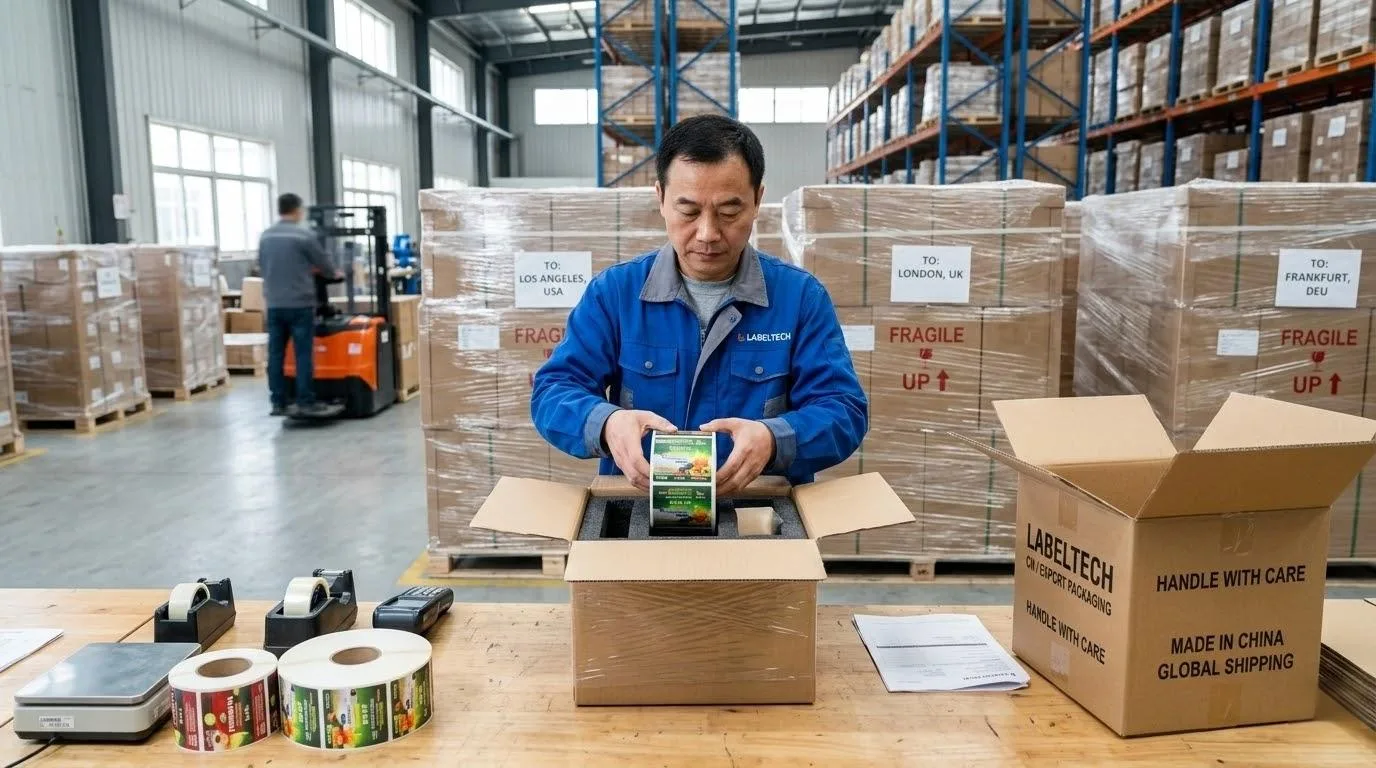
A reliable partner manages the logistics of shipping labels from China to the USA with the same precision they use for printing.
They should be able to discuss Section 301 tariffs and sea-freight humidity risks without hesitation. By looking at these industrial “scars” rather than the showroom “makeup,” you ensure your production stays on track and your brand stays protected.
Your Remote Vetting Action Plan
By now, you realize that a cheap unit price is often the most expensive choice you can make if it comes with hidden quality risks. To successfully vet a China-based label factory, you need a structured workflow that prioritizes data over promises. Think of this as your “digital shield” against supply chain disruptions.
| Audit Phase | Action Item | High-Performance Benchmark |
|---|---|---|
| 1. Preliminary Screening | Verify Export License & Tax Rating | Status: Active / A-Level Credit |
| 2. Equipment Audit | Match Machine Serial Numbers via Video | Machine Age: < 5 Years |
| 3. Technical Sampling | Demand a 180° Peel Adhesion Test | Result: 15-20 N/25mm |
| 4. Financial Safety | Verify Refund & Quality Claim Clauses | Supports Trade Assurance / Credit Insurance |
| 5. Cultural Fit | Measure Technical Response Time | Average Response: < 4 Hours |
Implementing this plan ensures you are not just buying stickers; you are investing in a robust manufacturing partnership. Remember that the best factories are not the ones that claim to be perfect, but the ones that show you exactly how they maintain their standards.
In the fast-paced world of DTC branding, your labels are the first thing your customers touch. Don’t let a “black box” supplier jeopardize that experience. By using the spectral audits, mass balance checks, and anti-fraud techniques we have discussed, you gain the “eyes and ears” on the ground that you thought were only possible with a plane ticket.
If you are currently looking for a partner who welcomes this level of scrutiny, we invite you to take the next step. Whether you need a detailed technical audit report or a live video walkthrough of our production line, we are here to provide the transparency you deserve.