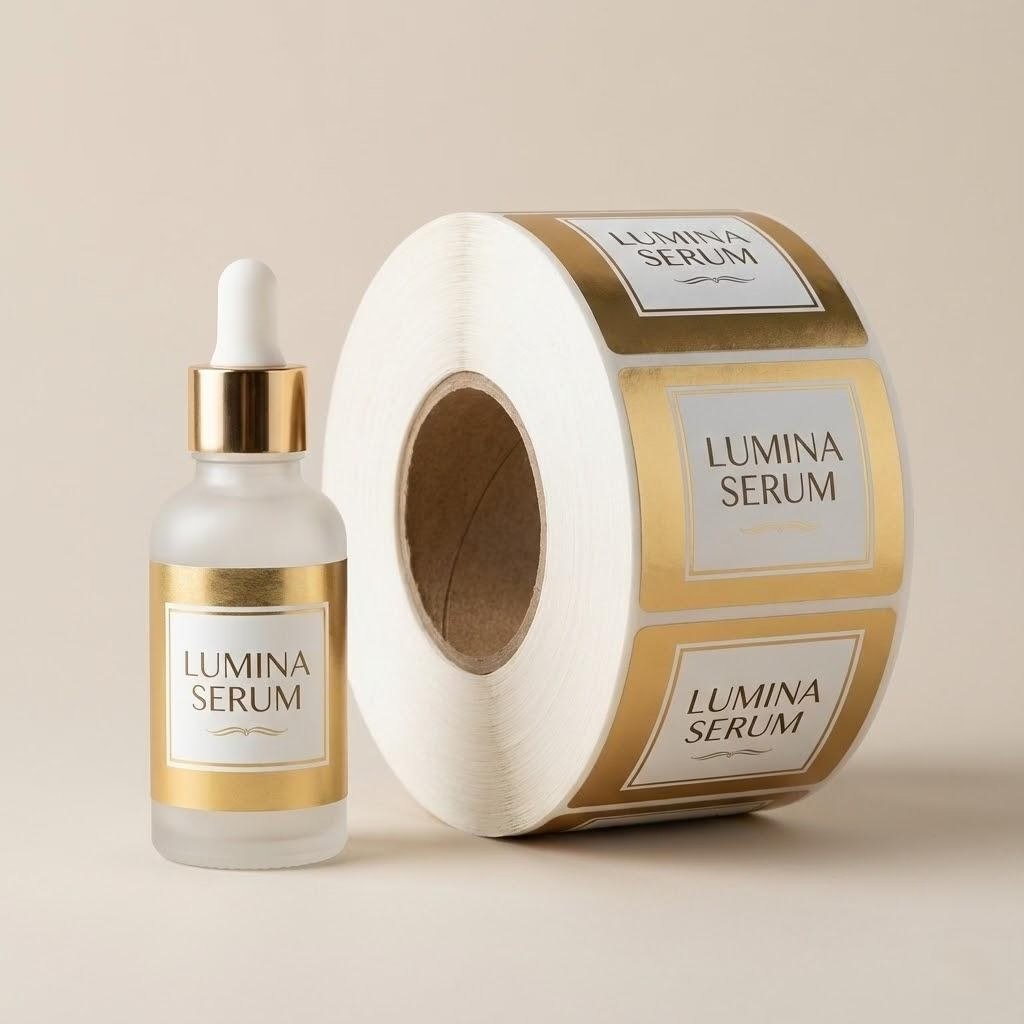
Struggling with smeared ink, greasy fingerprints, and peeling corners on your custom product packaging? I’m going to show you exactly how to bulletproof your brand so it survives the realities of the consumer vanity table.
To keep essential oil labels looking sharp, you must use a synthetic waterproof substrate like BOPP or PET film instead of paper. Additionally, apply a chemical-resistant clear PET overlaminate to protect the ink from aggressive terpenes, and use a high-tack solvent-resistant acrylic adhesive.
Want the exact technical specifications that prevent edge-lift on tight glass rollerballs? Keep reading to discover the hidden material traps that drain B2B profit margins. Building the full line? Start from our custom essential oil labels program page for bottles, caps, and blends.
Paper vs. Synthetic Films
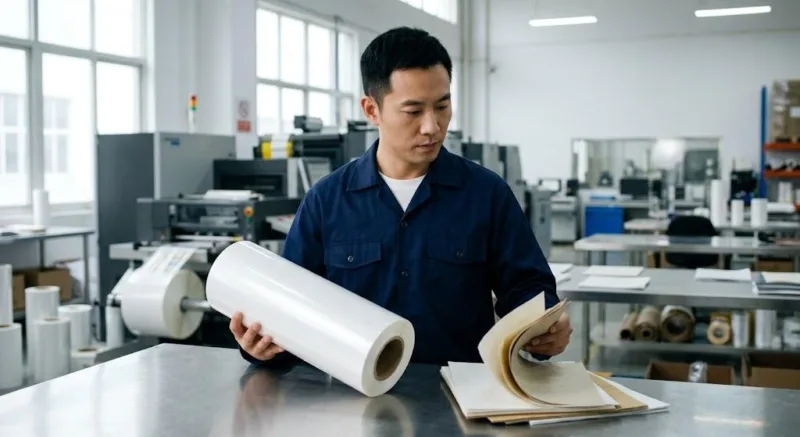
The most frequent critical failure procurement managers make is confusing water resistance with solvent resistance. Essential oils are packed with highly volatile organic compounds—specifically terpenes, phenols, and aldehydes. These do not act like water; they act as aggressive natural solvents.
When you specify a standard coated paper or an untreated estate texture stock, you are effectively wrapping your product in a sponge.
- Capillary Action is Immediate: Within days of a minor leak, capillary action draws the carrier oil directly into the unprotected paper edges.
- Structural Delamination: The paper fibers become fully saturated, turning the label translucent and causing the material to split apart.
- Aesthetic Destruction: Oil stains permanently darken the face stock, making regulatory text unreadable and barcodes unscannable.
To block oil migration at the base level, you must transition your supply chain entirely to synthetic films. Biaxially Oriented Polypropylene (BOPP) and Polyester (PET) are the non-negotiable standards for solvent-heavy applications.
Material Cost-Benefit & Resistance Matrix
Comparison of Label Materials for Essential Oil Exposure
| Face Stock Material | Solvent Resistance | Dimensional Stability | Edge-Lift Risk | Cost Index | Best Use Case |
|---|---|---|---|---|---|
| Estate Paper (Uncoated) | Critical Failure | Low | Medium | $ | Dry goods, single-use boxes |
| Standard Vinyl (PVC) | Poor (Stretches) | Low | High | $$ | Promotional stickers only |
| 2-mil BOPP (Polypropylene) | Excellent | High | Low | $$ | Standard carrier oil blends |
| 2-mil PET (Polyester) | Maximum | Maximum | Very Low | $$$ | Pure citrus, tea tree, aggressive solvents |
TL;DR: If your priority is maximum chemical defense, choose 2-mil PET; if you face standard oily environments, invest in 2-mil BOPP.
A 2-mil BOPP provides an impenetrable, non-porous foundation that stops fractionated coconut oil or jojoba oil dead in its tracks. However, if you are bottling highly aggressive pure citrus (high in limonene) or clove oils, upgrading to a 2-mil PET face stock delivers superior dimensional stability. PET actively prevents the material from stretching, bubbling, or warping when subjected to repeated chemical baths.
Protecting Ink from Dissolving
Securing the right base material is only phase one. Even if the film itself survives, the inks sitting on top of it will rapidly dissolve without a chemical-grade barrier. Pure essential oils strip standard flexographic and digital UV inks right off the substrate.
Do not settle for a standard aqueous coating or a basic UV varnish. While these liquid coatings reduce friction on the printing press and lower production costs, they fail catastrophically under sustained exposure to terpenes.
“When engineering labels for products containing high concentrations of essential oils, liquid varnishes offer inadequate defense. True chemical resistance requires encapsulating the ink layer beneath a physical barrier film, such as a high-gauge polyester overlaminate, to prevent solvent migration.”
— Paraphrased from specialty graphic and packaging compliance standards.
To keep your essential oil labels looking sharp, you must lock the ink beneath a physical film overlaminate. A 1-mil clear PET laminate is the industry benchmark for this level of chemical defense.
After you lock film and laminate for oil contact, confirm printable-zone millimeters per fill volume with our fragrance oil label size guide for 5–100 mL bottles.
The Matte Finish Dilemma
Brands love the tactile, premium feel of a matte finish. But standard matte laminations are micro-porous. When a consumer with greasy fingers touches a standard matte label, the microscopic pores trap the oil, leaving permanent dark fingerprints that cannot be wiped away.
Your Procurement Directive: If your brand identity demands a flat matte or soft-touch aesthetic, you must explicitly specify a hard-coated, solvent-resistant matte thermal laminate. These specialized laminates deliver the low-glare look without the porous surface, allowing oil drips to be wiped off cleanly without staining.
The Physics of Small-Diameter Bottles
Understanding substrates and laminates is standard engineering. But failing to account for the physics of application is where experienced buyers get trapped.
Over my many years managing production at Label Printing China, I’ve seen this exact scenario destroy profit margins: A procurement manager brilliantly specs out a thick 2.5-mil BOPP face stock with a heavy 1.5-mil PET laminate.
The labels feel premium and look indestructible. They are mechanically applied to a batch of 10ml amber glass rollerballs, shipped to a 3PL, and within three weeks, the edges of every single label are peeling backward off the glass.
The Diagnosis: The buyer prioritized chemical resistance but completely ignored material thickness, adhesive chemistry, and the tight radius of the bottle.
When you combine a thick face stock with a rigid laminate, you create a very stiff composite material. When wrapped around a tight curve—like a 10ml cylinder—the material’s natural “memory” forces it to try and lay flat. This structural rebound places constant, intense outward pressure on the overlapping edges.
If a consumer uses the rollerball, oil inevitably coats the exterior glass. This oil migrates directly to the exposed edge of the label. Standard, general-purpose emulsion acrylic adhesives break down immediately upon contact with oil, turning into a slimy residue and losing all tack.
The combination of stiff material memory and dissolved adhesive results in immediate “edge-lift” (flagging).
Secure Your Fragile Brand Equity Now
Don’t let edge-lift or dissolved ink destroy your product’s premium appeal. Get a factory-direct quote on custom labels engineered specifically for essential oils and high-solvent formulations.
How to Engineer Out Edge-Lift
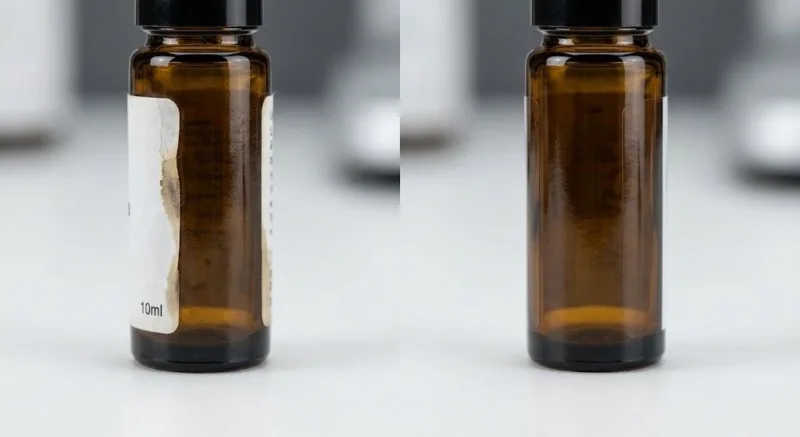
To completely eliminate this risk on tight mandrels (anything under 1 ounce or 30ml), your procurement specifications must include the following tolerances:
- Substrate Flexibility: Keep the combined thickness of the face stock and the laminate under 3.0 mils. Use highly flexible BOPP instead of rigid PET for small-diameter curves.
- Adhesive Coat Weight: Demand an aggressive, high-tack solvent-resistant acrylic adhesive with a heavy coat weight. Standard coat weights will not survive the oil exposure.
- Material Grain Direction: This is a separator between average printers and top-tier partners. Ensure your factory cuts the labels so the machine grain direction of the film wraps around the bottle, not up and down. Bending against the grain increases stiffness and guarantees edge-lift.
- The Overlap Strategy: Design the label to physically overlap itself by at least 1/8 inch (approx. 3mm). Film-to-film adhesion is significantly stronger than film-to-glass adhesion, creating a locked mechanical bond.
Advanced Procurement: Vetting Suppliers for Precision
Knowing the chemistry and physics of oil-resistant packaging is useless if your supply chain cannot execute the technical specifications with rigorous quality control. When vetting a custom industrial label printing manufacturer, you must move past basic pricing matrixes and demand quantifiable engineering data.
If a supplier cannot clearly articulate their adhesive coat weights or provide technical data sheets (TDS) for their laminations, they do not possess the capabilities to handle volatile cosmetic compounds.
The 72-Hour Real-World Stress Test
Do not authorize a massive production run based on a digital proof. A reliable factory partner will enforce a structural integrity test. Demand your supplier execute the following protocol:
When those bottles are CBD oil or supplement packs at about 1,000 labels per SKU, freeze oil-ready builds and roll format with the CBD bottle roll specs before you scale.
- Blank Application: Apply the exact blank, laminated stock construction to your specific glass vials.
- Chemical Submersion: Coat the exterior of the bottles, specifically targeting the label edges, with your heaviest carrier oil and your most volatile pure extract (e.g., Lemon or Eucalyptus).
- Incubation: Let the bottles sit in a 75°F environment for 72 hours.
- Mechanical Verification: Inspect for any loss of optical clarity, adhesive degradation, or edge flagging.
This protocol isolates the adhesive performance, verifies the chemical resistance of the barrier layer, and proves that the material memory will not fight the tight curvature of your specific glass sourcing.
Monitoring ΔE Color Variance
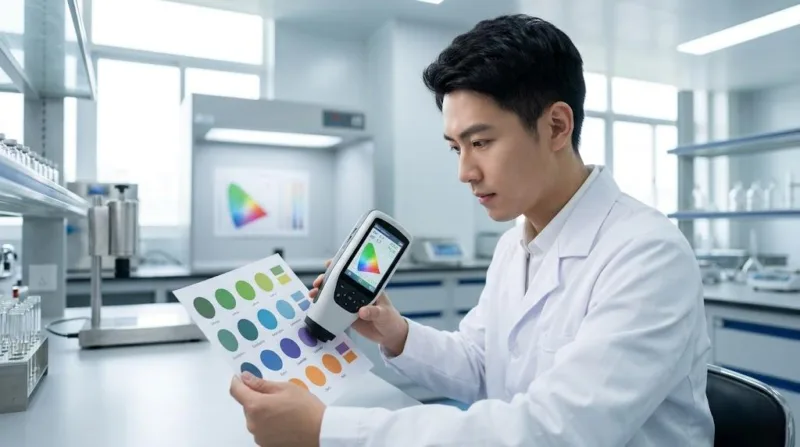
Heavy laminations and synthetic BOPP films interact with ink differently than standard paper. This can cause color shifts, which is disastrous if you have strict brand identity guidelines.
Require your printer to use a spectrophotometer to measure the monitoring ΔE color variance between your approved proof and the final laminated product. A ΔE value of less than 2.0 ensures that your brand colors remain exactly as your designer intended, even when buried under a thick layer of chemical-resistant polyester.
Balancing Environmental Compliance with Durability
A growing pain point for modern procurement managers is the internal push for sustainable, eco-friendly packaging. Brand owners want PCR (Post-Consumer Recycled) materials, compostable films, or uncoated papers to market a “green” aesthetic.
Here is the harsh industry truth: Current biodegradable and paper-based materials cannot withstand pure essential oils.
Applying a compostable label to an essential oil bottle guarantees a failed product experience. The aggressive solvents will melt compostable adhesives and saturate sustainable papers in days.
If your brand mandates an eco-friendly angle, you must localize the sustainability to the outer secondary packaging (e.g., using 100% recycled corrugated paper for the retail box). For the primary label touching the glass vial, function must override aesthetic ideology.
Using a durable, recyclable BOPP label is ultimately more sustainable than dealing with the massive carbon footprint of recalling, destroying, and replacing thousands of unsellable, oil-soaked bottles.
The Final Strategic Directive
Securing long-term brand equity relies entirely on eliminating friction in the consumer experience. Faded regulatory text, peeling corners, and saturated paper directly communicate a low-tier product, effectively destroying your ability to command premium retail pricing regardless of the purity of the extracts inside.
Do not let your packaging fail the final mile of the consumer journey. By engineering your labels from the substrate up—utilizing PET films, aggressive solvent-resistant adhesives, heavy coat weights, and impenetrable barrier laminations—you protect both your operating margins and your market positioning.
Stop accepting generic waterproof stickers that fail under the realities of daily cosmetic use. Mandate precise chemical-grade specifications from your manufacturing partners, respect the physics of your glass sourcing, and you will consistently keep your essential oil and serum brands labels looking sharp.
If you’ve noticed your current labels are lifting or fading, you need to fix label printing issues before your next production run hits the shelves.