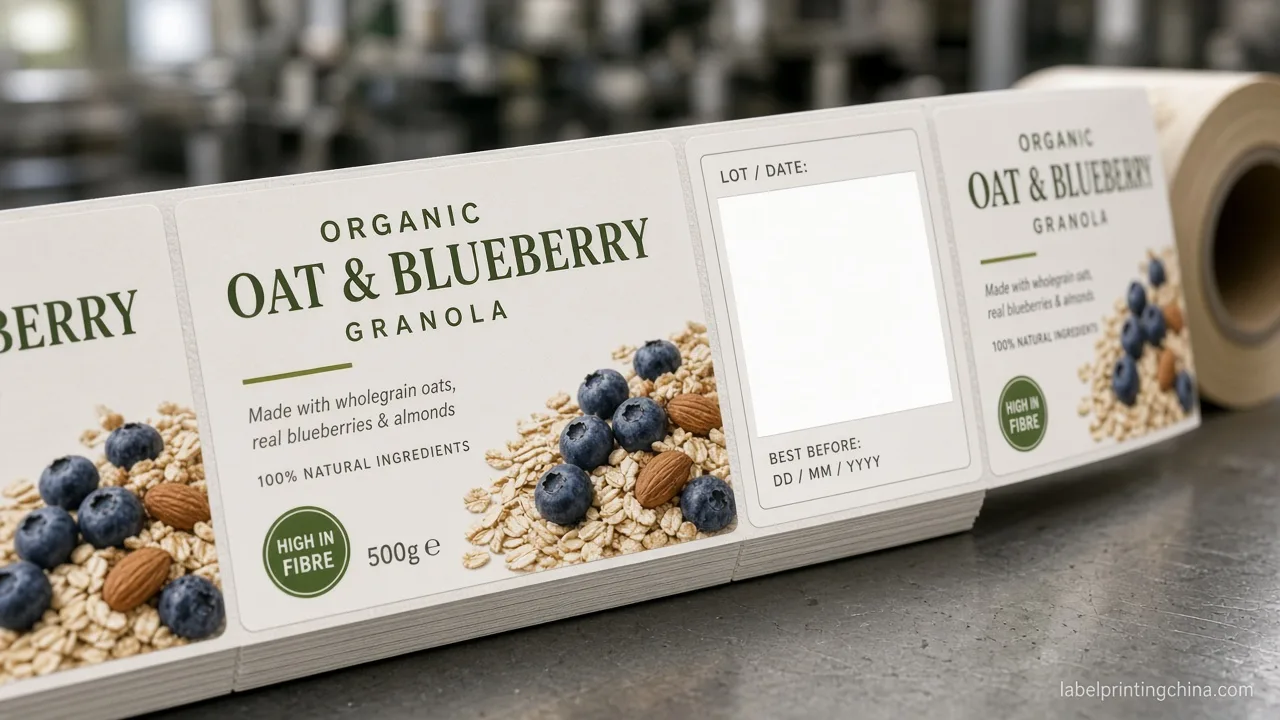
Moving to Big Box retail is a high-stakes game. One tiny label mistake can lead to a rejected shipment and a massive financial chargeback. This guide shows you exactly how to build high-performance labels that pass every inspection, every time.
To pass inspection, nutrition facts labels must meet FDA 21 CFR 101.9: use 16pt bold for ‘Calories,’ 8pt for nutrients, and ensure a ‘Grade A’ barcode. Use moisture-resistant BOPP for cold storage and maintain $\pm 0.1mm$ die-cut precision to guarantee 100% machine-readability on retail lines.
Want to see how the pros do it? Read on to discover the 18-year industrial secrets to saving 30% on production while keeping your supply chain 100% secure.
Buyer Takeaway: What Must Pass Before Retail Submission
A nutrition facts label is not only an artwork item. For food brands moving from farmers markets to retail shelves, it becomes an inspection, scanning, and packaging-control document.
- Check compliance first: beverage label requirements or ingredient hierarchy before artwork approval.
- Check production second: verify barcode quiet zones, print contrast, label material, adhesive, and roll direction before mass printing.
- Check buyer evidence: keep the final dieline, approved PDF, barcode report, material spec, and sample photos in one preflight folder for retailer or inspector review.
1. The “Big Box” Reality: Performance vs. Aesthetics
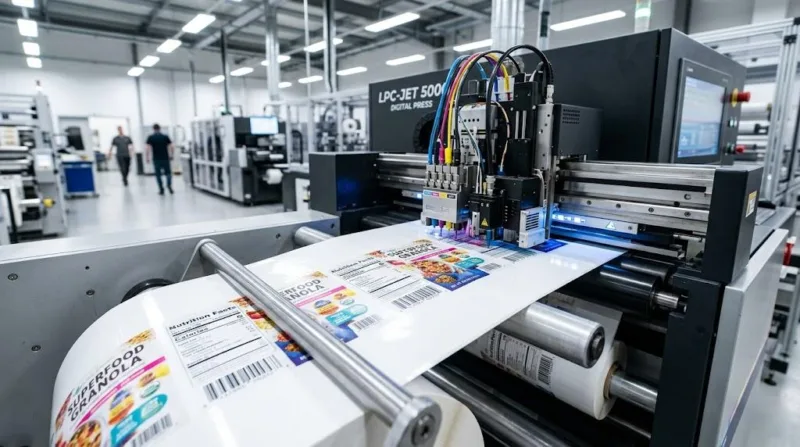
In the artisan world, a label is about “storytelling.” In the big-box world, a label is about data integrity and machine readability. Retailers utilize high-speed automated sorting systems that scan thousands of items per hour. If your label fails to perform, the system stops.
Before inspection, lock the long ingredient layout so hierarchy, leading, and approved-copy versions already survive die size.
The Technical Gap: Artisan vs. Industrial Standards
| Feature | Farmers Market Standard | Big Box Retail Standard |
|---|---|---|
| Barcode Quality | “It scans on my phone” | ISO/IEC 15416 Grade A or B |
| Legibility | Visual clarity to the eye | Spectrophotometer-verified contrast (>80%) |
| Durability | Hand-applied, minimal friction | High-rub resistance (ASTM D5264) |
| Compliance | General FDA adherence | Strict 21 CFR 101.9 Typeface/Leading specs |
| Tolerance | pm 1.0mm registration | pm 0.1mm precision die-cutting |
“The integrity of the supply chain begins with the integrity of the package. A failure in label scannability is a failure in inventory velocity.”
— Industry Analyst, Smithers
Most design software presets are not optimized for the granular requirements of the NLEA (Nutrition Labeling and Education Act). A common “rookie mistake” is scaling a nutrition grid to fit a design without realizing that nutrition facts label requirements.
The “Hidden” FDA Typography Rules
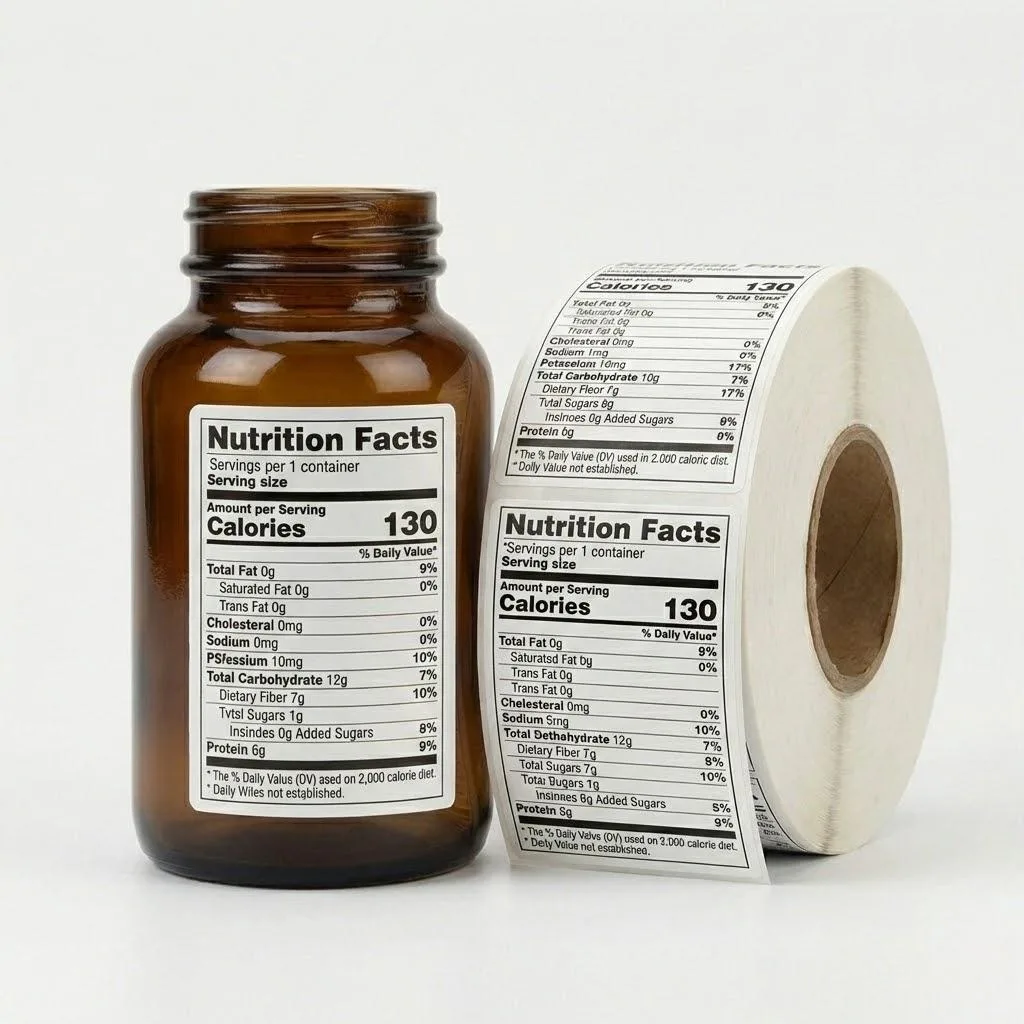
- Calories: Must be in a bold type and equal to or greater than 16 points (for standard-size labels).
- Nutrients: Must be at least 8-point Helvetica or equivalent legible font.
- Leading (Line Spacing): Must be tight enough to maintain the “box” aesthetic but wide enough to prevent ink-fill on a flexographic press.
- The Hairline Rule: The lines (rules) separating nutrient blocks must be at least 0.25 points or 0.5 points depending on the section.
I have seen brands submit beautiful “minimalist” labels where the nutrition grid lines were 0.1pt thin. On a high-speed press, “dot gain”—the natural spreading of ink—can cause those lines to blur or disappear entirely.
If a retail inspector cannot see a clear separation between “Total Fat” and “Cholesterol,” your brand is at risk. We always recommend a “Buffer Zone” of 0.2mm for all rule lines to account for press-side ink expansion.
3. Barcode Grading: The Difference Between “In-Stock” and “Rejected”

In big-box logistics, a barcode is your product’s passport. Most small-scale printers produce “Grade C” barcodes. While these might work on a local shop’s hand-held scanner, they fail on the high-speed overhead omnidirectional scanners used in massive distribution centers.
Factors That Kill Your Barcode Grade:
- Quiet Zone Encroachment: The white space before and after the barcode must be at least 10 times the width of the narrowest bar. Designers often squeeze this space to fit more marketing copy.
- Ink Bleed: On porous paper, ink “feathers,” shrinking the white gaps between bars.
- Color Choice: Scanners use red light. If you print a green barcode on a white background, the scanner sees it as “invisible” (no contrast). Always use high-density black on a white or pale yellow background.
Ready to Achieve 100% Retail Compliance?
Don’t let a barcode rejection stall your supply chain. Our “Machine-Ready” labels are engineered to pass Grade A inspections on the fastest retail sorting lines.
4. Substrate Engineering: Survival of the Fittest
The retail shelf is a violent environment. Your product will be vibrated in a truck for 1,000 miles, stacked under weight, and subjected to fluctuating temperatures.
Material Selection Strategy
- For Dry Goods: Use a 60# Semi-Gloss Paper with a UV-Cured Varnish. The varnish prevents “scuffing” where the labels rub against each other in the corrugated shipping box.
- For Refrigerated/Chilled: You must move to BOPP (Biaxially Oriented Polypropylene). Paper labels will absorb moisture (“edge-wicking”), causing the nutrition facts to wrinkle and peel.
- The “Glare” Factor: Big-box stores use high-intensity LED or Fluorescent lighting. A high-gloss laminate can create a “hot spot” that blinds scanners. We often recommend a Matte Satin finish to ensure 360-degree scannability.
5. Avoiding the “Invisible” Cost Traps
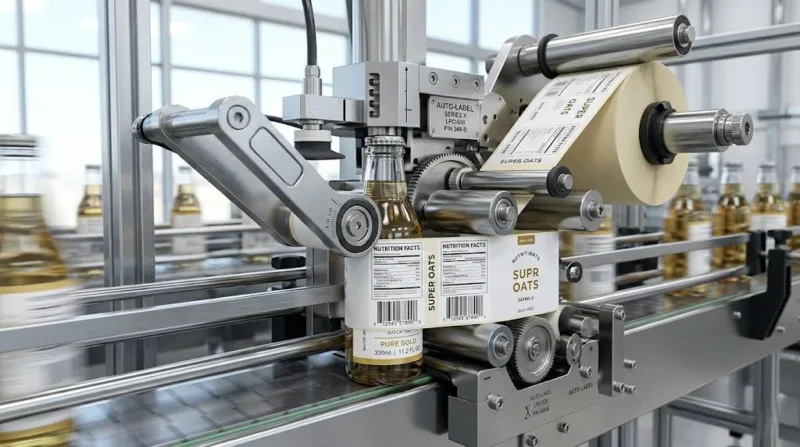
When you scale from 1,000 labels to 100,000, small inefficiencies become massive financial leaks.
1. The “Wasted Web” Trap
If your label size is 4.125 inches wide, but the printing press “web” is 10 inches wide, you are paying for wasted material. Adjusting your design by just 1/8th of an inch can often allow for an extra “lane” of labels on the press, cutting your unit cost by 15–20%.
2. Die-Cut Precision and High-Speed Application
Most big-box suppliers use automated label applicators. If your label converter uses dull dies, the “liner” (the paper the label sits on) may be microscopically nicked. During high-speed application, that liner will snap, shutting down your entire production line.
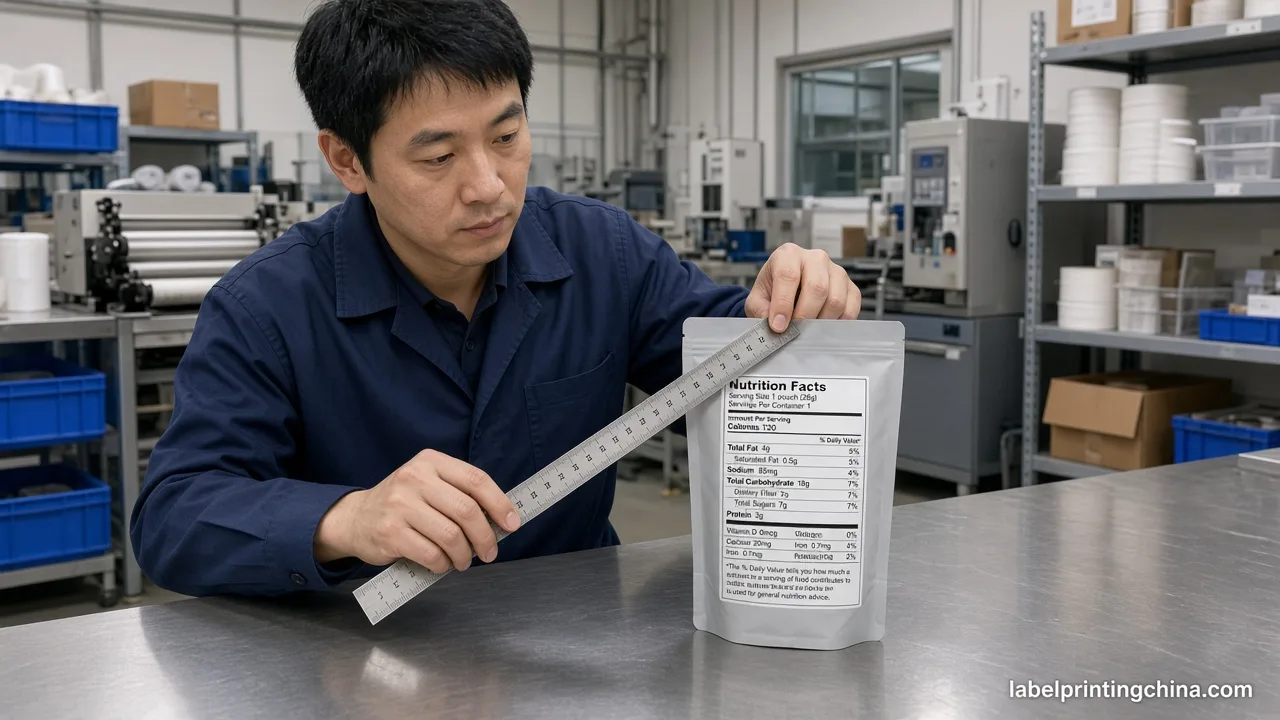
Always ask your printer for a $\pm 0.1mm$ tolerance guarantee on die-cut registration. Anything higher increases the risk of “label flagging” or jam-ups during the packaging process.
6. The Final Compliance Checklist: Pre-Flight Audit
Before you sign off on a production run of 100,000 labels, run this final gauntlet:
- [ ] Spectral Verification: Is the black ink density at least 1.4 D? (Critical for barcode contrast).
- [ ] Fiber Direction: Does the paper fiber run parallel to the label’s application direction? (Prevents curling).
- [ ] Allergen Boldness: Are the “Contains: Milk, Soy” warnings in a typeface that meets the FALCPA requirements for prominence?
- [ ] Total Weight Accuracy: Does the net weight statement appear in the bottom 30% of the principal display panel?
- [ ] Proof of Conformance: Does your printer provide a COA (Certificate of Analysis) for the ink and substrate?
Inspection Failure Matrix for Nutrition Facts Labels
Use this matrix before sending files to print. It turns the article from a compliance explanation into a practical inspection checklist for buyers, designers, and suppliers.
| Inspection failure | What usually causes it | Buyer-side prevention |
|---|---|---|
| Nutrition panel rejected | Serving size, nutrient order, type size, or formatting does not match the approved panel. | Freeze the nutrition panel as a controlled artwork element before design styling begins. |
| Barcode scan failure | Low contrast, insufficient quiet zone, curved placement, or reflective material. | Request a barcode verification screenshot or scan report from the printer before shipment. |
| Ingredient/allergen concern | Ingredient order, allergen statement, or claim wording is inconsistent with the formula. | Have the formula owner approve the final ingredient and allergen copy, not only the designer. |
| Retail shelf rework | Label material lifts, smears, wrinkles, or fails under refrigeration and handling. | Match substrate, adhesive, and finish to the package surface and storage temperature. |
Nutrition Facts Artwork Checklist Before Printing
The safest approval flow is to separate regulated content from visual styling. Lock the nutrition panel and required copy first, then review layout, material, barcode, and production setup.
| Artwork checkpoint | What to verify | Pass signal |
|---|---|---|
| Nutrition facts block | Panel format, serving information, nutrient order, %DV, type size, and contrast. | The approved PDF matches the compliance source file and remains readable at final size. |
| Net quantity and identity | Product identity statement and net quantity placement. | Front panel information is visible without competing with decorative graphics. |
| Ingredients and allergens | Ingredient order, allergen declaration, and claim wording. | Formula owner and regulatory reviewer approve the same final copy. |
| Dieline and bleed | Trim line, safe zone, bleed, corner radius, and panel fold or seam area. | No compliance copy, barcode, or batch code sits inside risky trim or curve zones. |
Barcode and Legibility QC Table
Retail rejection often happens after a label looks correct on screen. Printed samples should be checked for scan reliability, contrast, material behavior, and batch-coding space.
| QC item | Risk to inspect | Recommended evidence |
|---|---|---|
| Barcode | The printed barcode scans poorly after varnish, lamination, or curved application. | Scan result from the printed sample or production proof. |
| Legibility | Small type, dense claims, or low-contrast colors become unreadable on shelf. | Photo at actual size plus a reviewer check under normal lighting. |
| Material fit | Paper, film, adhesive, or finish does not match cold, oil, moisture, or squeeze handling. | Material spec and sample test on the actual container. |
| Batch coding space | Date code, lot code, or retailer label covers required information. | Marked coding area on the dieline before production. |
Buyer Preflight Checklist for Food Label Orders
Before asking for a final quote or approving mass production, prepare one controlled preflight package. This helps a supplier such as custom food labels, custom nutrition labels, or roll labels confirm the same production assumptions.
| Before approving print | Owner | Must be locked |
|---|---|---|
| Nutrition and ingredient copy | Regulatory or formula owner | Serving data, ingredients, allergens, claims, and required statements. |
| Print-ready artwork | Brand/designer | Dieline, bleed, safe zones, color mode, fonts/outlines, barcode, and batch-code area. |
| Production setup | Label supplier | Material, adhesive, finish, roll direction, core size, quantity, and packing method. |
| Inspection evidence | Buyer and supplier | Approved PDF, printed sample photos, barcode check, and material confirmation. |
Conclusion: Partnering for Success
Moving into Big Box retail is the ultimate validation of your brand, but it requires a shift from “marketing-first” to “compliance-first.”
By focusing on scannability, substrate durability, and microscopic precision, you ensure that your product doesn’t just reach the shelf—it stays there. Don’t let a 0.5mm design error cost you a $50,000 retail contract.
Partner with a manufacturer who understands the “Big Box” playbook and treats your Nutrition Facts with the technical respect they deserve.