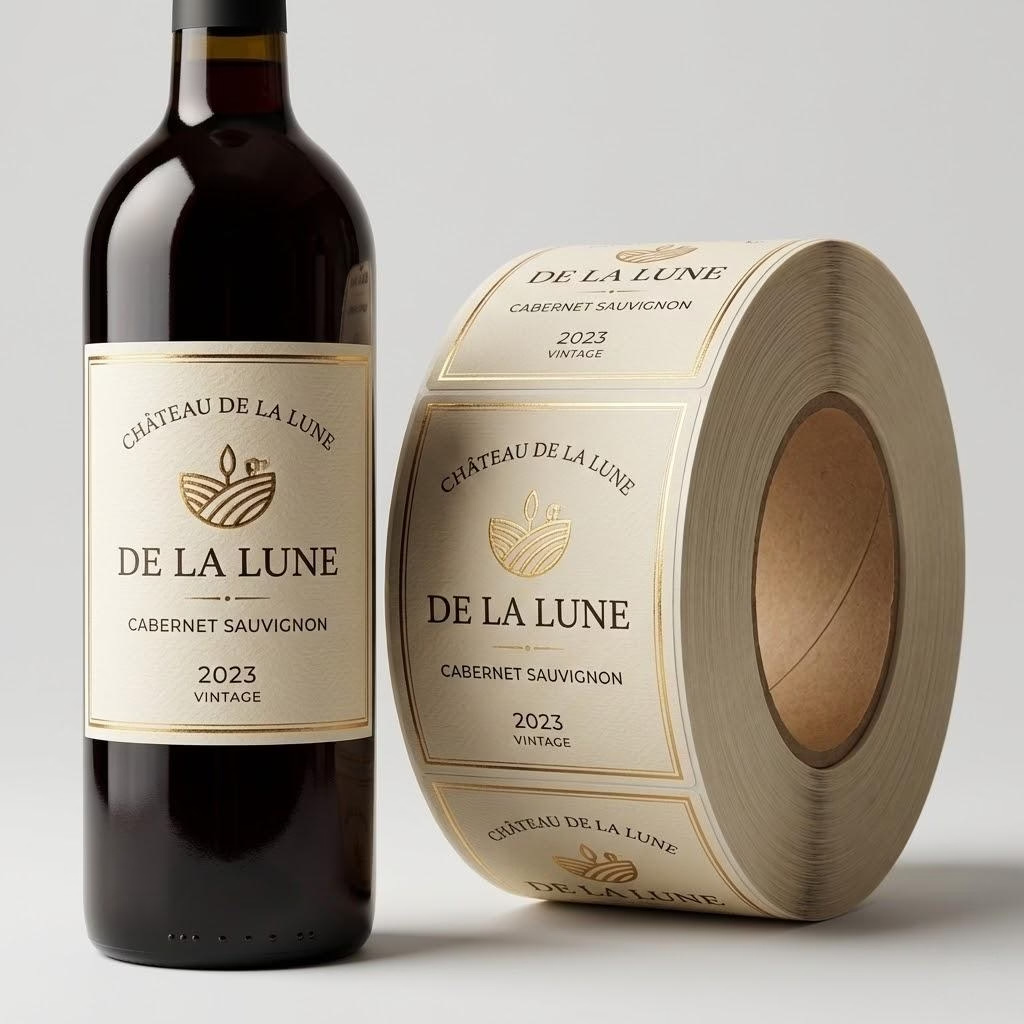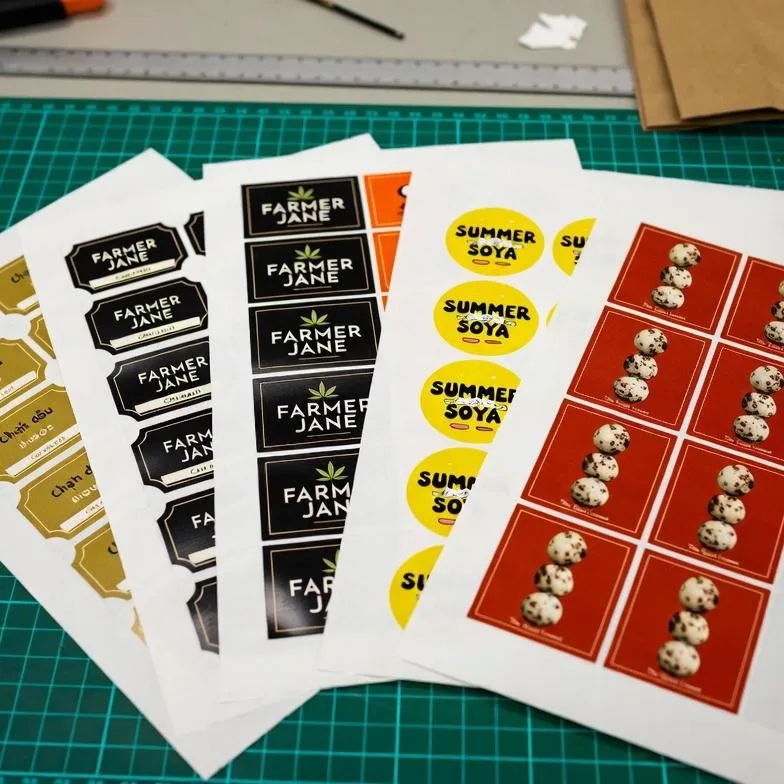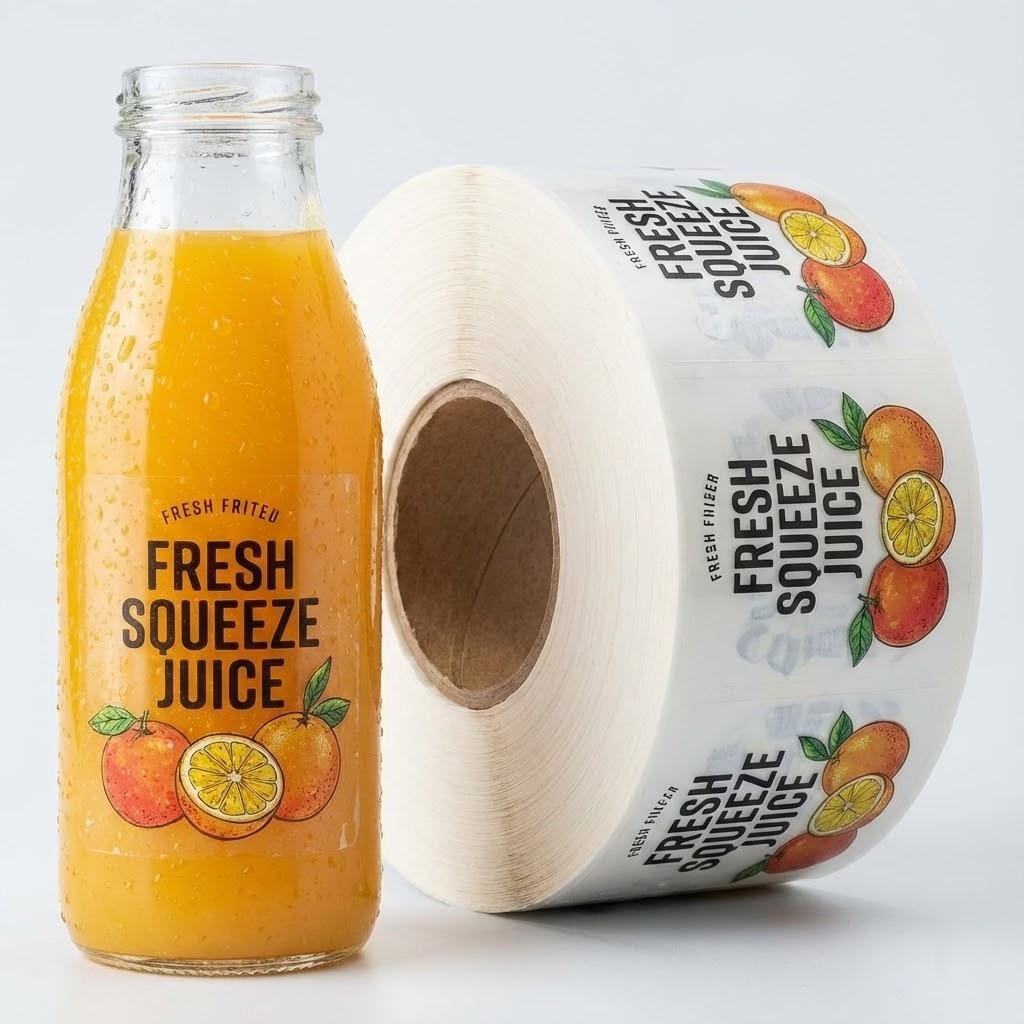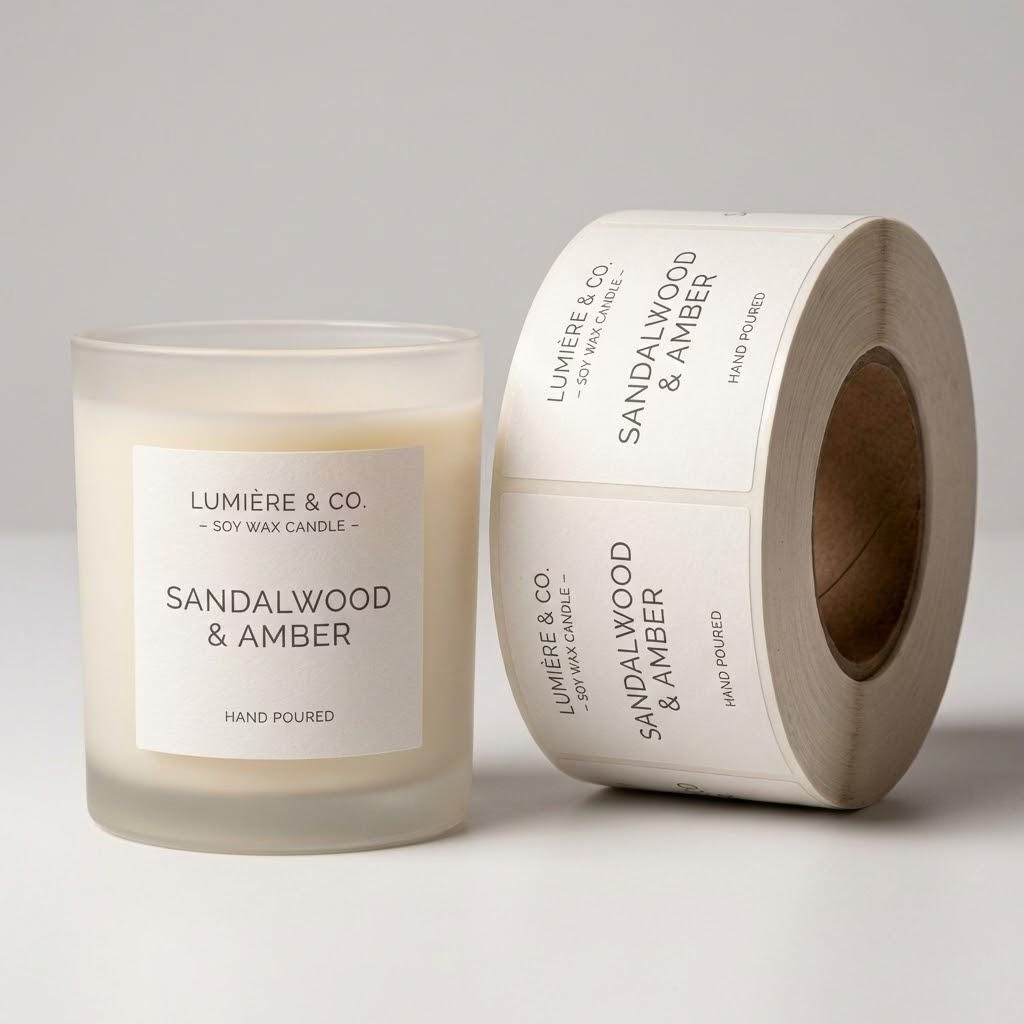
Choosing the wrong label finish doesn’t just ruin your packaging—it causes massive retail chargebacks and supply chain delays. In this guide, you’ll discover exactly how to choose between varnish and lamination based on hard production data, not guesswork.
Lamination applies a structural plastic film (BOPP/PET) over labels, offering extreme durability for high-friction transit. Varnish is a liquid UV coating that provides basic scuff resistance and flexibility at a lower cost. Choose lamination for heavy logistics, and varnish for high-speed, curved applications.
But which one actually guarantees maximum ROI for your specific manufacturing line? Let’s dive into the hidden machine tolerances and real-world friction tests that most contract printers won’t tell you about.
The Physics Of Transit Friction: Why Print Layers Fail
To understand how to protect your label design, you must first understand how it dies.
Scuffing rarely happens on the retail shelf. The actual damage occurs during LTL (Less Than Truckload) freight transit, which underscores the critical necessity of strict scuffed label prevention.
As pallets vibrate across thousands of miles, your products are subjected to constant, micro-level abrasion. They rub against corrugated cardboard dividers, shrink wrap, and adjacent containers.
This vibration acts exactly like fine sandpaper.
When procurement managers compare varnish vs. lamination, they often look strictly at the unit price. This is a critical mistake. You are not buying a “shiny look”—you are buying mechanical insurance for your barcode readability and brand image.
UV Varnish: Liquid Protection And Its Physical Limits
A UV varnish is a liquid coating applied directly over wet ink and cured instantly via ultraviolet light. It is highly cost-effective and provides a great baseline defense against casual human handling and minor moisture exposure.
But here is the hard truth about liquid coatings: they lack physical mass.
A standard UV varnish layer is exceptionally thin. Under sustained friction testing—such as the industry-standard Sutherland Rub Test—standard varnishes often begin to show micro-fractures very quickly.
- Light Friction: Varnish holds up well to shelf-handling.
- Heavy Transit (100-200 strokes): Varnish begins to breach, allowing corrugated fibers to chew directly into your CMYK ink layers.
If your product is heavy, irregularly shaped, or packaged with loose tolerances inside a master carton, a liquid varnish simply cannot absorb the heavy transit abrasion.
Lamination: Total Structural Encapsulation
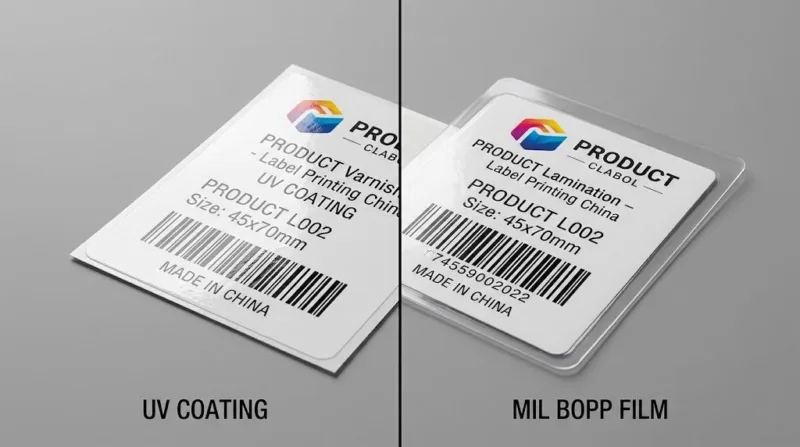
Unlike a liquid coating, lamination involves applying a physical, solid plastic film over the printed substrate. Typically, this is a 1.0 to 1.5 mil BOPP (Biaxially Oriented Polypropylene) or PET (Polyethylene Terephthalate) film.
Lamination fundamentally changes the architecture of your label.
It doesn’t just cover the ink; it encapsulates it. When a laminated label is subjected to severe transit vibration, the plastic film itself takes the physical beating. Even if the outer surface of the laminate becomes heavily scuffed, the barcode and brand colors remain completely pristine underneath the transparent barrier.
“Substituting structural film lamination with high-build varnish in high-friction supply chains is one of the most common causes of preventable retail chargebacks in the B2B sector.”
— Packaging Material Analytics, Smithers Institute
In aggressive rub testing environments, a quality PET laminate can routinely withstand thousands of friction cycles without exposing the print layer. It is the ultimate shield.
Ready to Bulletproof Your Product Logistics?
Stop guessing which finish will survive the supply chain. Get a precision-engineered quote for machine-ready labels that eliminate scuffing and retail chargebacks.
The Hidden Production Costs: Machine Tolerances And Application Failures
Upgrading to a structural film seems like the obvious choice for maximum scuff resistance, right?
Not so fast.
This decision carries massive downstream consequences on the factory floor. You cannot simply slap a 1.5 mil matte laminate onto your existing paper substrate without recalculating the physical mechanics of your automated packaging line.
Over my past decade managing roll-to-roll label production floors, I have seen this exact scenario play out constantly. A purchasing manager at a cosmetics brand gets tired of scuffed labels and blindly demands thick PET lamination on their next run of small squeeze tubes.
The result? A complete production disaster.
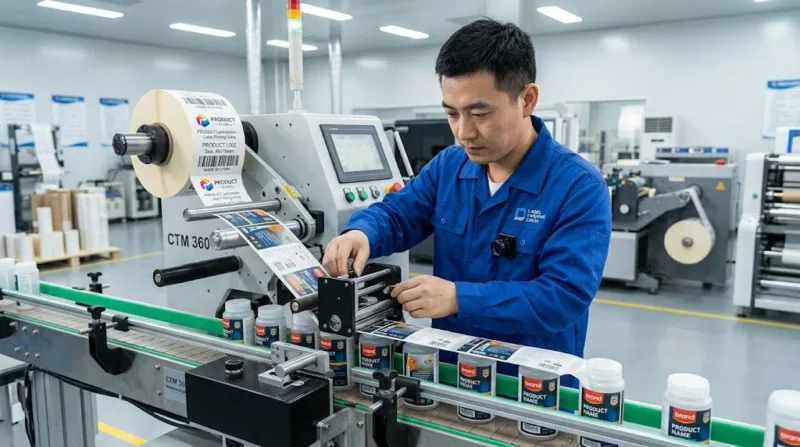
Adding a layer of BOPP or PET fundamentally alters the rigidity and memory of the label. When running these stiff, reinforced rolls through high-speed auto-applicators, that extra stiffness causes the label edges to peel back—a defect known as edge flagging. The label literally fights the curvature of the tight-radius container.
Furthermore, film lamination demands surgical precision during the die-cutting process. A liquid varnish simply cures flat. But a laminate introduces a tough, tear-resistant plastic layer. If your label supplier’s rotary die is even slightly worn, or if they fail to maintain a strict ± 0.1mm die strike tolerance, the laminate will not cut cleanly.
This causes adhesive bleeding and matrix stripping failures. Your applicator machine will constantly jam, snapping the web tension and halting your entire bottling line. The cost of that machine downtime instantly wipes out any pennies you saved during the procurement phase.
This is exactly where UV varnish re-enters the strategic conversation.
If your product requires application on compound curves, tight radiuses, or if your high-speed application line is highly sensitive to roll tension changes, a premium UV coating is often the necessary compromise. It protects the primary viewing panel from baseline abrasion while maintaining the original, pliable flexibility of the substrate.
Material Selection Framework For High-Volume Workflows
Beyond physical scuffing and machine tolerances, there is a third critical metric dominating the US market: end-of-life compliance.
The sustainability demands of modern retail networks (like Target and Walmart) have fundamentally shifted how we specify surface finishes. Many procurement teams pay a massive premium for FSC-certified paper stocks to meet corporate ESG (Environmental, Social, and Governance) goals. But then, they make a fatal error.
They bond a layer of heavy polypropylene (lamination) directly to the paper surface.
When a paper label is encapsulated in plastic film lamination, it instantly becomes a mixed-material waste product. It cannot be easily repulped in standard municipal recycling streams. Conversely, standard UV varnishes generally burn off or wash away during the repulping process, maintaining the eco-friendly integrity of the original paper stock.
If your buyers demand strict sustainability compliance, over-engineering your scuff protection with thick plastic films will create a serious vendor compliance liability.
| Performance Metric | Premium UV Varnish | Structural Film Lamination |
|---|---|---|
| Transit Scuff Resistance | Baseline (Sutherland Rub < 200 cycles) | Extreme (Sutherland Rub 1,000+ cycles) |
| Substrate Flexibility | High (Conforms perfectly to tight radiuses) | Low (Prone to edge flagging on curves) |
| Die-Cutting Precision | Forgiving (Standard rotary tooling) | Critical (Requires strict ± 0.1mm tolerances) |
| End-of-Life Recyclability | High (Repulpable in standard streams) | Low (Creates mixed-material waste) |
| Cost Multiplier | $ (Most economical) | $$$ (Premium investment) |
How To Audit Your Supply Chain For The Perfect Finish
Stop allowing your contract manufacturers to dictate your finish based on what is easiest for their flexographic presses to run. You must take control of the specification process.
Here is exactly how to audit your needs before your next label run:
- Analyze the Master Carton: Are your products packed tightly with cardboard dividers, or is there room for internal shifting? If they shift, structural lamination is mandatory to prevent vibration-induced ink transfer.
- Measure the Container Radius: Are you applying labels to a flat jerrycan or a 1-ounce cylindrical vial? Small cylinders require the flexibility of varnish to prevent edge flagging.
- Review the Application Speed: High-speed automated lines require consistent web tension. Ensure your printer has the tooling to die-cut laminate cleanly, or stick to varnish to avoid machine jams.
- Check Retailer ESG Guidelines: If you are selling into major big-box retailers with strict 2026 sustainability mandates, you may be forced to use varnish to maintain paper recyclability.
The Final Verdict On Protecting Your Labels
The core of the varnish vs. lamination debate is never truly about aesthetics. Matte vs. glossy is a marketing conversation. Varnish vs. lamination is a calculated engineering decision based on your acceptable failure rates.
If you are shipping heavy industrial drums, automotive chemicals, or bulk logistics crates through aggressive cross-docking facilities, structural lamination is your only viable insurance policy. It protects you against unreadable barcodes, rejected shipments, and massive retail penalties. The extra tooling costs are negligible compared to the cost of a ruined reputation.
However, if you are running high-speed consumer goods lines—where bottling speeds, strict label flexibility on curved containers, and sustainable packaging claims dictate your daily operational output—a high-build UV coating delivers the necessary baseline defense without crippling your manufacturing velocity.
Match the physical mass of the coating to the exact friction of your logistics network. Do that, and your labels will survive exactly as designed.