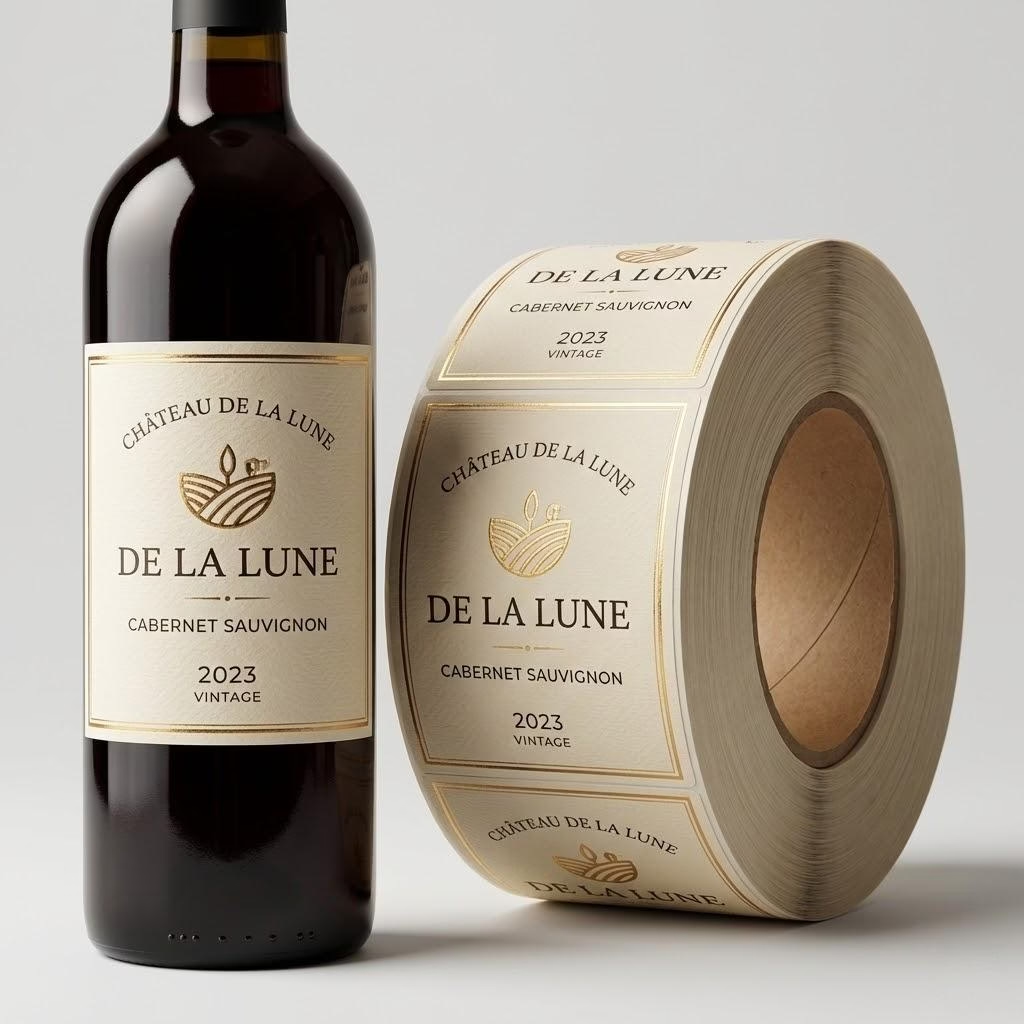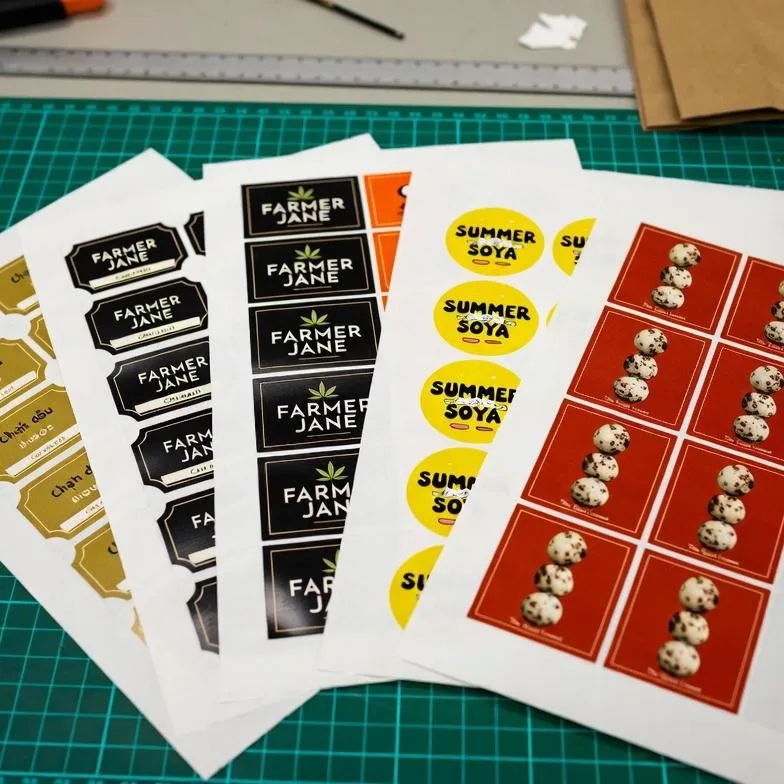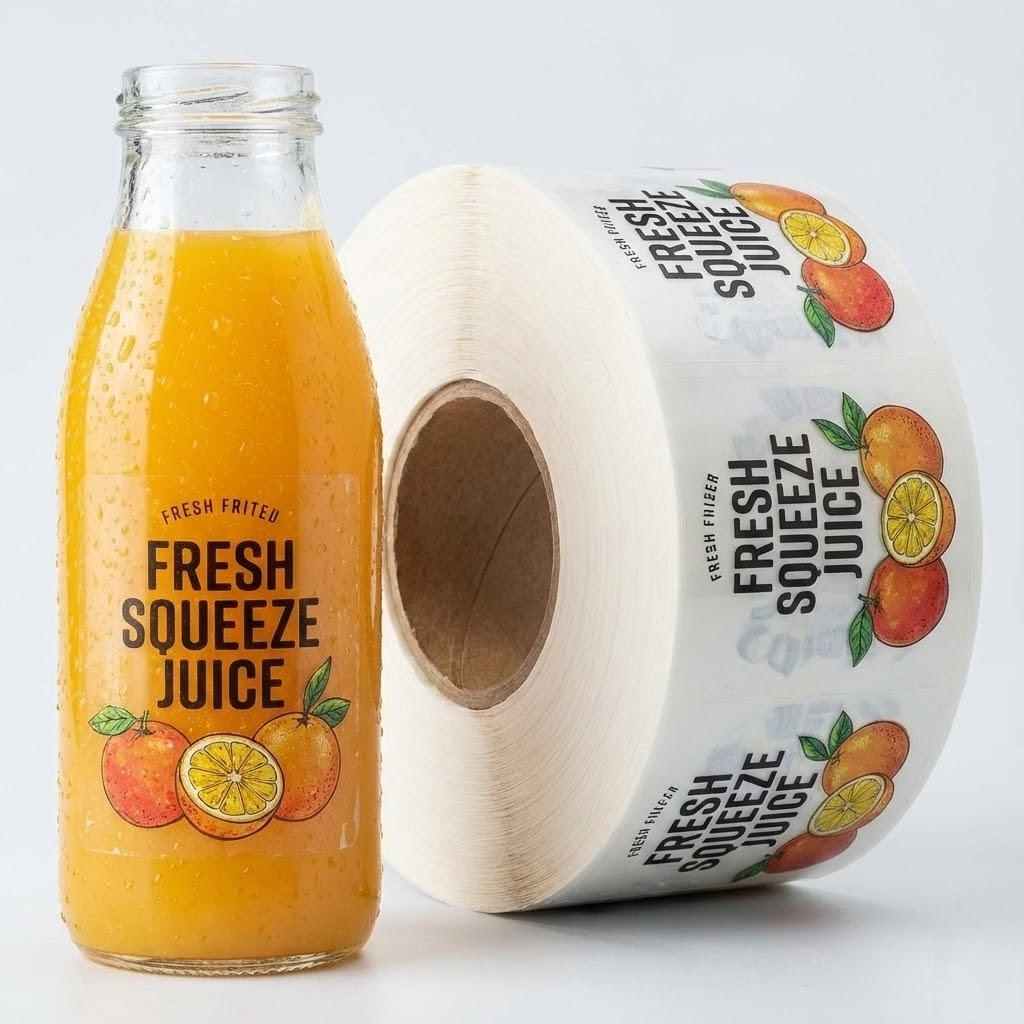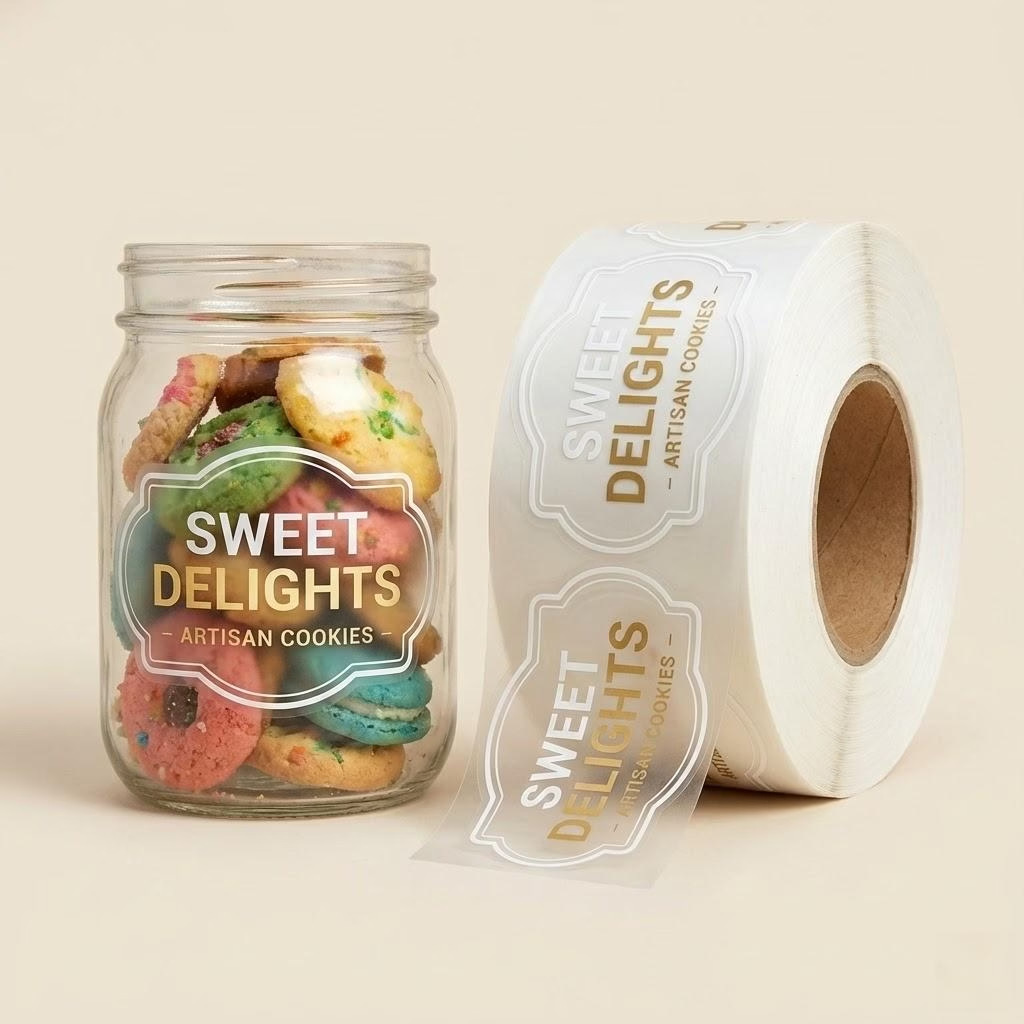
A “factory price” for custom roll labels rarely matches what finance books after duties, brokerage, and last-mile delivery. When Incoterm language is vague, you discover the gap on the first customs invoice—after you already committed to a production slot.
Treat DDP as an all-in door delivered quote only when every line—freight, duty buffer, clearance, and inland delivery—is written on the same sheet you approve, then verify that number with a worked import-cost build for your label SKU before you PO.
Below you will get an Incoterm routing table, a 5,000-roll U.S. worked example, a DDP include checklist, one Pass If / Fail If quote audit, and a short FAQ—then a clear next step to request a no-hidden-fee DDP number.
What “True Import Cost” Means for Label Buyers
True import cost is the cash you pay until rolls sit on your dock ready for labeling—not the unit price on an EXW or FOB email.
What this means: lock DDP, DAP, or FOB on the same sheet as your door ZIP before you compare any factory unit price.
For labels, that stack includes print and finishing, export pack, international freight and insurance, import duty and related fees, customs brokerage, and inland delivery to the named place.
Generic freight calculators stop at cargo value and HS code. They rarely model winding, cores, pallet height, or how a paper versus film face stock changes duty exposure—so you still need a label-specific build.
Machine-ready label orders add a second cost layer most Incoterm guides ignore: wrong unwind, wrong core inner diameter, or crushed roll edges can force a remake that dwarfs the duty line you negotiated so carefully.
That is why true import cost for labels is both a logistics number and a production-compatibility number. A DDP door fee that delivers unusable rolls is still an expensive failure for your line.
If you need the material and HTS deep dive (paper 4821 versus plastic 3919, MPF floors, Section 301 stacking), use our companion guide on label landed costs as the classification playbook. This article stays on DDP routing and quote trust.
Keep both tabs open when you RFQ: classification accuracy from the companion guide, and Incoterm credibility from the tables below. Skipping either side recreates the same invoice shock under a different name.
DDP vs DAP vs FOB for Custom Label Imports
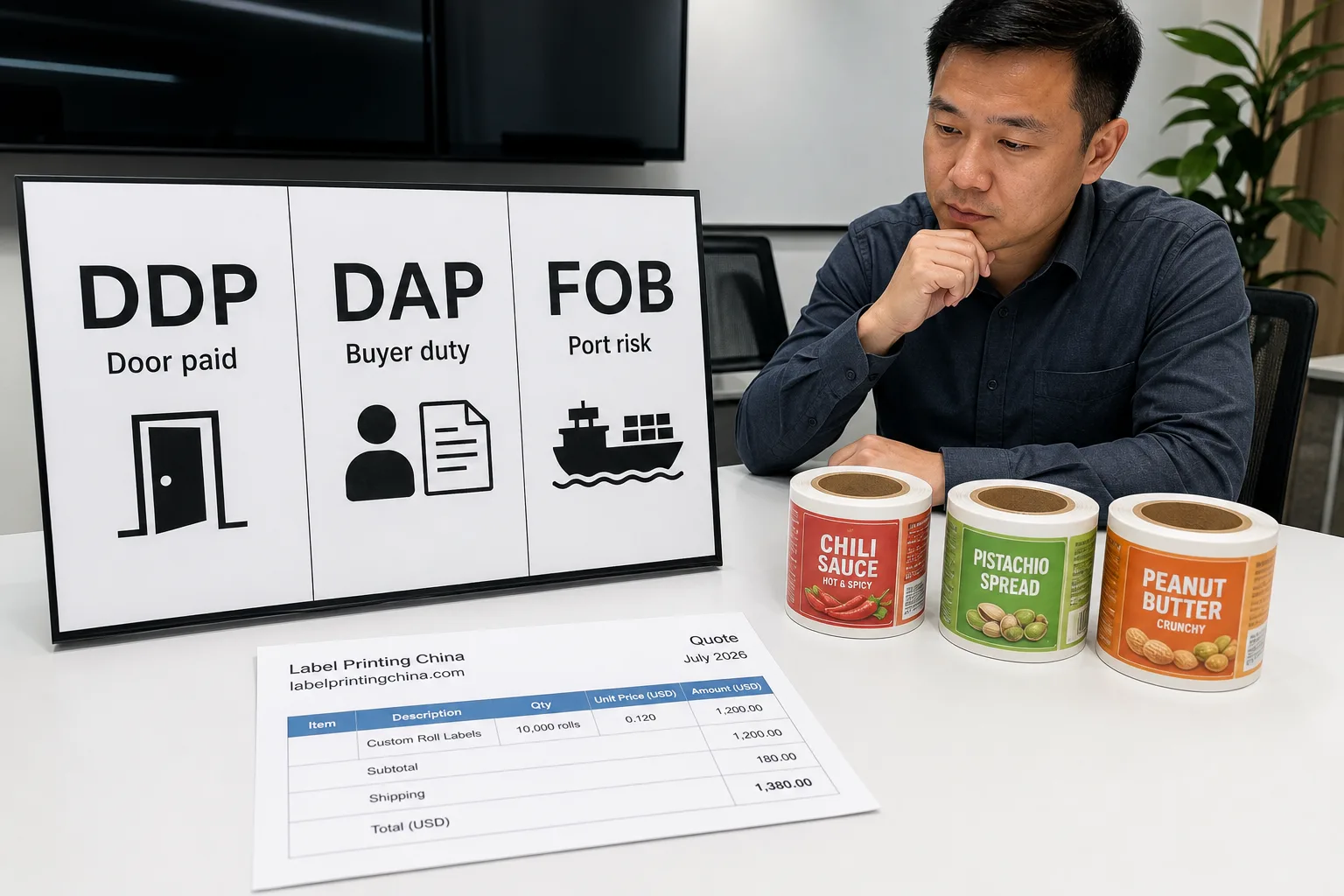
Incoterms define who pays for freight, clearance, and duties—and where risk transfers. The U.S. International Trade Administration summarizes buyer and seller duties under each term in its Know Your Incoterms overview.
For label procurement, the useful question is not “which term sounds premium,” but which term matches your customs capability this quarter.
| Decision question | DDP (Delivered Duty Paid) | DAP (Delivered at Place) | FOB (port named) |
|---|---|---|---|
| Who pays import duty & tax? | Seller / factory (prepaid) | Buyer at destination | Buyer (plus main freight after FOB point) |
| Who clears import customs? | Seller arranges (needs workable IOR path) | Buyer / buyer’s broker | Buyer after vessel/aircraft arrival |
| Cash surprise risk for first-time importer | Lowest—if quote is truly all-in | Medium—duty + broker invoices arrive later | Highest—freight, duty, broker, inland all open |
| Best when… | You want one PO number for finance | You already have a U.S. broker and duty budget | You consolidate freight with other SKUs |
| Watch-out for label rolls | Fake “DDP” that excludes MPF/brokerage | Pallet sits while duty disputes drag | Unit price looks cheap; dock cost explodes |
Route first-time U.S. label imports and tight launch calendars to DDP when the factory can document every prepaid fee.
Keep DAP only if your broker already files entries for print packaging and you can fund duty within days of arrival.
Keep FOB for multi-SKU consolidations where your freight forwarder already owns the lane—and you add a deliberate duty buffer instead of hoping the unit price absorbs it.
A procurement lead once accepted an FOB roll-label quote that sat 18% under a DDP offer from the same capacity window. After ocean freight, duty, and broker minimums landed, the “cheap” path cost more than the all-in sheet—and the rolls arrived six days later because clearance sat in queue.
The checkpoint you can reuse: if your team cannot name the broker, duty line, and dock date on day one, do not “save” money with FOB just to beat a DDP headline.
First-time brand owners often underestimate how much administrative time DAP consumes—bond setup, broker onboarding, and answering document holds—while production managers care only that rolls arrive before the co-packer slot.
If that internal gap exists, DDP is usually the cheaper organizational choice even when the door price looks a few points higher on paper.
Repeat importers with a bonded broker and multi-SKU consolidations can keep DAP or FOB, but they should still force vendors to price a DDP alternate so the delta is measured, not imagined.
Worked Example — 5,000 Roll Labels to the U.S.
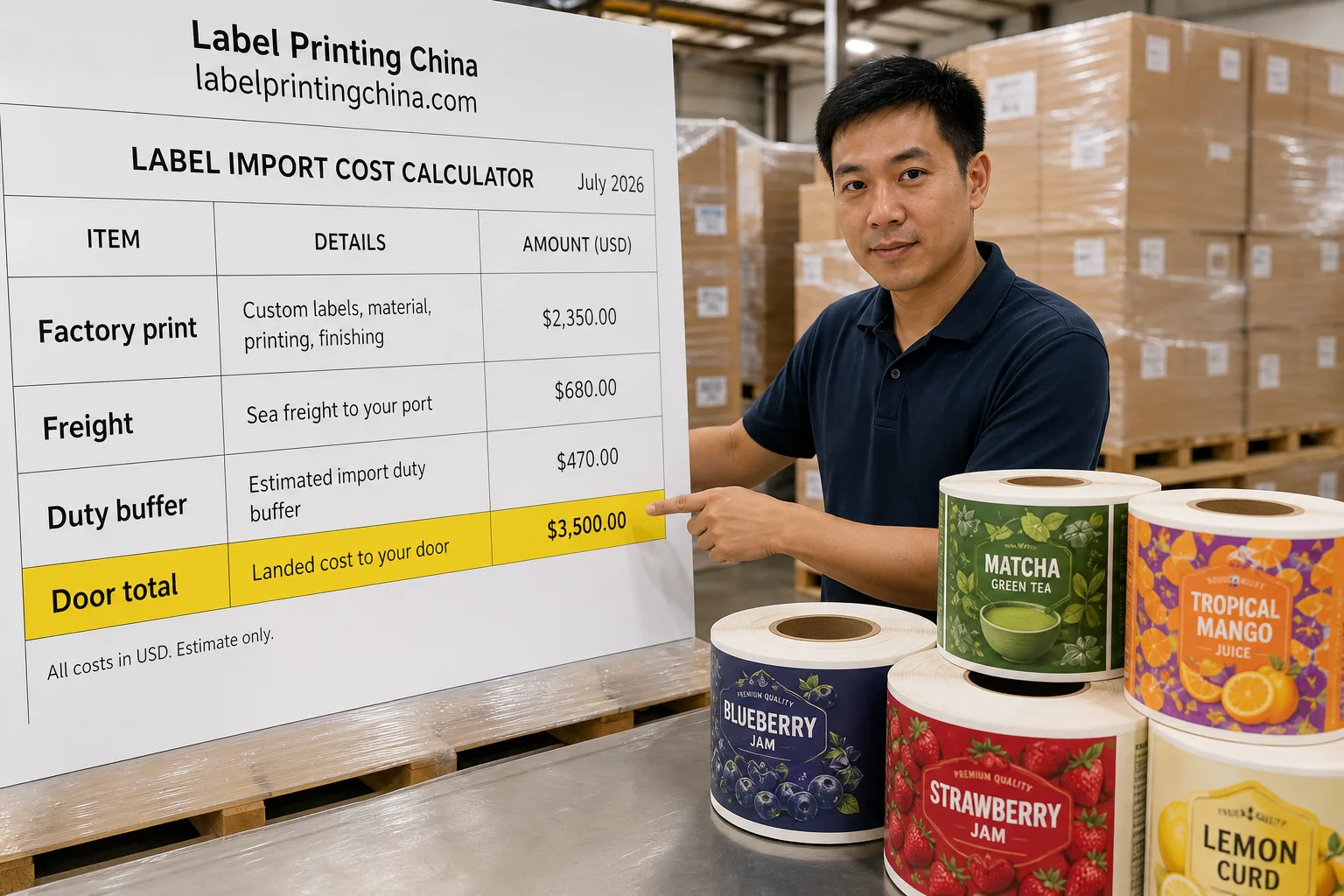
Use this worked sheet as a label import cost calculator pattern. Swap your factory price, lane, and duty rate; keep the line names so finance can audit the same structure on every RFQ.
Assumptions below are illustrative for planning: 5,000 machine-ready rolls (typical food or Cosmo jar labels), paper face stock on a standard core, China origin to a U.S. Midwest warehouse door, ocean LCL or economy air for a time-sensitive lot.
| Cost line | Planning note | Example USD |
|---|---|---|
| Factory print + finish (ex-works style base) | Confirm unwind, core, and scrap allowance in the same PO | 4,800 |
| Export cartons + pallet + moisture barrier | Roll crush risk is a hidden remake cost if omitted | 180 |
| International freight + insurance | Ask mode (air vs ocean) and named place ZIP | 920 |
| Estimated import duty buffer | Rate follows HTS + origin; verify before lock—see landed-cost companion | 690 |
| Clearance / brokerage / MPF-style fees (bundled) | Minimum fee regimes punish small first lots under DAP/FOB | 260 |
| Inland to named warehouse | Must match the DDP named place on the commercial invoice | 210 |
| True import cost (door) | Compare this total—not unit print price alone | 7,060 |
| Implied all-in per 1,000 labels (example) | Use for finance vs domestic quote; recalculate when qty changes | 1,412 |
On a 5,000-roll beverage launch, the buyer locked unit print price first and left Incoterm as “TBD.” Duty and broker minimums later added roughly the same percentage swing as choosing a premium laminate.
They re-ran the worked sheet, switched the RFQ to DDP door delivery, and asked suppliers to quote the same named place—then picked the factory whose DDP total beat the rebuilt FOB path by a clear margin with fewer open lines.
Reuse that sequence: build the sheet with your numbers, force every vendor onto the same door, and only then rank unit print price inside roll label pricing tiers.
Sensitivity tip: double the freight line and re-run the total before you celebrate a razor-thin DDP win. Peak-season air surcharges can flip a “cheap door” decision back toward domestic capacity for short windows.
Second tip: if your qty is far below 5,000 rolls, raise the clearance/brokerage planning figure toward the fixed-fee floor instead of scaling it linearly—small lots bear disproportionate admin weight under DAP and FOB.
Third tip: when two DDP quotes differ by less than five percent, stop optimizing cents and score machine-ready risk, color control, and remake SLA—those lines dominate life-cycle cost after the first reprint.
Get a DDP Quote — No Hidden Fees
Send size, material, unwind, qty, and U.S. door ZIP. We return one all-in number covering print, export pack, freight, duty handling, and delivery—so finance can approve against your true import cost sheet.
RFQ Inputs That Make DDP Quotes Comparable
Suppliers cannot invent a trustworthy door price from “approx 5K labels, somewhere in the Midwest.” Incomplete RFQs create fake DDP spreads that vanish after clarification rounds.
Send the same packet to every factory so Incoterm comparisons stay honest:
- Die size, shape, and final quantity with scrap policy preference
- Face stock, adhesive, liner, and any varnish or laminate callouts
- Unwind direction diagram and core ID for your applicator
- Artwork revision ID and color standard (Pantone refs or drawdown)
- Pack mode preference (air vs ocean) and launch date that must be met
- Exact door address or 3PL dock instructions for the named place
- Explicit ask: “Quote DDP [city, ZIP] as a single all-in number with inclusions listed”
When one supplier comes back FOB-only, ask them to price the same door as a DDP alternate using your worked sheet line names. A refusal is information—you know they cannot absorb clearance risk for that SKU.
When all suppliers return DDP but with different named places, force a reissue to your ZIP. Comparing Chicago door to Los Angeles terminal is not a DDP decision; it is a geography trap.
Document the RFQ packet in your PO file. If duty rates or freight lanes move before ship date, you can requote from the same baseline without restarting the entire sourcing story.
What a Factory DDP Quote Must Include
A credible DDP line for custom labels is a contract package, not a buzzword on the email footer.
Demand these inclusions in writing before you compare any “all-in” number:
- Print, finishing, and scrap rules for the approved artwork revision
- Export packaging that protects roll edges and cores in transit
- Main carriage to the destination country plus cargo insurance scope
- Import duty and tax prepaid under the stated Incoterm
- Customs clearance / brokerage path and who acts as IOR when required
- Inland delivery to the exact named place (street or bonded warehouse)
- Named exclusions in one list—never buried in a different attachment
U.S. Customs and Border Protection’s importer and exporter tips reinforce why classification, documentation, and fee awareness matter before goods move—the same discipline you apply when a factory claims DDP.
If any bullet is missing, treat the quote as DAP or FOB with a marketing sticker until the supplier rewrites the sheet.
Audit Any All-In DDP Quote Before You PO
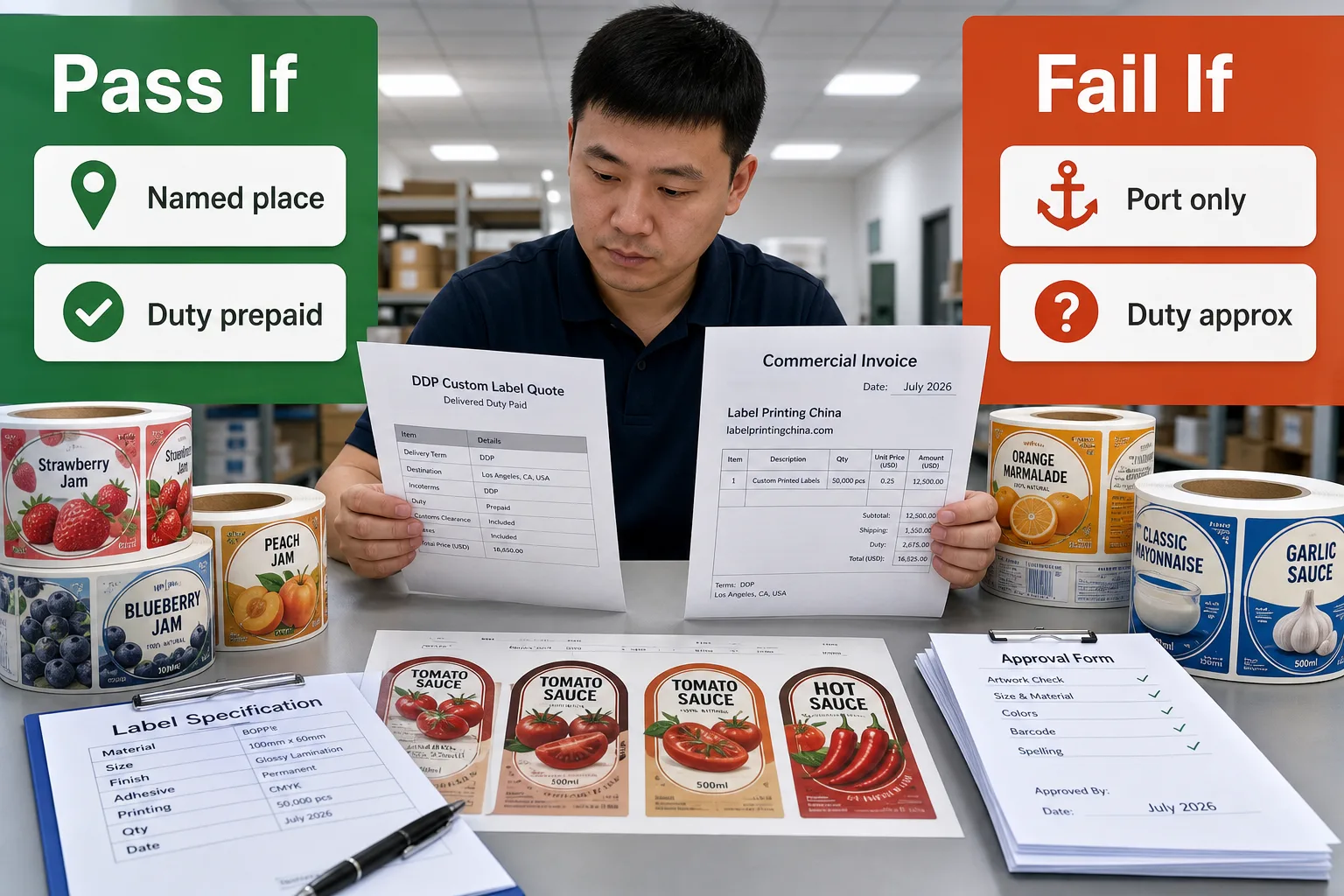
Use this single Pass/Fail audit table as your last gate. One miss in the Fail If column is enough to reopen the Incoterm conversation.
| Check | Pass If | Fail If |
|---|---|---|
| Incoterm string | States “DDP” + city/ZIP named place | Says “DDP-ish,” “door,” or omits place |
| Duty & tax | Explicit prepaid duty/tax line or bundled all-in note | “Duties approx.” or buyer pays any surplus |
| Brokerage / MPF-class fees | Included or itemized with a firm maximum | Silent on clearance; “buyer’s broker” appears later |
| Inland delivery | Matches your dock or 3PL address exactly | Stops at port, airport, or “customer arrange pickup” |
| Material / HTS alignment | Face stock named; duty logic matches paper vs film plan | Material TBD after PO; duty “guess” |
| Remake / damage path | Transit damage and reprint SLA written | “Sales as-is after sailing” |
Red flags that usually mean the DDP price is incomplete:
- Unit price matches a prior FOB email with only the Incoterm word swapped
- Named place is a vague city with no door for roll unloading
- Supplier cannot name who files the U.S. entry
- Duty buffer is “included” but the face stock is still undecided
- Quote expires for freight but stays silent when duty rates move
When a Quote Fail If row trips, ask for a revised DDP sheet—not a verbal “we can cover it.” Finance needs the revision on the same artifact you file with the PO.
Run the audit with procurement and the person who books the co-packer in the same meeting. Disagreements about named place or dock hours surface cheaper before deposit than after container booking.
Archive the Pass If / Fail If snapshot beside the commercial invoice. If a later broker bill appears despite “DDP,” you have a written gap to escalate instead of an email thread that never named brokerage.
Keep the import label sourcing checklist beside that archive so duty, brokerage, and remake lines are priced before the next RFQ.
How Label Printing China Structures One-Price DDP
On custom label printing, we quote DDP as a single door number for production SKUs when you lock size, material, unwind, quantity, and destination.
That number is meant to absorb the lines from the worked example—print, pack, freight, duty handling path, and inland—so you are not juggling three invoices after sailing.
We still require accurate face-stock and construction callouts up front, because duty logic and machine-ready specs travel together; changing from paper to film midstream is a requote, not a free swap under the old DDP total.
Typical planning windows for DDP label projects combine factory production after artwork approval with international transit to your named place. Exact calendars vary by mode, peak season, and inspection holds, so lock the dock date before you book co-packer labor.
If your launch date cannot flex, say so in the RFQ and ask which mode is already baked into the DDP number. Air-inclusive DDP and ocean-inclusive DDP are different products even when the Incoterm word is identical.
We also keep remake and transit-damage language tied to the same PO. A door price without a repair path leaves you funding emergency domestic reprints while disputing freight claims—another form of hidden import cost.
If your project needs HTS coaching before you choose film, start with the landed-cost companion, then return here for the Incoterm and audit gates before RFQ.
When you are ready, route the RFQ through the custom roll labels page with door ZIP, construction, and the Pass If checklist completed. That packet is what lets us return a no-hidden-fee DDP figure finance can approve without a second round of duty surprises.
FAQ — DDP Label Shipping and Import Cost
What does a DDP quote for custom labels usually include?
A real DDP quote should cover print and finishing, export packing, international freight and insurance within scope, prepaid import duty and tax, clearance support, and inland delivery to the named place.If inland or brokerage is excluded, the sheet is not door DDP for budgeting. Ask suppliers to map each include to a line on your true import cost sheet so nothing hides inside a vague “all-in” phrase.
When should I choose DAP instead of DDP?
Choose DAP when you already have a U.S. customs broker, a funded duty budget, and you want to hold classification decisions yourself.Keep DDP when launch timing and cash predictability matter more than owning the entry paperwork. Many teams still price a DDP alternate even when they plan to buy DAP, because the delta reveals how much clearance risk they are volunteering to carry.
How do I estimate duty before I pick paper or film?
Face stock drives HTS paths and stacked rates; treat duty as unknown until material is named. Use the companion landed-cost guide for classification tables, then drop the estimated duty buffer into the 5,000-roll worked sheet here.If marketing has not locked film versus paper, freeze a temporary material assumption in writing so every supplier quotes the same duty logic.
Can I compare a domestic quote to a China DDP number fairly?
Yes—only after both sides mean “label rolls at my door.” Convert domestic freight-included quotes and China DDP totals to the same per-1,000 or per-SKU view, and keep scrap and remake risk on the same scorecard.Add calendar risk too: a lower door price that misses your co-packer window can force overtime or idle labor that erases the saving.
Before you approve the next label PO, rebuild the true import cost sheet with your qty and door ZIP, force every supplier onto DDP or document why not, and run the Pass If / Fail If audit once.When you are ready for a single number, request a DDP quote on custom roll labels with no hidden fees and compare it against that sheet—not against a factory unit price alone.