Are your custom roll labels causing expensive applicator downtime? This advanced label sourcing checklist gives you the exact engineering metrics needed to audit suppliers and eliminate hidden procurement waste. Stop guessing and start building a resilient supply chain today.
A professional label sourcing checklist evaluates a supplier’s industrial precision, cost transparency, and delivery security. Key metrics include verifying die-cutting depth tolerances (±0.02mm), MD/CD liner tensile strength, adhesive thermal stability, and automated vision inspection rates.
But knowing what to ask is only half the battle. Read on to discover the exact dynamic tension thresholds and DDP logistics protocols that separate world-class manufacturers from the rest.
The Physics Behind “Machine-Ready” Labels

Traditional vendor assessments frequently begin with a misguided focus: evaluating static ink fidelity or asking what materials a facility can print, rather than executing an advanced label procurement framework.
When securing custom roll labels for automated environments, visual perfection is irrelevant if the physical parameters fail under stress.
Evaluating a label manufacturer requires abandoning static visual approvals and implementing a dynamic tension and physical compatibility audit. Consider a common, yet fatal, trap in large-scale procurement where a purchasing manager signs off on a visually flawless, hand-applied sample and proceeds with a bulk order.
Once the large-scale label rolls are loaded onto a high-speed applicator, the production line experiences catastrophic web breaks. The standard supplier excuse often points to “incorrect machine tension settings,” but the engineering reality is entirely different. To secure a competitively low bid, substandard factories will silently introduce failures into the production chain:
- Material Downgrading: They silently downgrade a standard 60g glassine liner to a weaker 50g substitute.
- Machinery Limitations: They rely on outdated machinery yielding a die-cutting tolerance exceeding ±0.05mm.
- Inevitable Failure: Combined with weak liners, the die blade inevitably scores the silicone release layer.
Under high-speed mechanical pulling, the liner snaps precisely at these microscopic stress points. Based on industrial precision standards, ensuring 100% machine-ready rolls requires precise die-cutting tolerance control and adhesive stability testing.
A rigorous physical risk mitigation strategy dictates that cutting depth variance must be strictly capped at ±0.02mm. Achieving this exact specification consistently across millions of units is a process that must be overseen by a Master Printing Engineer with extensive Heidelberg operational expertise, effectively eliminating the root cause of applicator downtime.
To establish a strict technical baseline, mandate engineering data points in your next supplier auditing phase rather than generic material inquiries. Use this matrix to upgrade your RFQ criteria, specifically focusing on critical factors like the 3 inch core and max roll diameter to ensure hardware compatibility.
The Applicator Compatibility Matrix
| Standard Procurement Question | Advanced Engineering Audit | Evaluated Risk Factor |
|---|---|---|
| “What liners do you offer?” | Specify your standard die-cutting depth tolerance. | Must be verified at ±0.02mm to prevent liner scoring and breakage. |
| “Is the paper strong?” | Provide MD and CD tensile strength data. | Ensures the liner withstands mechanical pulling without snapping. |
| “Will the labels stick?” | Detail the release force parameters (e.g., 15g – 35g). | Prevents dispensing failures or premature “fly-offs” on rollers. |
| “What core sizes are available?” | Request structural integrity data for the inner core. | Prevents core crushing which makes mounting on spindles impossible. |
Quick Guide: If your priority is zero-downtime automation, choose a vendor that guarantees ±0.02mm tolerances; if you use manual application, focus on adhesive initial tack.
- Demand Dynamic Tension SLAs: Never accept static visual approvals as final and require dynamic tension and die-cutting tolerance commitments in the Purchase Order.
- Establish Rejection Baselines: Make MD/CD tensile strength data a non-negotiable pass/fail metric for inbound quality control.
- Verify Equipment Age: Precision tolerances of ±0.02mm are impossible on legacy flatbed die-cutters, so verify the use of modern rotary systems.
Engineering a 30% Structural Cost Reduction
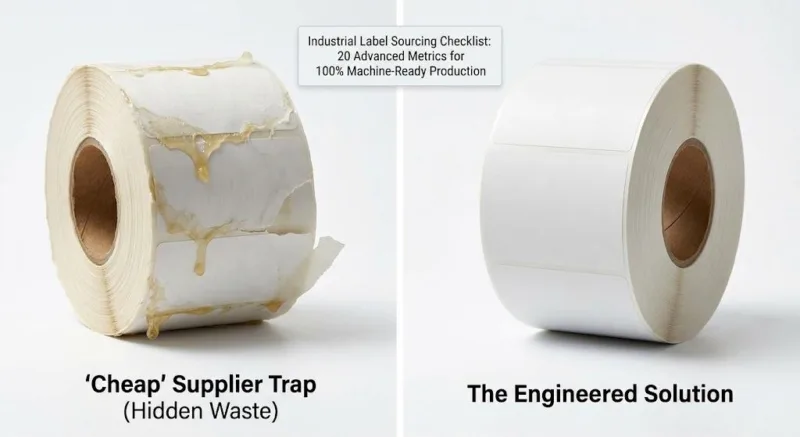
The most dangerous trap in B2B procurement is equating a low unit price with actual cost reduction. Under intense pressure to meet annual savings targets, buyers often accept bids that look favorable on paper, unaware of the hidden waste embedded in the manufacturing process.
To win these low-margin contracts, substandard facilities frequently resort to invisible compromises. These cost-cutting traps typically include:
- Adhesive Dilution: Reducing the adhesive coating weight to artificially lower the raw material price.
- Substandard Liners: Utilizing cheap liners with wide thickness variances that disrupt applicator sensors.
- Imposition Waste: Relying on outdated machinery with poor imposition efficiency, creating excessive edge waste.
This illusion of savings quickly evaporates when concealed costs erupt on the factory floor, manifesting as excessive edge waste or the necessity of expensive, manual secondary inspections due to inconsistent quality.
As Dr. W. Edwards Deming famously warned, “End the practice of awarding business on the basis of price tag. Instead, minimize total cost.”
Achieving a legitimate, structural 30% cost reduction requires moving past aggressive price negotiations and auditing the engineering architecture of the label manufacturer. Cost transparency is rooted in measurable, physical efficiencies, not arbitrary discounts.
A prime example of this engineering-based approach is material downgauging. Rather than simply haggling over the price of standard materials, a sophisticated supplier audit should evaluate structural alternatives.
By replacing a conventional 80g glassine liner with a high-tensile, ultra-thin PET liner, the overall weight and dimensional volume of the finished rolls drop significantly. This engineered adjustment yields immediate, measurable reductions in cross-border logistics costs without compromising physical durability on the applicator line, a strategy you can explore further to calculate label landed costs effectively.
Furthermore, assessing a vendor’s quality control infrastructure must be quantified—manual spot-checking is entirely insufficient for high-volume custom roll labels.
Waste vs. Engineered Efficiency
| Focus Area | The “Cheap” Supplier Trap | The Engineered Solution |
|---|---|---|
| Material Selection | Uses thick, cheap glassine to mask poor die-cutting. | Downgauging reduces volumetric weight by 15-20%. |
| Defect Management | Relies on manual spot-checks. | 100% inline AVT scanning Purges defects at 0.01% rate. |
| Tooling & Layout | Standard layout creates 10-12% edge waste. | Optimization software reduces edge waste to under 3%. |
| TCO Outcome | Saves $0.005 on price, loses $3,000/hr in downtime. | Maintains 400 BPM speeds for maximum OEE. |
Quick Guide: If your priority is long-term ROI, invest in automated inspection and optimized imposition; avoid vendors who only compete on raw material unit price.
Ready to Achieve 100% Machine-Ready Production?
Stop gambling with your production uptime. Our technical audit ensures your labels are engineered for high-speed applicators while slashing hidden waste.
- Audit the Inspection Hardware: Require proof of inline Vision Inspection Systems as structural cost control is impossible if the supplier relies solely on human eyes.
- Calculate TCO in the RFP: Force suppliers to fill out a TCO calculator that includes estimated waste percentages, exposing the true cost of inefficient factories.
- Challenge Material Defaults: Actively ask vendors to propose downgauging strategies to reduce shipping weight while maintaining physical performance.
Mitigating DDP Logistics Risks and Moisture Shock
Standard procurement guidelines frequently prioritize “lead time” while entirely ignoring the brutal physics of cross-border transit. Securing custom labels from overseas introduces a massive environmental variable that static supplier audits miss.
During a typical 30-to-40-day transpacific ocean freight journey, the internal temperature of a shipping container can easily spike to 60°C, with humidity levels surging past 90%. This extreme fluctuation introduces a critical vulnerability known as “Moisture Shock.”
Consider a scenario where a Texas-based industrial equipment manufacturer negotiated a 15% reduction in their initial purchase order for weather-resistant labels. The supplier met the commercial terms and the designated shipping date, yet upon arrival, the entire batch was scrapped. This extreme container heat triggers a chain reaction of failures:
- Thermal Instability: Severe adhesive bleeding occurs due to the supplier’s use of a cheap adhesive with a narrow thermal stability range.
- Material Fusing: The labels literally melt and fuse together into solid blocks inside the packaging.
- Applicator Fouling: The compromised rolls immediately foul the applicator sensors upon reaching the production line.
This single environmental failure transformed a theoretical 15% saving into a 100% material loss, compounding the hidden costs of immediate domestic repurchasing. It is precisely why brands must know how to proceed when an imported label batch fails inspection.
As Knut Alicke, Partner at McKinsey & Company specializing in supply chain management, notes: “Transparency is the prerequisite for resilience. Is your supply chain risk blind—or risk resilient? Supply-chain leaders need to look beyond the top tier of their supply networks to identify and mitigate hidden vulnerabilities before they disrupt production.”
Evaluating a supplier’s global reach requires looking beyond factory walls. Translating logistics into true production security relies on macroscopic supply chain management—typically directed by strategic roles like a Director—coupled with the flawless execution of DDP logistics managed by a Senior Project Manager.
The delivery protocol must evolve from a simple commercial shipping term into a chemical and physical defense agreement. To build a zero-friction DDP delivery protocol, mandate the following environmental compliance metrics before signing the final contract:
- Thermal Rheology Validation: Demand test data proving the adhesive’s stability inside an 80°C thermal chamber to ensure labels do not fail before reaching your facility.
- Moisture-Barrier Packaging Standards: Require explicit packaging architecture, including vacuum-sealed aluminum foil bags and industrial desiccants, as standard cardboard boxes fail at sea.
- Edge Crush Test (ECT) Compliance: Mandate high-strength corrugated boxes that pass ECT requirements to prevent pallet collapse during rough ocean swells.
- Customs and Compliance Pre-Checks: Verify that the project management team executes thorough HTS code audits prior to departure to prevent port detentions.
- DDP SLA Enforcement: Define clear financial penalties for adhesive bleeding or core crushing, shifting the liability of transit physical security back to the manufacturer.
The 2026 Supplier Audit Implementation Guide

Eliminating supply chain friction and securing structural cost control requires arming the procurement department with undeniable engineering metrics. The variables discussed above should immediately be integrated into your next Request for Quote (RFQ) documentation. These explicitly include:
- Dynamic die-cutting tolerances to prevent high-speed web breaks.
- Material downgauging methodologies to reduce shipping weight safely.
- Vision inspection rates to guarantee zero-defect deliveries.
- Moisture-shock defense protocols to protect adhesive integrity during transit.
By forcing potential vendors to answer complex physical and mechanical questions rather than just commercial ones, an impenetrable screening barrier is established. Suppliers lacking the necessary technical infrastructure will quickly self-select out of the bidding process when asked to provide precise MD/CD tensile strength data.
Mitigating international procurement risks fundamentally requires partners backed by at least 18 years of technical expertise. When an audit shifts from surface-level pricing to verifying 100% machine-ready physical parameters, the true capabilities of a manufacturing facility are exposed.
Adopting machine-ready label manufacturing standards ensures that every roll of labels acts as a precise, predictable component ready for high-speed assembly. Relying on verified engineering standards delivers absolute certainty to the production line, permanently eliminating the anxiety of hidden costs and supply chain instability.