Struggling with FDA and GHS label compliance? You are not alone.
In this guide, I will show you exactly how to engineer audit-proof labels that sail through regulatory reviews and completely eliminate expensive machine downtime.
Audit-proof labels are industrial-grade packaging components engineered to meet strict FDA and GHS regulatory standards while ensuring 100% machine-readiness. Achieving this requires precise pre-press color auditing (ΔE < 2.0), low surface energy adhesives, and strict die-cut tolerances.
But passing a PDF legal review is only step one.
Read on to discover the exact material science and “Machine-Ready” engineering secrets that will prevent your labels from snapping on the production line—while saving you up to 30% on procurement costs.
Eliminating FDA Recall Risks at the Factory Level

When you submit your packaging artwork, the most dangerous assumption a procurement manager can make is that an overseas manufacturer will simply press “print.”
A genuinely audit-proof operation requires a systematic pre-press inspection that intercepts compliance failures before a single die is cut.
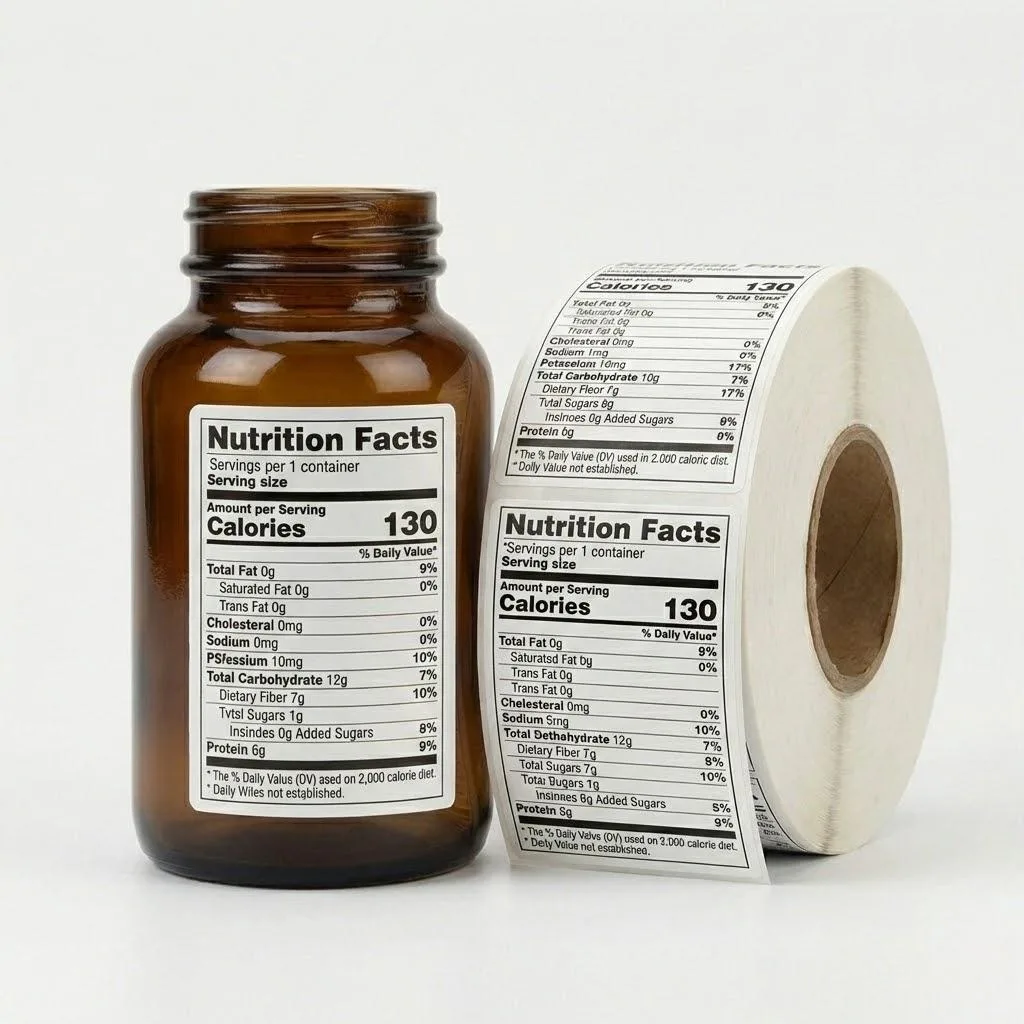
Consider the FDA 21 CFR Part 101 mandates, which dictate minimum nutritional panel font sizes based strictly on your container’s total surface area.
A common, yet catastrophic, trap for FDA beverage label compliance for US buyers sourcing overseas lies in the metric conversion process.
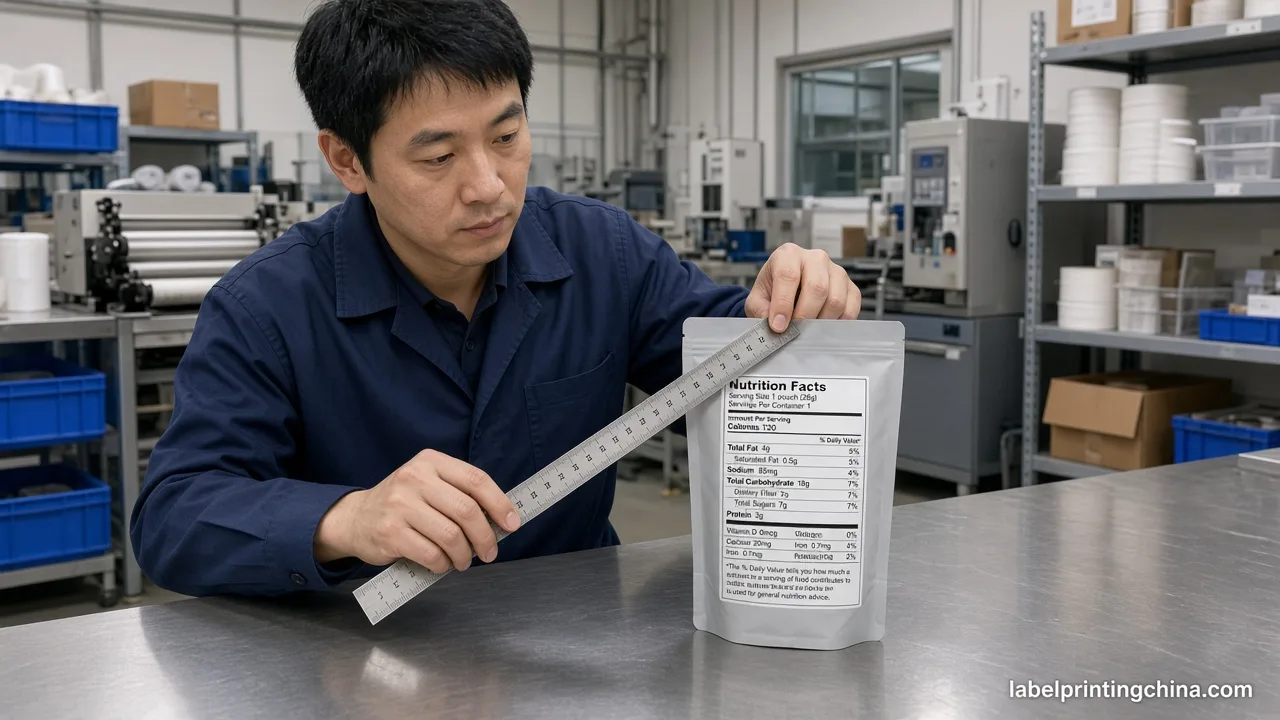
If your industrial packaging requires a 1/16-inch minimum font height, standard metric conversion calculates this to 1.58mm. Far too often, procurement teams face severe US Customs delays because a low-bid vendor arbitrarily rounded down to 1.5mm to fit a crowded design.
To combat this hidden liability, our Master Printing Engineer must enforce a strict, positive-only tolerance protocol during the pre-press phase.
Forcing that font up to a minimum of 1.7mm might sound microscopic, but during a regulatory review, that fractional difference is the absolute barrier between a cleared shipment and a federal hold.
“The food label is the most read piece of literature in the world.” — Dr. David Kessler, Former Commissioner of the US Food and Drug Administration (FDA)
This same mathematical rigor must apply to your GHS certified packaging labels, where red diamond borders are not suggestions but visual safety triggers.
These pictograms are governed by the OSHA Hazard Communication Standard. You cannot rely on a press operator’s naked eye to match hazard warning colors across a run of a million stickers.
To guarantee compliance, you must demand quantitative color data from your supplier, locking the color variance for all warning pictograms at a ΔE < 2.0 using automated spectrophotometers.
- Zero-Negative Tolerance Protocols: Strict adherence to +0.1mm / -0mm scaling on all FDA-mandated typography.
- Automated Color Auditing: Spectrophotometer reports verifying ΔE < 2.0 across diverse production batches.
- Barcode Readability Pre-Testing: ANSI/ISO grade verification to ensure supply chain scannability is never compromised.
The Material Science of Extreme Compliance
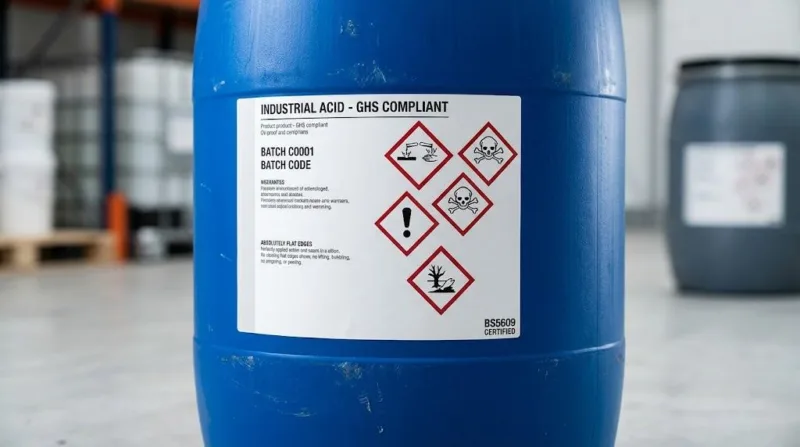
The most catastrophic compliance failures rarely happen on a printing press; they happen in warehouses and on shipping vessels weeks after delivery.
Many procurement teams fall into the trap of treating FDA and GHS compliance as a simple “waterproof” requirement while ignoring the science of adhesion between the substrate and the container.
A US-based co-packer sourced millions of GHS warning labels for a new line of industrial acid. The labels passed the PDF legal review and successfully repelled water during initial tests.
Three weeks after being applied to High-Density Polyethylene (HDPE) drums and stored in a hot Houston facility, severe edge lifting occurred across the entire inventory. The overseas vendor had used standard acrylic adhesives, fundamentally misunderstanding the physics of Low Surface Energy (LSE) plastics.
HDPE has a surface energy below 36 dynes/cm, meaning standard adhesives simply slide off over time. The entire batch faced an immediate FDA recall threat. Solving this requires material engineering, not stronger tape.
Replacing standard acrylics with modified rubber-based adhesives featuring an initial tack exceeding 15 N/25mm immediately neutralizes the LSE threat.
To build an impenetrable regulatory moat, your purchasing decisions must be governed by material engineering data.
If your product is shipped internationally by sea, your label must withstand the BS5609 Section 3 marine immersion standard—meaning the adhesive remains fully bonded and the ink legible after 90 days submerged in saltwater.
Furthermore, the base material and UV-proof over-laminate must guarantee structural integrity across a temperature delta of -20°C to 149°C.
For outdoor-rated builds beyond GHS drums, the UV-proof outdoor label engineering guide benchmarks five-year weatherability standards worth copying.
“Exposure to hazardous chemicals is one of the most serious threats facing American workers today… Revising OSHA’s Hazard Communication standard will improve the quality and consistency of hazard information.” — Dr. David Michaels, Former Assistant Secretary of Labor for OSHA
Eradicating Applicator Downtime
A label that is legally compliant but physically jams your automated packaging line is a defective industrial part.
For senior sourcing managers, the ultimate operational nightmare is applicator downtime. When a high-speed labeler halts because of a web snap, the hourly financial bleed eclipses whatever was saved on the unit price.
Achieving a zero-downtime manufacturing environment requires strict adherence to automated machine parameters.
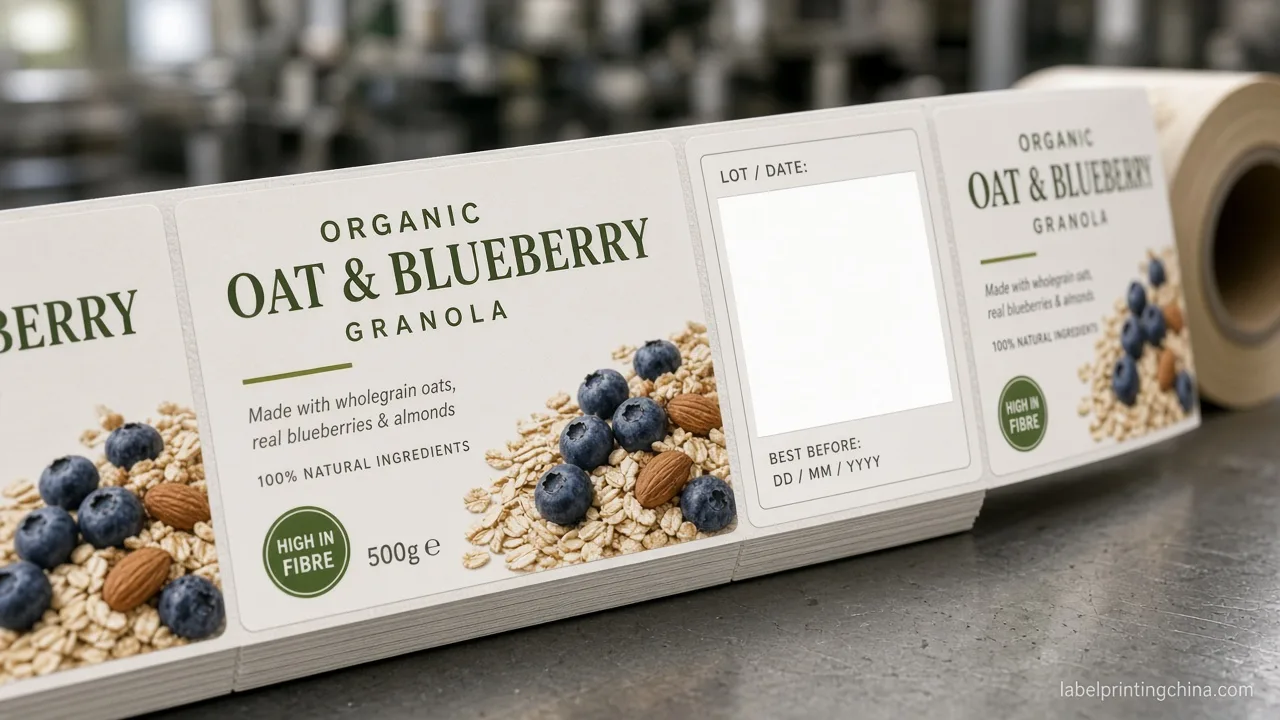
If the physical architecture of the label roll is incompatible with the applicator, the production line stops. The die-cut tolerance is particularly lethal. If the die-strike penetrates even a fraction of a micron too deep into the glassine liner, the tensile strength of the roll is compromised.
True audit-proof manufacturing means engineering the label to survive both the federal regulatory inspector and the physical violence of the applicator machine.
Visualizing the Cost of Poor Tolerances: Standard vs. Machine-Ready
| Packaging Parameter | Standard Commercial Print | Machine-Ready Standard | Operational Impact |
|---|---|---|---|
| Core Size | Approximate 3-inch | Precision-milled 76.2mm | Prevents RPM tension loss |
| Unwind Direction | Random/Unverified | Aligned Positions 1-8 | Ensures perfect PDP strike |
| Die-Cut Tolerance | ±1.0mm to 1.5mm | Rigid ±0.5mm deviation | Reduces web snaps by 98% |
| Release Force | Highly Variable | Calibrated 15-25 g/inch | Stable high-speed dispensing |
TL;DR: If your priority is absolute line efficiency, choose the Machine-Ready Standard; if you face constant production delays, invest in precision ±0.5mm die-cutting.
CASE STUDY: Engineering Compliance for High-Stakes Industrial Applications
Learn how our technical team resolves complex adhesion failures for hazardous chemical brands using specialized LSE adhesive technology.
The Zero-Risk Supply Chain Transition SOP

Even if you engineer the perfect label, trans-Pacific logistics introduces a profound, yet rarely discussed, variable: moisture shock.
Transitioning to an overseas supplier often triggers anxiety within the C-suite because of the “black box” nature of international delivery across humid climates.
If a paper-based label absorbs oceanic humidity, the liner expands. Upon arrival, the label exhibits “curling” or “wavy edges,” rendering the rolls useless for high-speed application.
To eliminate this friction and deliver on the promise of a 30% cost reduction, a robust Vendor Transition SOP must be executed.
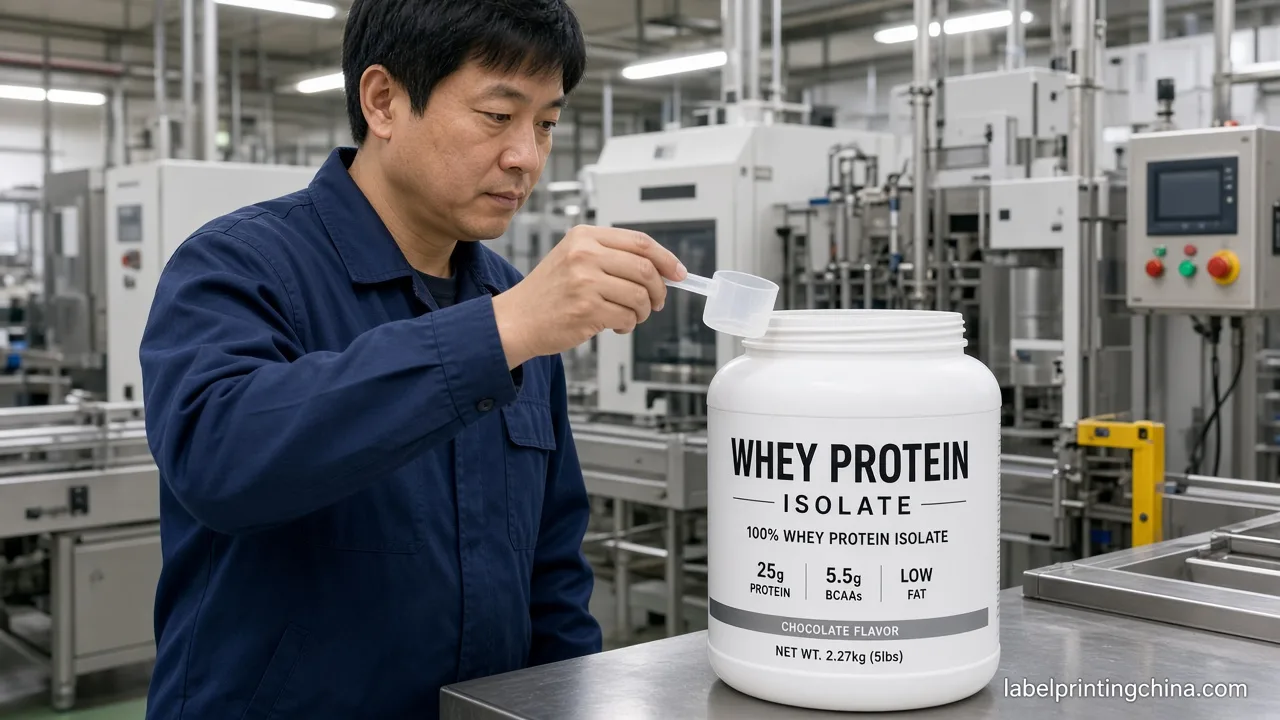
Based on 18 years of China manufacturing experience, we implement a mandatory “Six-Side Defense Protocol” for all trans-Pacific shipments. Before any roll leaves the factory floor, the labels undergo a moisture equilibrium process, driving the water content below 12%. They are then hermetically sealed in heavy-duty aluminum foil vacuums, packed with industrial desiccants. This protocol ensures the labels arrive in Chicago or Dallas in the exact pristine condition they left the press.
The 30% cost optimization achieved through overseas sourcing should never be derived from downgrading materials, but through layout efficiency, consolidated logistics, and precise urgent label order management during peak commercial windows.
Transitioning your vendor should not feel like gambling with your supply chain. It should be a calculated, engineered upgrade.
Final Executive Action
Securing audit-proof labels for the US market is a rigorous exercise that aligns legal compliance with molecular material science and machine tolerances.
You cannot afford to let a millimeter of die-cut error or a humid shipping container trigger a federal recall or halt your packaging line.
When your brand’s reputation and ROI are on the line, relying on superficial “waterproof” claims is a dereliction of duty.
Stop guessing on compliance. Align your procurement strategy with the industrial precision standard.
Submit your current artwork today for a complimentary Pre-Press Tolerance Audit, and secure the 100% machine-ready reliability your production line demands.