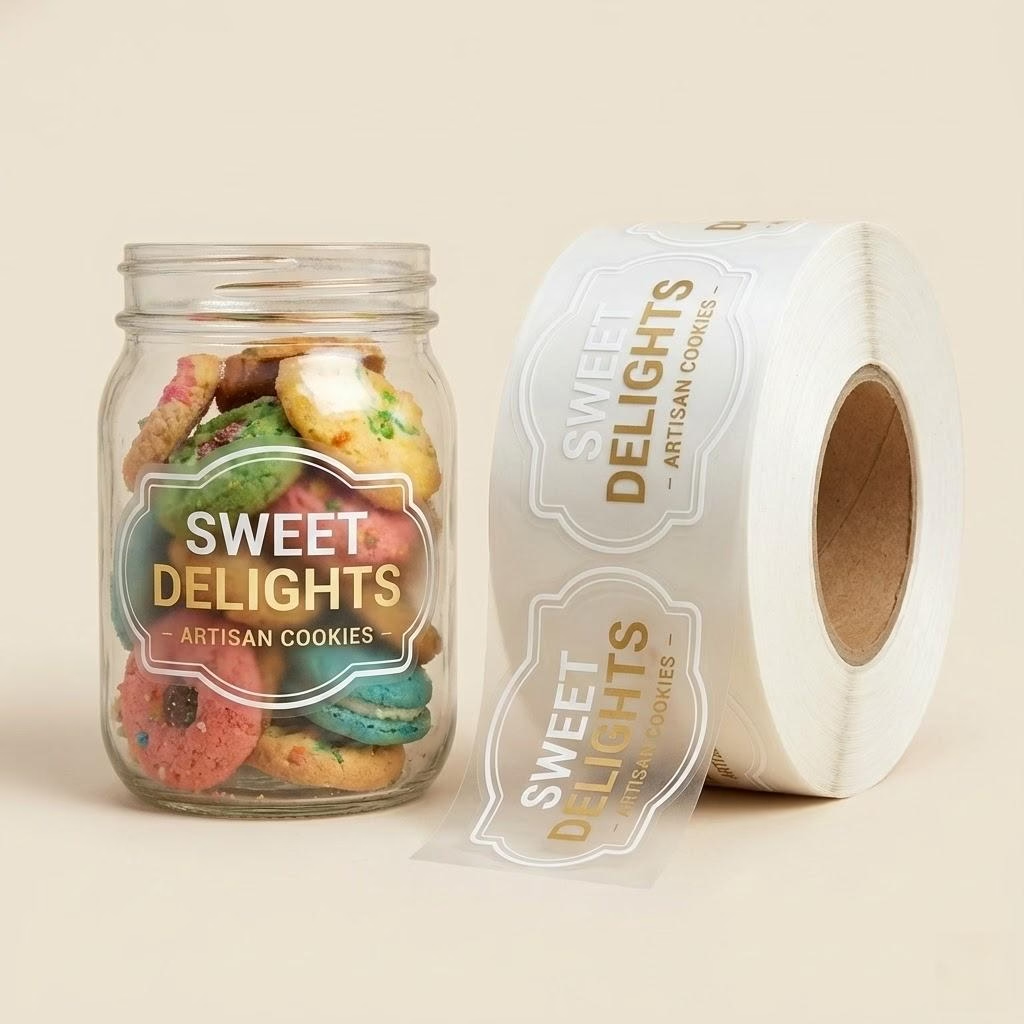
Are your clear labels creating a milky “frosting” effect during automated application, even after you approved perfectly clear hand-applied samples? This analysis provides the engineering truth behind this failure, focusing on the one specification that protects your brand aesthetic and production uptime.
The “no-label” look fails when a standard paper liner imparts a microscopic texture onto the adhesive, causing cloudiness. A flawless finish requires a super-smooth 1.2 mil PET (Polyester) film liner that ensures perfect adhesive “wet-out” for total clarity on automated lines.
This guide provides a 3-point specification checklist to prevent procurement errors. We will outline the factory-floor realities of high-speed application and explain the ROI of specifying the correct material stack to avoid costly production failures.
Why Do Most Clear Labels Fail to Look Invisible?
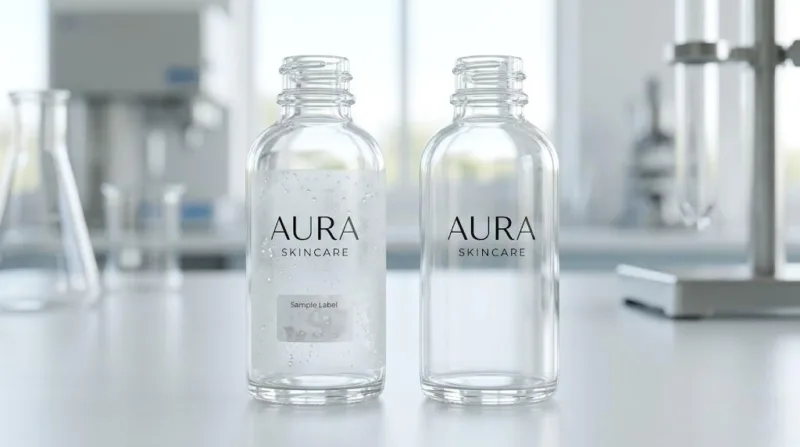
You’re aiming for that premium, “no-label” look where the design seems printed directly on the container. Yet, so often, the final product on the production line ends up with a subtle, milky “frosting” or cloudiness that cheapens the entire brand aesthetic. This happens even when the hand-applied samples you approved looked perfectly clear.
The issue isn’t a simple material choice; it’s a failure in manufacturing specifications that only becomes visible under the pressure and speed of automated application. The most common and overlooked culprit is the label’s backing paper, or liner.
The Invisible Killer: The Liner’s Texture
A low-cost quote for clear labels almost always uses a standard glassine (paper) liner. While it seems fine, this material has a microscopic fibrous texture that transfers onto the adhesive.
- The “Frosting” Effect: This texture prevents the adhesive from achieving perfect “wet-out,” trapping millions of tiny air pockets on the container surface. This is the cloudiness you see.
- The Production Failure: Paper liners are also prone to tearing on high-speed lines (150+ units per minute), causing costly stoppages.
The Specification for Flawless Clarity
To guarantee the “no-label” look at scale, your technical specification must solve for both aesthetics and production efficiency. The only way to achieve this is with a specific material stack:
- Ultra-Clear Film: Specify a BOPP or PE film with a haze value of less than 1%. Standard clear films are often 3-5%.
- Optically Clear Adhesive: Use a non-yellowing, pure acrylic adhesive. Emulsion-based glues will always appear cloudy.
- PET Film Liner: This is non-negotiable. A super-smooth 1.2 mil PET (Polyester) liner ensures a flawless adhesive surface for perfect clarity and won’t tear during application.
Deconstructing the ‘Total Clarity’ Material Stack
Achieving a true “no-label” look isn’t about finding a single clear material; it’s about engineering a three-part system where every layer works in perfect concert. A failure in any one of these components will compromise the entire effect, leading to the frosting or bubbling that cheapens a premium product.
Let’s break down the exact manufacturing-grade specifications required. This is the technical checklist that separates a flawless application from a costly production failure.
The Three Critical Layers of an Invisible Label
- The Film (Face Stock): Standard clear films are not clear enough. You must specify an Ultra-Clear BOPP or PE film with a haze value of less than 1%. Anything higher (like the common 3-5%) will be visible on the final product.
- The Adhesive: The adhesive must be an optically clear, non-yellowing acrylic. Standard emulsion adhesives will appear cloudy on glass and prevent the perfect “wet-out” needed for total invisibility.
- The Liner (Backing Paper): This is the most common point of failure. A standard paper (glassine) liner imparts a microscopic “orange peel” texture onto the adhesive. For flawless clarity, you must use a super-smooth 1.2 mil PET (Polyester) film liner, as specified by industry leaders like Avery Dennison for their “Clear-on-Clear” products.
This specific combination—ultra-clear film, optical adhesive, and a PET liner—is the only way to guarantee the adhesive lays down perfectly flat, eliminating the trapped micro-air pockets that cause the dreaded “frosting” effect on automated lines.
Precision Engineering for High-Speed Automation
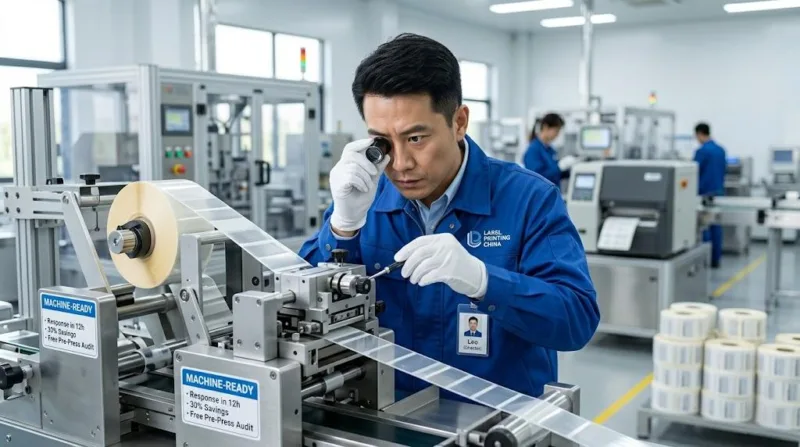
Achieving a flawless “no-label” look is one challenge. Ensuring that look can be replicated perfectly on an automated line running at 150+ units per minute (UPM) is an entirely different engineering problem.
The single most common point of failure we see isn’t the label film or the adhesive—it’s the liner. A standard glassine (paper) liner will tear under the tension of high-speed applicators, causing costly line stoppages and production delays.
The Machine-Ready Specification Checklist
To protect your production uptime, the label specification must be built for mechanical stress, not just aesthetics. Our pre-press audit verifies these critical points for any automated application:
- Liner Material: We specify a super-smooth 1.2 mil PET (Polyester) film liner. It’s virtually un-tearable at high speeds and ensures the adhesive remains flawless, preventing the “frosting” effect common with paper liners.
- Die-Cutting Tolerance: To prevent adhesive ooze that can gum up machinery, we hold a die-cut tolerance of ±0.2mm. This creates a clean, sharp edge that performs reliably.
- Sensor Compatibility: For clear labels, standard optical sensors will fail. We confirm if your machinery requires a printed black mark on the liner’s reverse side to guarantee accurate application every time.
These specifications are not upgrades; they are the baseline for production security. They ensure the label you approved by hand is the same one your machine can apply without failure, protecting both your brand image and your operational efficiency.
The 3-Point Checklist for Production-Ready Clear Labels
Achieving a flawless “no-label” look goes beyond just choosing a clear material. It requires a precise technical specification that balances perfect aesthetics with high-speed production reality. Anything less risks costly downtime and a compromised brand image.
To protect your project, your label specification must get a “Yes” on all three of these critical points. This is the framework we use in our “Machine-Ready” Pre-Press Audit to guarantee success.
Clear Label Specification Comparison
| Feature | Standard Label | Machine-Ready Label |
|---|---|---|
| Face Film Haze | 3-5% Visible | <1% Invisible |
| Adhesive Type | Emulsion Cloudy | Optically Clear Acrylic |
| Liner Material | Paper Tears/Texture | 1.2 mil PET Smooth |
| Unwind Direction | Often Mismatched | Matches Applicator |
| Core Size | Variable Fit | 76mm (3″) Standard |
| Max Roll Diameter | May Jam | Fits Housing |
| Sensor Prep | No Mark/Fails | Black Mark Included |
1. Is the Material Stack Engineered for Total Clarity?
The visual quality of your label is determined by three components working together. A failure in one will compromise the entire “invisible” effect.
- Face Film: Specify an Ultra-Clear BOPP or PE with a haze value of <1%. Standard clear films (3-5% haze) will not disappear on the container.
- Adhesive: It must be an optically clear, non-yellowing acrylic. Standard emulsion adhesives will cause a milky “frosting” effect.
- Liner: This is non-negotiable. Use a super-smooth 1.2 mil PET (Polyester) film liner to prevent microscopic “orange peel” texture and liner tears at high speeds.
2. Are the Roll Specifications Matched to Your Applicator?
A perfectly engineered label is useless if it can’t be loaded onto your machine. Confirming these details prevents physical incompatibility and production delays.
- Unwind Direction: Does the label orientation match your machine’s feed path?
- Core Size: Is the inner core diameter correct, typically 76mm (3 inches) for industrial applicators?
- Max Roll Diameter: Will the finished roll fit within your labeler’s housing without rubbing or jamming?
3. Is the Liner Prepared for Automated Sensors?
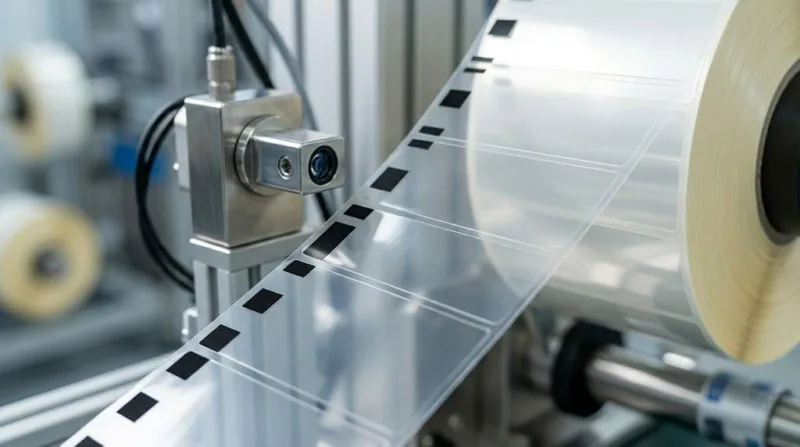
This is the most common point of failure for automated clear label application. Because the label and liner are both transparent, standard optical sensors cannot detect the gap between labels.
The solution is clear label sensor calibration: a printed black mark on the reverse side of the PET liner. This gives the sensor a clear target to read, ensuring consistent application at speeds of 150+ units per minute without errors.
The $0.003 Mistake That Costs Brands Thousands
When you’re sourcing clear labels for a premium product, a quote that’s just a fraction of a cent cheaper per unit is incredibly tempting. However, this tiny saving is often a trap that leads to production line failures and thousands of dollars in unsellable inventory.
The problem isn’t the label film you can see; it’s the backing liner you throw away. A hand-applied sample might look perfect, but an automated applicator running at high speed exposes the hidden flaw.
The Root Cause: Paper vs. PET Liners
The critical failure point is the material choice for the label’s backing paper, or liner. The cheaper option almost always uses a standard paper liner, which is where the disaster begins.
- The Trap (Glassine Paper Liner): This paper liner has a microscopic fibrous texture. Under the high tension of a machine, it imparts an “orange peel” pattern onto the clear adhesive, preventing a perfect bond and causing a milky, “frosted” look on your product.
- The Solution (PET Film Liner): A super-smooth 1.2 mil PET (Polyester) liner is non-negotiable for automated lines. It ensures the adhesive remains flawless, allowing for perfect “wet-out” and true invisibility on the container.
From $150 Saved to $10,000 Wasted
We’ve seen this exact scenario unfold. A brand saved $150 on a 50,000-label order by choosing the cheaper quote. But the paper liner not only caused the frosting effect but also snapped repeatedly on their line, causing constant stoppages.
They were left with $10,000 in ruined inventory and significant production downtime. That $0.003 per-label cost difference isn’t for a “better” label; it’s insurance against catastrophic production failure. Our “Machine-Ready” audit prevents this by specifying a PET liner for any clear label running at speeds over 80 units per minute, protecting your investment and your brand’s reputation.
Ensure Your Clear Labels Perform Flawlessly
Don’t let hidden material flaws or incorrect specifications derail your production. Our ‘Machine-Ready’ audit guarantees perfect clarity and uptime for your automated lines.
Once the material decisions are locked, the transparent label manufacturing process guide shows exactly what happens between your deposit and delivery — and who checks what before the rolls ship.
How Our ‘Machine-Ready’ Audit Guarantees Flawless Application
A flawless “no-label” look is a non-negotiable for premium brands. Yet, a sample label that looks perfect when applied by hand can become a production nightmare, causing frosting, bubbles, and line stoppages on your automated equipment.
This failure often stems from a hidden specification mismatch. A supplier might save you $0.003 per label by using a standard glassine (paper) liner instead of a PET film liner. While invisible during manual approval, the paper liner’s texture prevents the adhesive from achieving perfect “wet-out” at high speeds, creating a milky haze and risking tears that shut down your line.
Our Machine-Ready Audit makes this failure impossible. We go beyond material specs and analyze your production reality, focusing on the three critical points of failure for clear labels.
The Total Clarity Checklist
- The Material Stack: We verify you have an ultra-clear film (<1% haze), an optically clear adhesive, and the essential super-smooth PET film liner for perfect clarity.
- The Roll Specification: We confirm unwind direction, core size (typically 76mm), and max roll diameter to ensure 100% compatibility with your specific labeler.
- The Sensor Compatibility: If your machine uses optical sensors, we ensure a printed black mark is included on the liner’s reverse side to prevent automation errors.
This audit isn’t an upsell; it’s production insurance. By asking for your target application speed (UPM) upfront, we engineer a label that protects your brand’s aesthetic and your production uptime.
Buyer Takeaway
Clear-label quality is a system decision: container surface, film, adhesive, liner, sensor and applicator settings should be reviewed together before the production launch.
Clear-Label Machine-Readiness Data Sheet
Use this record with the RFQ, sample approval and production release. It is a decision aid, not a replacement for the technical checks explained above.
| System input | Record for the trial | Why it matters |
|---|---|---|
| Container | Material, surface finish, diameter and curvature | Affects wet-out and visual clarity |
| Label construction | Film, adhesive, liner and gauge | Controls clarity, dispensing and recovery |
| Applicator | Speed, sensor type, web path and label gap | Determines stable placement |
| Acceptance | Viewing conditions and allowed visual defects | Makes the trial result reviewable |
Approval and Handoff Checklist
- Send the container specification and real samples with the RFQ.
- Test one defined construction at representative speed before approving a broad production claim.
- Document the visual standard under normal retail lighting rather than relying on a single close-up photo.
Frequently Asked Questions
Why do clear labels look different on different containers?
Surface finish, curvature, color, adhesive wet-out and lighting can change the perceived clarity even when the film is the same.
What is a machine-ready clear-label trial?
It is a documented run using the proposed container, label construction and applicator conditions with agreed acceptance criteria.
Conclusion: Ensure Flawless Clear Label Performance
Achieving a true ‘no-label’ look demands more than just clear materials. The microscopic texture of a standard paper liner causes cloudiness and production failures.
Your specification must include an ultra-clear film, optical adhesive, and a 1.2 mil PET film liner. This material stack is non-negotiable for both aesthetics and high-speed automation.
Ignoring these details risks costly downtime and compromised brand image. Protect your investment and brand reputation by requesting a Machine-Ready audit and Get Your Custom Quote.