Your liner passed the trial run, the unit price looked right, and then hour five happened — and that pattern has a precise, preventable engineering cause.
At 300+ BPM, glassine liner (6–8 kN/m tensile, 0.3% humidity expansion) becomes a structural liability; high-tensile PET liner delivers 25–30 kN/m strength, stays within 0.1% dimensional tolerance, and fits 30% more labels per roll.
Below, we outline the exact 2-factor Decision Matrix and hard TCO benchmarks your sourcing team needs before committing to a full production run.
The Hidden Cost of “Good Enough” Liners
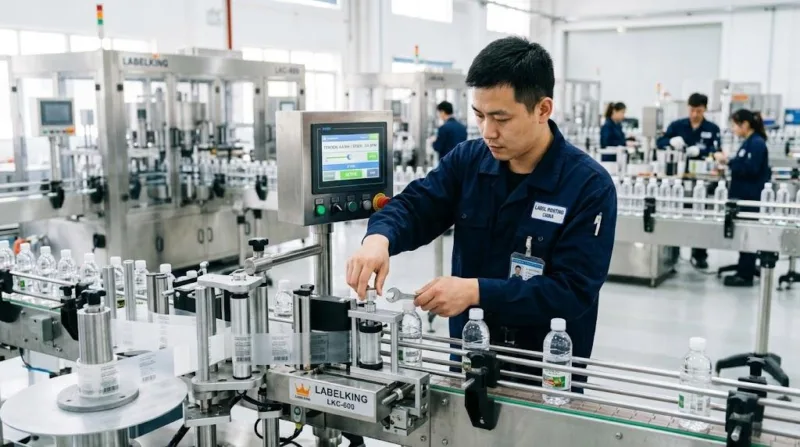
Here’s a scenario that plays out on production floors more often than anyone admits: a liner material passes a short trial run without a single issue, the unit price looks favorable, and the decision gets signed off. Then, six hours into a full production shift, the misfeeds start, the waste climbs, and the line slows down to compensate. The material didn’t fail dramatically — it just quietly eroded your output.
This is the real cost of “good enough,” and it almost never shows up on the original quote. What you actually pay for is buried in operational waste, unplanned downtime, and the labor cost of troubleshooting a problem that was preventable from the start. That silent erosion is exactly what a proper Total Cost of Operation analysis is designed to surface before the order is placed.
Paper vs. PET Under Stress
Here is the problem nobody talks about openly: your liner material is under mechanical stress every single second it runs through your applicator, and the two most common options — glassine paper and PET film — respond to that stress in completely different ways. Understanding that difference is not an academic exercise; it directly determines whether your line runs clean for a full 8-hour shift or starts throwing misfeeds at hour five.
The Physics Behind the Failure
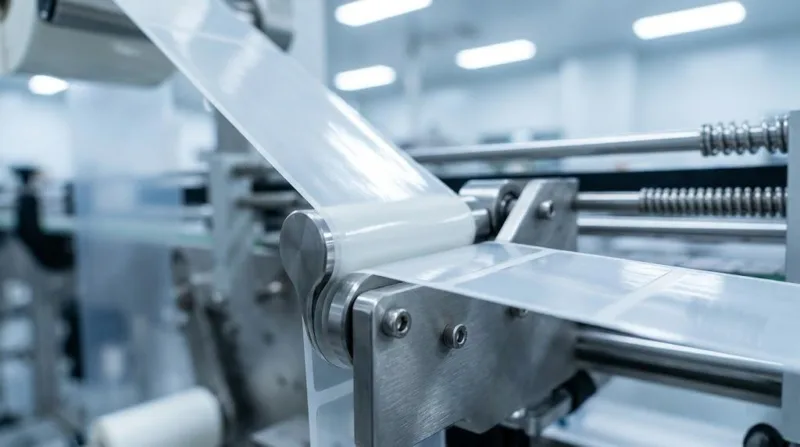
Tensile strength is the number that matters most under high-speed web tension, and the gap between these two materials is not marginal — it is structural. Glassine paper liner typically measures 6–8 kN/m in the machine direction, while a high-tensile PET liner delivers 25–30 kN/m, a difference of roughly four times.
- Glassine width can expand up to 0.3% at humidity above 60% RH, throwing optical registration sensors off-target
- PET dimensional change stays below 0.1% under the same conditions, keeping your sensor reads consistent
- At speeds above 250 BPM, paper liner splice strength and web control become statistically unreliable on high-torque unwind stands
- PET is engineered for stable, continuous operation from 300 BPM up to 600+ BPM
“PET makes it possible to run at the highest speeds even in humid conditions and eliminates production bottlenecks due to web breaks.” — UPM Raflatac Technical Documentation
There is also a yield advantage that gets overlooked in cost comparisons: a standard 75gsm glassine liner runs approximately 70 microns thick, while a premium PET liner sits at 50 microns, allowing roughly 30% more labels per roll at the same outer diameter—a specification that also proves critical for achieving total clarity and avoiding the common “frosting” effect on clear-on-clear applications.
The Total Cost of Ownership (TCO) Calculator
Here is where most sourcing decisions go wrong: the comparison stops at the unit price per thousand labels. What that number never shows you is the full operational cost that accumulates over a production month, and that gap between “quoted price” and “true cost” is exactly where budget overruns are born. For industrial-grade label applications, the calculation has to account for cost centers that rarely appear on a supplier’s quote sheet.
The Four Hidden Cost Centers
- Line downtime cost: A single web break on a 300 BPM line can cost 15–25 minutes of restart time, multiplied across a full shift.
- Changeover labor: A 70-micron glassine roll delivers roughly 30% fewer labels per roll than a 50-micron PET liner at the same outer diameter, meaning more frequent stops.
- Application waste rate: Sporadic misfeeds from liner micro-fractures typically generate a 2–3% waste rate that gets absorbed into “standard operational loss” and never traced back to the material.
- Humidity-driven registration drift: Glassine width can expand up to 0.3% at high humidity, triggering optical sensor misreads and rejected units downstream.
The 2-Factor Machine-Ready Decision Matrix
Here is the honest truth that most material suppliers will never tell you: the debate between paper liner and PET liner is not really about material preference, it is about where your production line sits against two hard thresholds. Get this wrong, and you are not just paying a higher unit price—you are absorbing hidden downtime costs that quietly destroy your line efficiency KPIs. This is the foundation of zero-downtime production strategies for global brands.
The Two Non-Negotiable Thresholds
- Factor A — Line Speed: Is your applicator running above 250 BPM? At this velocity, glassine tensile strength (6–8 kN/m) becomes a liability against PET’s 25–30 kN/m rating.
- Factor B — Environment: Does your production floor average above 60% relative humidity? Glassine can expand up to 0.3% in width, throwing optical registration sensors into misalignment.
Glassine vs. High-Tensile PET Liner: Performance Comparison at 300+ BPM
| Performance Metric | Glassine Liner | High-Tensile PET Liner |
|---|---|---|
| Tensile Strength (kN/m) | 6–8 | 25–30 |
| Humidity Expansion | Up to 0.3% | Below 0.1% |
| Typical Caliper | 70 microns | 50 microns |
| Labels Per Roll | Standard Yield | +30% More |
| Reliable Speed Range | Below 250 BPM | 300–600+ BPM |
Stop absorbing “normal waste.” Get a pre-run TCO snapshot for your high-speed line.
Our 18-year technical team will analyze your applicator speed, humidity, and roll specs to provide a data-backed liner recommendation and a true cost comparison. Protect your production schedule from the start.
The Label Printing China Pre-Press Audit
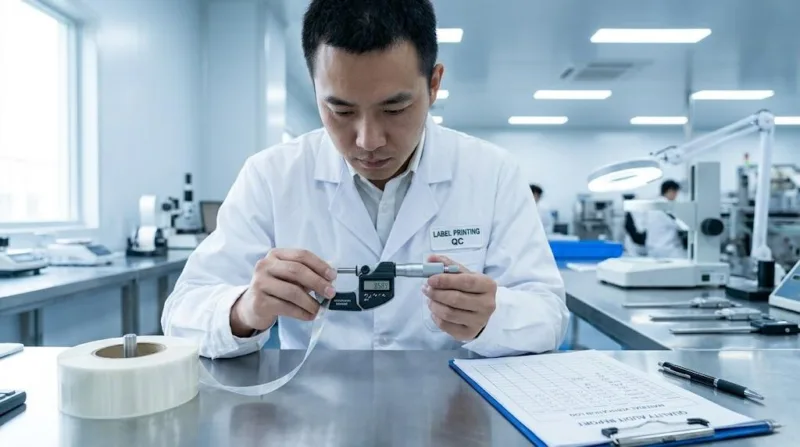
Before a single label rolls off the press, the decisions made in pre-press determine whether your production run is a success or a costly rework.
Our pre-press audit protocol is built around one principle: your line speed and operating environment must dictate the material spec, not the other way around. Following a strict machine-ready signing-off protocol ensures every incoming job is evaluated against industrial precision standards before approving it for press.
What the Audit Checks — and Why Each Point Protects Your Run
- Line Speed Declaration: If your applicator runs above 250 BPM, paper liner is flagged as a production risk and PET is specified automatically.
- Environment Assessment: Facilities exceeding 60% relative humidity trigger a mandatory liner upgrade to prevent optical sensor misalignment.
- Roll Yield Calculation: We calculate if a thinner 50-micron PET liner can reduce your changeover frequency by up to 30%.
- TCO Snapshot: We model the true cost of a 100,000-label run, comparing material price against projected downtime and waste.
Buyer Takeaway
At high speed, select a liner only after validating release behavior, sensor response and web stability on the actual applicator. Material names alone are not a production guarantee.
300+ BPM Liner Validation Card
Use this record with the RFQ, sample approval and production release. It is a decision aid, not a replacement for the technical checks explained above.
| High-speed check | Trial record | Release condition |
|---|---|---|
| Web stability | Speed range, tension and break/track observations | Stable run at the target line speed |
| Sensor response | Sensor type, baseline and detection consistency | No unexplained misses or nuisance stops |
| Release behavior | Dispensing and label placement observations | No lifting, skew or inconsistent release |
| Economic comparison | Downtime, rejects and rework assumptions | Total-cost decision documented |
Approval and Handoff Checklist
- Use the target applicator and a representative production speed for liner approval.
- Record a pass/fail limit before the trial starts so the result is not interpreted after a problem.
- Compare liners using downtime and reject risk as well as quoted material price.
Frequently Asked Questions
Is PET liner automatically necessary above 300 BPM?
Not automatically. The right construction depends on the applicator, label geometry, sensor and operating conditions, which should be validated in a trial.
What should a liner trial report include?
Include the material construction, machine, speed, settings, observed alarms, rejects, samples and approval decision.
Conclusion: Protect Your Line from Silent Erosion
The choice between glassine and PET liner is an engineering decision, not a cost negotiation. At speeds above 250 BPM or in humid environments, the structural and dimensional stability of high-tensile PET liners directly prevents the silent waste and downtime that erode your line’s true efficiency.
To ensure your next run is protected from these preventable costs, Request a Custom Quote and receive a data-backed TCO snapshot for your specific line.