Honey jar labels fail in ways flat dielines hide—shoulder curves lift edges, sticky drips creep under laminate, and a premium foil job can double unit cost on a 500-jar run. Pick materials before you lock artwork.
Custom honey jar labels need a face stock and laminate stack matched to jar curvature, fill temperature, and your run size—measure the shoulder arc, specify peel adhesion above 18 N/25mm, and route finishes through digital or flexo before you approve a quote.
Below are jar-geometry safe zones, moisture and oil resistance stacks, foil and texture-paper options for small batches, MOQ routing for 500–5,000 jars, and a pre-press checklist that shows what this means on your actual jar stock.
Jar Geometry and Label Fit on Curved Honey Jars
Queenline hex jars, classic mason shoulders, and squat bear jars each change how a label seats. A rectangle that looks perfect flat will bridge at the shoulder, lift a corner within 48 hours, and collect wax and drip residue under the edge.
Measure circumference at three heights: base, maximum diameter, and 5 mm below the shoulder. Compare those three numbers—if spread exceeds 4 mm on a 75 mm-wide label, you need a curved dieline or a shorter label height, not tighter adhesive alone.
Leave a 2–3 mm bleed beyond the live copy on every edge that contacts curvature. Artwork that ends exactly at the trim line will show white slivers when the label relaxes on the jar.For wrap labels that overlap, mark the overlap zone on the dieline PDF so prepress does not shift color-critical logo elements into the seam.
| Jar Profile | Typical Risk | Pass / Fail |
|---|---|---|
| Straight-wall round (8 oz) | Minimal curve; overlap OK | Pass → 2–3 mm bleed each side |
| Mason shoulder jar | Edge lift at shoulder | Fail if label spans shoulder arc |
| Queenline hex jar | Facet bridging, corner peel | Pass → facet-specific dieline |
| Tapered squeeze bear | Barcode quiet zone compression | Pass → proof at min diameter |
On recent hex-jar runs, labels that passed flat proofing still lifted within 72 hours because artwork used a rectangular dieline across two facets—the fix was a six-panel wrap dieline with 1.5 mm relief at each corner, not a heavier adhesive coat.
When you move from hand apply to a semi-auto line, irregular jars need synchronized feed timing. The unwind and applicator setup in our guide to synchronizing roll labels on curved glass explains how roll labels stay registered on shoulders that standard wrap calculators ignore.
Material Stacks for Honey Moisture, Oil, and Drip Resistance
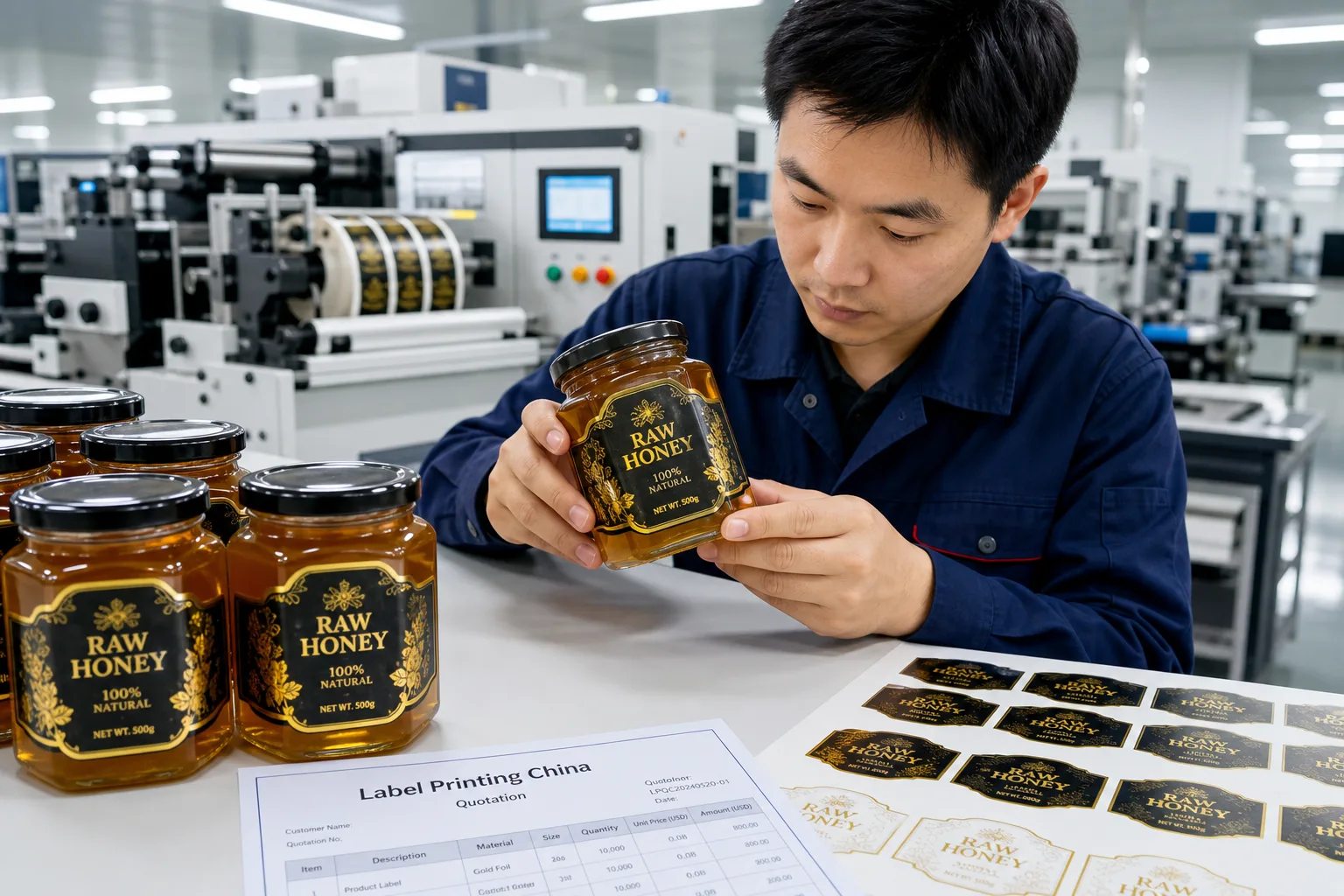
Honey is hygroscopic and leaves a thin oil film on the jar lip. Room-temperature fill behaves differently from warm-pack at 38–42°C. The wrong face stock swells, laminate haze develops, and fine type under gloss turns illegible after one season in a farm-store cooler.
Match the stack to fill temperature and shelf environment before you specify foil or texture overlays—premium finishes fail faster when the base laminate is wrong.
Request a wipe test protocol in your spec: 30 seconds of honey smear followed by a dry cloth wipe, then a 24-hour hold at the storage temperature you actually use.Converters who skip substrate testing often quote a generic BOPP stack that passes in the lab but fails on recycled-glass jars with micro-pitting on the shoulder.
| Stack | Best For | Peel Target | Pass / Fail |
|---|---|---|---|
| BOPP + permanent acrylic | Room-temp fill, indoor retail | 18–22 N/25mm | Pass → wipe test 30 sec |
| BOPP + matte laminate | Drip-prone farm stands | 20–24 N/25mm | Pass → 24h honey smear test |
| Textured paper + gloss OPV | Premium artisan shelf | 16–20 N/25mm | Fail if warm-fill >40°C |
| Clear film + freezer-grade adhesive | Creamed honey, cold storage | 22–26 N/25mm | Pass → −10°C edge-lift test |
U.S. retail honey still falls under FDA food-labeling rules for identity, net weight, and ingredient statements. Cross-check mandatory copy against 21 CFR Part 101 before you shrink type to fit a texture background—panel failures trigger a full reprint, not a spot fix.
Watch for these red flags before you approve mass print:
- Laminate specified as “waterproof” with no fill-temperature data on the spec sheet
- Peel adhesion quoted without N/25mm test method or bottle surface treatment noted
- Texture paper chosen for shelf appeal but fill line runs at 42°C or above
- No 24-hour honey smear test on the actual jar substrate you will use
Foil, Texture Paper, and Premium Finishes on Small Runs
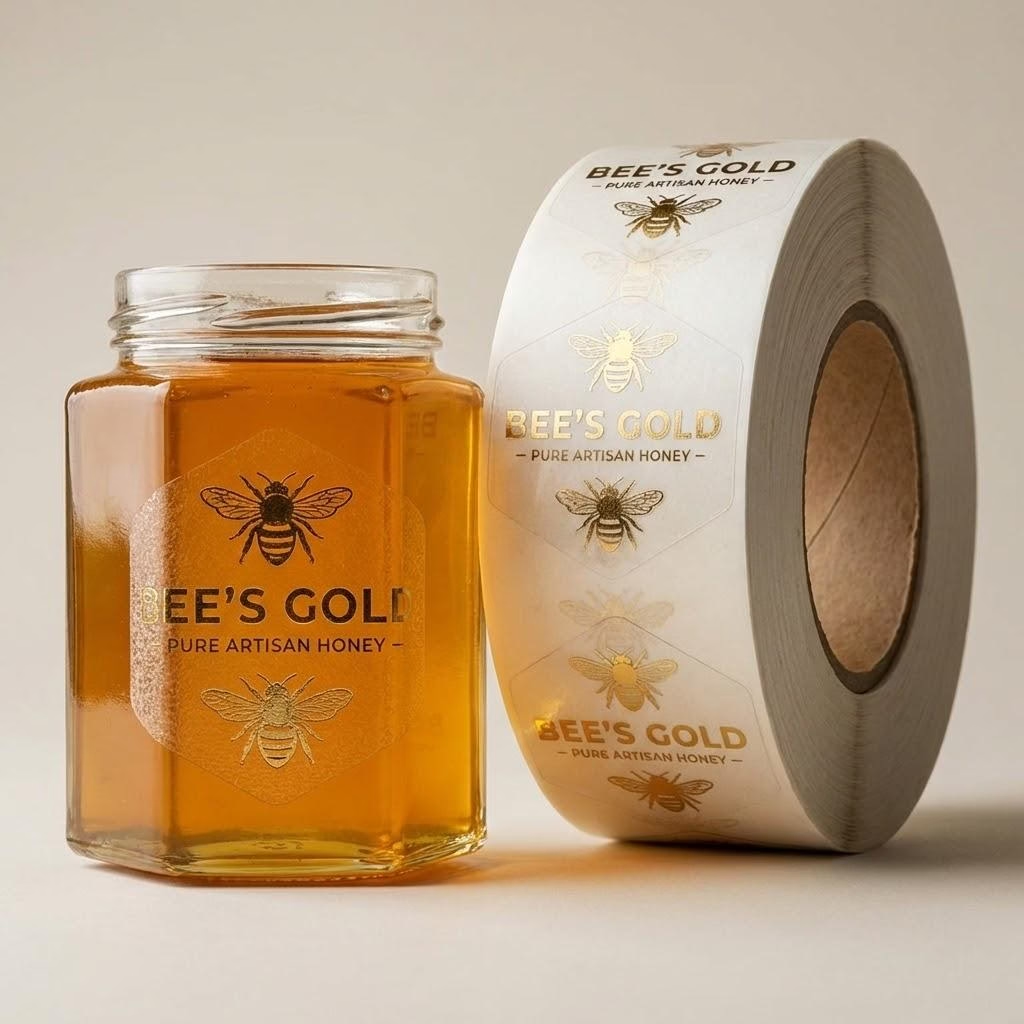
Gold foil and cotton-texture face stocks signal artisan quality—but on runs under 2,000 labels, setup charges dominate unless you route finishes correctly. Hot foil stamping needs a metal die; digital toner foil suits short runs but limits fine-line detail below 0.4 mm.
Texture papers add tactile appeal on farmers-market shelves. Pair them with a flood coat or spot varnish on logo areas only; full-panel gloss on texture stock flattens the hand-feel buyers pay for.
When you spec hot foil, ask whether the die is shared or dedicated. Shared dies save $80–$150 on first order but limit logo placement to fixed coordinates. Dedicated dies cost more upfront yet let you move foil fields when you add a new varietal line without reopening prepress.
For mixed-SKU apiaries, keep one master dieline and swap varietal names digitally. That approach cuts prepress cycles when you print custom honey labels across wildflower, clover, and seasonal harvest lines without re-tooling foil dies each time.
Based on 18 years of technical expertise exporting food labels from China, Label Printing China routes foil jobs above 3,000 pieces to flexo hot-stamp and keeps sub-1,500 runs on digital foil transfer—switching paths without re-quoting setup is the most common hidden cost on first-time artisan RFQs.
Test your jar geometry before you commit
Send jar photos with circumference measurements and receive printed samples on your actual face stock—verify fit, peel, and drip resistance on your fill line.
Small-Batch MOQ and Quote Routing for Artisan Brands
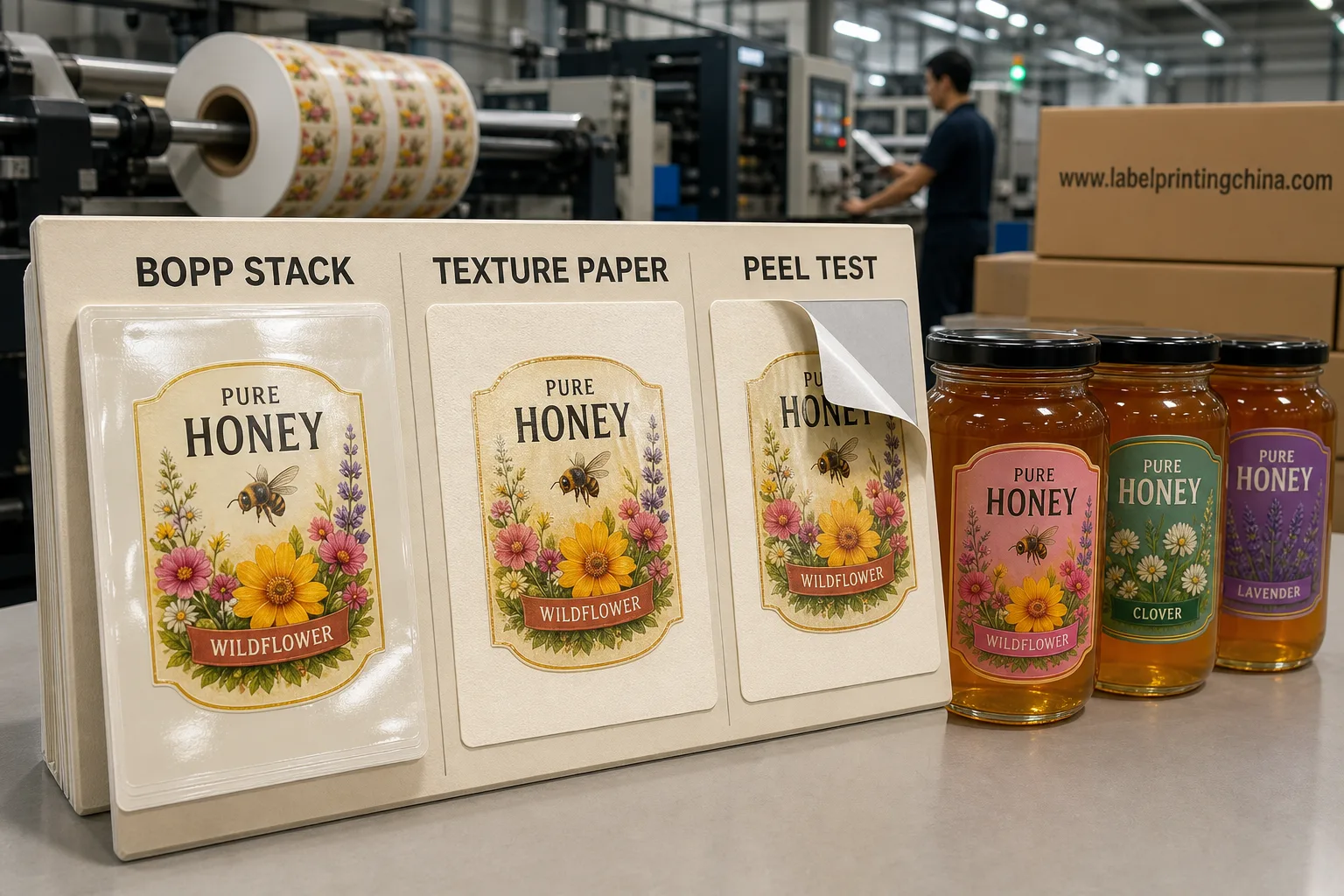
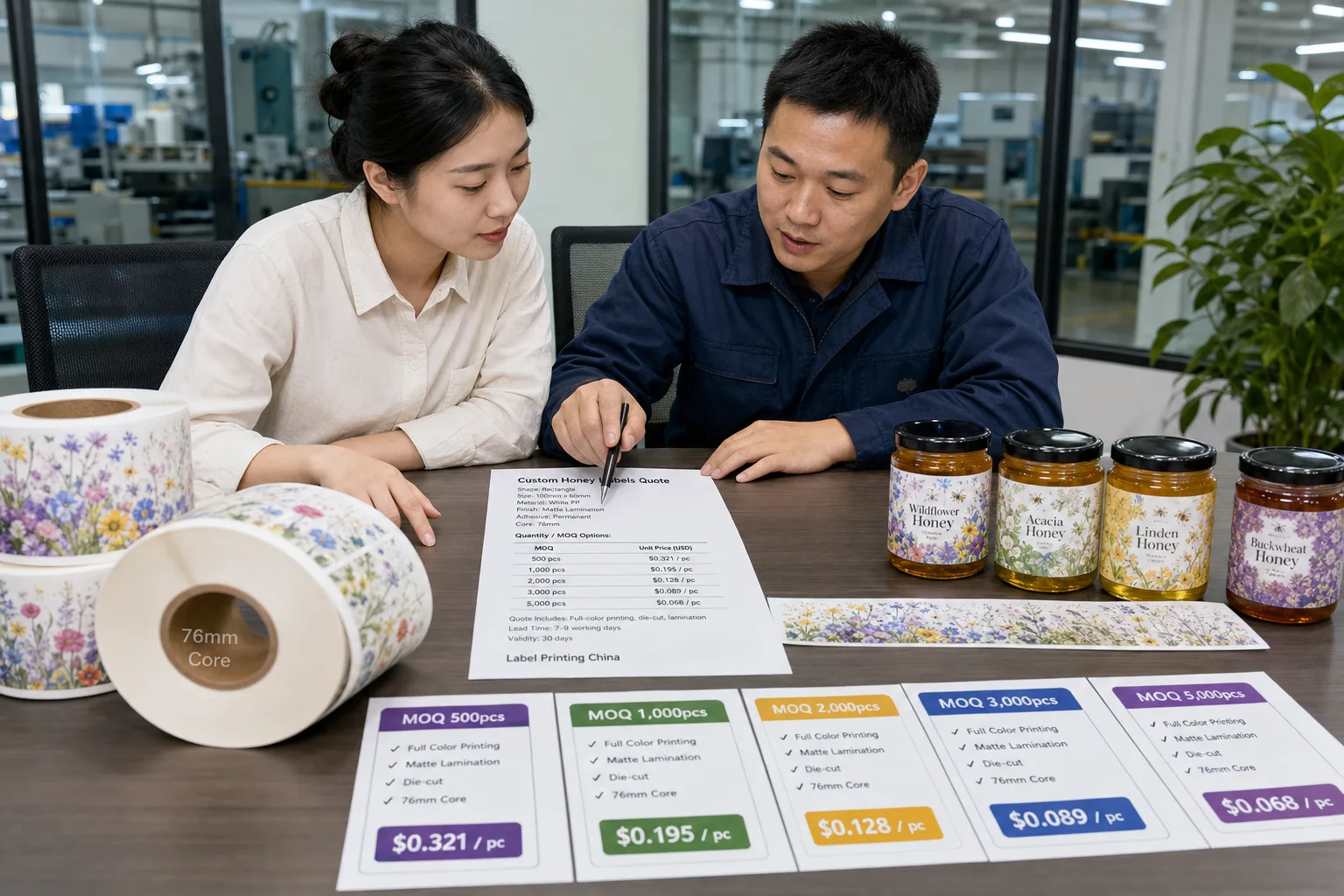
Runs between 500 and 5,000 jars sit in a cost valley: too large for desktop Avery sheets, too small for single-pass flexo without painful setup amortization. Quote structure matters as much as unit price.
Ask for a landed quote that separates ex-works label cost, die/plate ownership, and air-freight for rush harvest windows. A quote that looks 12% cheaper per thousand often hides plate reuse restrictions that force a full re-setup when you add a second varietal mid-season.
| Run Size | Recommended Route | Typical Setup | Pass / Fail |
|---|---|---|---|
| 500–1,000 labels | Digital + die-less cut | $120–$280 art/prepress | Pass → no flexo plates |
| 1,000–3,000 labels | Digital or short flexo | Compare plate vs. click cost | Fail if foil die added |
| 3,000–5,000 labels | Flexo + rotary die | Plate $180–$350 per color | Pass → unit cost drops 25–40% |
| 5,000+ labels | Flexo roll labels | 76 mm core standard | Pass → applicator-ready unwind |
Switching converters mid-season without re-quoting die and plate ownership is a recurring trap—plates made for one cylinder circumference rarely transfer without a new setup fee of $150–$400 and two weeks of lead time.
Before you sign a purchase order, confirm these five items on the quote PDF:
- Die-line version ID tied to your measured jar circumference at three heights
- Face stock, laminate, and adhesive named with fill-temperature ceiling
- Setup line items separated from per-thousand run charges
- Reprint policy if color drifts beyond Delta E 2.0 on repeat orders
- Sample approval gate before mass run—physical jar, not PDF alone
Industry packaging guidance from the FDA label regulations covers grade statements and origin claims; align marketing copy on your label with those rules before you print 5,000 units for a single harvest.
Buyer Takeaway
A honey jar label has to fit the jar geometry and survive sticky handling, moisture and oil around the lid. Treat material, adhesive, label size and finish as one approval decision. When the design work turns to production, our wholesale labels for jars run at wholesale factory volumes.
Honey Jar Label Approval Matrix
Use this brief with the RFQ, sample approval and production release. It turns the material discussion above into a comparable buyer decision.
| Jar-label risk | What to specify | Evidence to approve |
|---|---|---|
| Jar geometry | Diameter, taper, panel height and curved application area | Applied label sits flat across the intended panel |
| Honey and handling | Drips, lid oil, moisture and wipe-down exposure | No edge lift, smear or avoidable visible damage |
| Material and finish | Film/paper, adhesive, laminate, foil or texture | Approved sample reflects the desired shelf effect |
| Artwork and order | Final copy, size, quantity and revision control | Proof and quote reference the same file |
Honey Jar Pre-Production Checklist
- Measure the usable straight panel on the jar before locking label dimensions.
- Test the approved construction with representative drips and handling, not only a dry shelf sample.
- Retain one signed sample with artwork and material details for a repeat order.
Frequently Asked Questions
What size label fits a standard honey jar?
Measure jar circumference at the label centerline. For an 8 oz queenline jar, a 2.5 × 1.75 inch label is common, but hex facets need a custom dieline. Always proof on the physical jar—PDF flat proofs miss shoulder lift.
What label material resists honey drips and jar lip oil?
BOPP face stock with matte or gloss laminate and permanent acrylic adhesive in the 20–24 N/25mm peel range handles most drip exposure. Run a 24-hour honey smear test on your actual jar before mass approval.
What is the minimum order for custom honey jar labels?
Most export converters start at 500 labels for digital runs and 3,000+ for economical flexo. Setup fees of $120–$350 apply on first orders; ask for setup separated from unit cost in the quote.
Can you add gold foil to honey labels on a small run?
Yes—digital foil transfer suits runs under 1,500 pieces; hot foil stamping needs a metal die and pays off above 3,000 labels. Fine lines below 0.4 mm may not hold on digital foil paths.
Do honey jar labels need FDA nutrition panels?
Single-ingredient honey is typically exempt from Nutrition Facts, but net weight, identity, and producer information still apply under FDA food-labeling rules. Verify your SKU path before locking panel geometry.
When you export to multiple states, grade and origin claims may need to match regional honey standards—confirm copy with your co-packer before the first 5,000-unit run ships from the bottling line.