Looking to master strategic label sourcing without risking catastrophic assembly line downtime? You are in the exact right place. Backed by 18 years of technical manufacturing expertise, this guide will show you exactly how to cut your total cost of ownership by 30% while guaranteeing 100% machine-readiness.
Strategic label sourcing is the procurement process of acquiring high-volume industrial labels by evaluating total cost of ownership rather than just unit price. It integrates strict engineering tolerances, machine-readiness standards, and cross-border logistics to eliminate production downtime.
But dodging the dangerous “unit price” trap is just step one. Keep reading to discover the exact hidden-cost audit checklist we use to completely bulletproof global packaging supply chains.
Why “Unit Price” is the Biggest Financial Trap
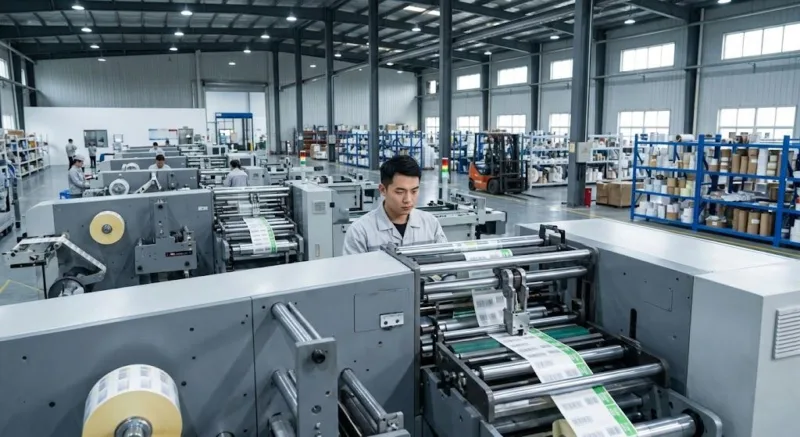
As a procurement leader, evaluating vendors based strictly on unit cost and standard material specifications creates a dangerous financial blind spot.
When you calculate the Total Cost of Ownership (TCO) for packaging procurement, the sticker price of the label is mathematically negligible compared to the operational leverage that label holds over your assembly line.
“Price has no meaning without a measure of the quality being purchased.”
— Dr. W. Edwards Deming, Pioneer of Total Quality Management (TQM).
In high-speed industrial manufacturing, “quality” does not simply mean the colors match the proof. Quality translates directly to zero-friction runability and machine readiness. A cheaper unit price is a disastrous strategy if it compromises the hidden mechanics of the application process.
Consider the physical reality of an automated application line running at 250 bottles per minute. The paramount metric is the prevention of non-planned production downtime.
We frequently audit failing global supply chains where a buyer successfully saved a fraction of a cent per unit on a massive PO, only to inadvertently sabotage their own plant’s overall equipment effectiveness (OEE).
A Real-World Failure Analysis
In a recent supply chain intervention, a North American chemical manufacturer faced continuous web breaks, causing their automated labelers to halt every twenty minutes. The operators were forced to constantly re-thread the machines and clean adhesive residue off the dispensing edge.
The root cause was entirely invisible to the naked eye, yet completely preventable: Their previous low-cost supplier had missed the die-cutting tolerance by a mere 0.03mm.
The die struck too deep, microscopically scoring the silicone layer of the release liner. Under the extreme pulling tension of a high-speed applicator, that compromised liner snapped repeatedly.
That 0.03mm error transformed a “cost-saving” label into a massive operational liability. To eliminate these hidden costs, you must shift your sourcing framework and visualize the financial impact of out-of-spec materials.
TCO Contrast Matrix
| Cost Metric | Traditional “Low Price” Model | Engineering-Driven Sourcing Model | Financial Impact at 250 BPM |
|---|---|---|---|
| Label Unit Price | $0.012 (Aggressively discounted) | $0.014 (Engineered precision) | Apparent upfront savings of $2,000 per million labels. |
| Die-Cutting Tolerance | ±0.05mm (Industry standard) | ±0.02mm (Zero-strike guarantee) | Eliminates liner scoring and tension failures. |
| Web Break Frequency | 3 to 5 breaks per shift | < 1 break per month | Halts line for 15-20 mins per incident. |
| Downtime Cost Penalty | +$4,500/day (Lost production time) | $0 (Continuous operation) | A $2,000 upfront saving results in a $135,000 annual loss. |
| True Landed ROI | Negative / Value Destructive | Positive / Value Accretive | True TCO favors precision over raw material discounts. |
Quick Guide: If your priority is absolute zero-downtime, choose engineering-driven sourcing; if you face severe OEE losses, invest in strict tolerance total cost of ownership auditing.
Key Decision Node:
- Reject generic quality promises on supplier intake forms.
- Demand custom label manufacturing engineered for 100 percent machine-ready application.
- Lock your suppliers into rigid die-cutting tolerances and require verified release liner tension metrics before any mass production begins.
Mitigating Physical Disasters in Cross-Border Logistics

Transferring your packaging materials supply chain across the globe introduces physical variables that procurement spreadsheets simply cannot capture.
When sourcing labels from overseas, the most destructive force is not a customs delay or a tariff fluctuation—it is extreme environmental volatility.
Prof. Yossi Sheffi, Director of the MIT Center for Transportation & Logistics, consistently emphasizes in his research, including The Resilient Enterprise, that focusing strictly on the lowest operational cost often creates highly fragile supply chains.
Resilient enterprises must prioritize risk mitigation and a comprehensive understanding of “total landed cost” over mere procurement price. Investing in a supplier who anticipates cross-border environmental risks is a strategic imperative.
The transit from a Chinese manufacturing facility to a North American plant is essentially a 30-day, uncontrolled chemical stress test.
A standard ocean freight shipping container crossing the equator can reach internal ambient temperatures exceeding 65°C (150°F). Upon reaching a port in the Midwest during winter, that same container experiences a drastic, rapid drop in both temperature and relative humidity.
The Anatomy of “Moisture Shock”
This violent fluctuation is known in the packaging engineering field as Moisture Shock. It wreaks havoc on label stock materials in three distinct ways:
- Substrate Curling: Paper-based liners absorb and release moisture at different rates than the BOPP or PET face films they carry. This differential expansion causes severe edge curling. When a curled roll is mounted on a labeling machine, the sensors misread the gaps, leading to misapplied labels and immediate line stoppage.
- Adhesive Shear Failure: Adhesives are complex chemical formulations. An acrylic or hot-melt adhesive engineered perfectly for a 25°C laboratory environment will suffer severe shear strength loss in a baking container. The chemical cross-linking degrades, resulting in “adhesive bleeding” (oozing out the sides of the roll), which binds the roll together and gums up your application equipment.
- Tack Degradation: The initial grab (tack) of the label upon application drops significantly after thermal stress, resulting in edge lifting on the final product, especially on curved or low-energy plastic surfaces.
You absolutely cannot afford to discover adhesive chemistry failure on your production floor. Securing supply chain resilience requires enforcing environmental hedging at the factory level, long before the cargo is loaded onto a vessel.
Standard vs. Fortified Delivery
Environmental Hedging Protocols
| Logistics Parameter | Standard Trade Practice (High Risk) | The 18-Year Engineering Standard (Zero Risk) |
|---|---|---|
| Pre-Shipment Testing | Visual inspection and standard room-temperature tack test. | Mandatory 72-hour Heat Stress Test simulating 65°C environments. |
| Primary Packaging | Standard corrugated cardboard boxes and shrink wrap. | Vacuum-sealed aluminum foil bags with integrated high-precision moisture indicator cards. |
| Palletization | Wood pallets with basic stretch film. | ISPM-15 certified pallets, reinforced edge protectors, and climate-barrier wrapping. |
| Delivery Model | FOB or CIF (leaving you to manage customs delays and port storage). | DDP (Delivered Duty Paid) directly to your facility door, minimizing port dwell times. |
Quick Guide: If your priority is eliminating transit damage, choose fortified DDP delivery; if you face moisture shock, invest in mandatory heat stress testing.
Key Decision Node:
- Mandate thermal stress testing reports for your specific adhesive formulation prior to mass production.
- Eliminate ambient humidity damage by codifying vacuum-sealed packaging into your vendor agreements.
- Integrate these physical safeguards with DDP logistics to strip the volatility out of offshore custom label printing and guarantee delivery security.
Ready to Eliminate Label Downtime?
Stop losing thousands of dollars to web breaks and adhesive failure. Get a free pre-press technical audit and discover how our 18 years of China manufacturing expertise can deliver 100% machine-ready labels while saving you 30%.
Evolving Beyond Excel Consolidation
Traditional B2B sourcing strategy dictates a straightforward approach to reducing costs: aggregate your spending.
Procurement managers are trained to bundle dozens of SKUs into massive purchase orders, using that volume as leverage to extract 15% to 20% discounts from vendors.
In the highly fragmented and volatile market of 2026, this brute-force, Excel-based approach is mathematically flawed.
It inevitably leads to bloated warehouse inventories, massive capital tie-ups, and a high risk of product obsolescence. True consolidation happens on the factory floor through technical ingenuity, not in a procurement spreadsheet through aggressive negotiation.
We define this high-level evolution as Engineering-Driven Spend Aggregation.
The Fallacy of “Batching Everything”
Consider a scenario where you manage 40 different label SKUs for an industrial lubricant brand. 12 of these are high-volume core products, while 28 are specialized, long-tail SKUs for niche markets.
A standard supplier will simply load all 40 SKUs onto their large flexographic presses, forcing you to order massive minimum quantities of the long-tail items just to secure the lower blended unit price.
Six months later, when a regulation changes and you must update a warning symbol, you are forced to scrap thousands of dollars in obsolete inventory.
Cross-Equipment Tooling Synergy
A supplier armed with decades of manufacturing expertise does not simply batch your orders; they engineer your print production.
When our Master Printing Engineers audit a portfolio of 40 SKUs, they dissect the color spaces, the run lengths, and, most importantly, the die-cutting paths.
- Process Bifurcation: We isolate the 12 high-volume core SKUs and allocate them to high-speed Heidelberg offset or advanced flexographic presses, maximizing extreme economies of scale.
- Digital Agility: We shift the 28 highly variable, short-run SKUs to advanced digital composite lines, which require zero setup time and allow for exact-quantity ordering (eliminating your inventory risk).
- The Engineering Masterstroke: Through precise prepress engineering, we align the layouts so that these vastly different printing technologies perfectly share the exact same physical die-cutting tooling.
Real Experience: The Inventory Rescue
We applied this exact methodology for a European chemical distributor drowning in redundant label stock. By implementing tooling synergy across flexo and digital platforms, we eliminated their plate charges for short runs and allowed them to order long-tail SKUs on demand.
The result? Their aggregate unit price dropped by 22%, and their warehouse footprint dedicated to labels was reduced by 60%. This is the power of utilizing your supplier as an engineering partner rather than a simple print-shop.
Key Decision Node:
- Stop asking suppliers for volume discounts based purely on aggregated piece counts.
- Evaluate your vendor’s capability to execute cross-platform production (flexo vs. digital).
- Require proof of prepress optimization that demonstrates how they plan to share tooling and reduce setup waste across your specific product matrix.
The 2026 Sourcing Director’s Actionable Toolkit
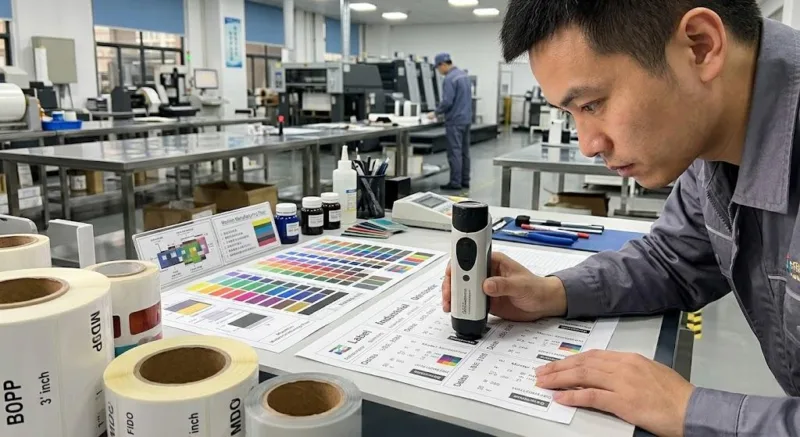
To successfully defend your sourcing strategy in the boardroom, satisfy the CFO’s cost mandates, and keep the Plant Manager’s machines running flawlessly, you need concrete operational leverage.
You must move past marketing brochures and force potential vendors to answer hard engineering questions.
Implement these two non-negotiable protocols with any potential supplier to establish immediate authority and filter out underqualified factories.
Tool 1: The Hidden-Cost Sourcing Audit
Force suppliers off their standard sales pitches by demanding raw engineering data. During your next vendor review, utilize this exact bulleted checklist:
- The Tolerance Question: “Specify your exact die-cutting depth tolerance limits for release liners intended for 250-bottle-per-minute applicators. How is this monitored inline during production?”
- The Environmental Question: “Provide your documented Standard Operating Procedure (SOP) for mitigating Moisture Shock and adhesive shear failure during a 30-to-40 day ocean transit.”
- The OEE Question: “What is your guaranteed acceptable defect rate regarding web breaks, and how do you financially compensate for machine downtime caused directly by out-of-spec liner tension?”
- The Tooling Question: “Demonstrate a case study where you utilized prepress engineering to share die-cutting tooling across both digital and conventional presses to reduce a client’s inventory liability.”
If a supplier answers with vague assurances about “strict quality control” instead of providing physical metrics (like ±0.02mm), they are an operational liability.
Tool 2: The Machine-Ready SLA Blueprint
Never rely on a standard purchase order. You must translate these physical parameters into legally binding safeguards within your Service Level Agreement (SLA).
- Material Science Lock: Explicitly define the allowable variance for core inner diameter deformation (e.g., maximum 1mm distortion) to ensure the rolls fit perfectly onto the applicator mandrels, choosing between 1-Inch vs. 3-Inch Cores based on equipment.
- Adhesive Performance Lock: Mandate specific initial tack testing standards that must be met after the cargo has undergone simulated thermal stress testing.
- Accountability Clause: Draft language that holds the supplier financially accountable for documented equipment downtime that is forensically traced back to out-of-spec labels (e.g., cut-through liners). This immediately separates the brokers from the true industrial manufacturers.
Securing Your Industrial Advantage
In 2026, the most expensive cost in B2B packaging procurement is not the ink or the paper—it is the catastrophic cost of operational friction.
Stop accepting production downtime as an unavoidable byproduct of doing business globally.
Sourcing custom labels from China represents a massive competitive advantage, but only when you partner with a manufacturer who views your order through the lens of industrial precision rather than simple commercial trading.
Your Next Strategic Move:
Do not issue another standard Request for Quote (RFQ). Instead, invite your production department to identify the one label SKU that consistently causes jams, web breaks, or application failures on your line.
Bring that “Troublemaker Label” to our team for a comprehensive Technical Audit.
Allow 18 years of manufacturing expertise to dissect the failure points and present an engineered solution. We will demonstrate exactly how cross-border logistics and zero-downtime application can be seamlessly integrated to permanently protect your bottom line, setting the standard for machine-ready label manufacturing.