If you are struggling with labels that crack, peel, or fade long before your equipment’s warranty expires, you have come to the right place. This guide breaks down the precise material science required to ensure your industrial markings survive 5+ years of relentless solar radiation and thermal stress.
UV-proof outdoor labels achieve 5-year durability through a “triad system” consisting of high-stability polymeric substrates, pigment-based inks, and UV-inhibitor overlaminates. To prevent failure, these components must be modulus-matched to the equipment’s thermal expansion and pass at least 3,000 hours of ASTM G154 accelerated weathering testing.
While most suppliers simply offer “weatherproof” stickers, there is a massive difference between a label that looks good today and one that survives 700 Kilo-Langleys of cumulative UV exposure.
Read on to discover the specific adhesive chemistry and engineering checklists that procurement pros use to eliminate field failures and high replacement costs.
1. Why “Standard” Labels Fail in 18 Months
In the industrial labeling sector, “weatherproof” is a marketing term, while “UV-Proof” is an engineering specification. Most failures occur because of a lack of understanding of photo-oxidation.
When UVB rays (290nm–315nm) strike a standard monomeric vinyl or poor-quality polyester, they possess enough energy to physically sever the carbon-hydrogen bonds within the polymer chain. This molecular destruction leads to the three “Death Signs” of outdoor labels:
- Chalking: The resin binder degrades, leaving a powdery white residue.
- Embrittlement: The loss of plasticizers makes the label crack like eggshells under thermal expansion.
- Chromophore Destruction: The chemical structures in the ink that reflect color are “bleached” by radiation.
“Standardized accelerated weathering testing is not merely a laboratory requirement; it is a critical predictive tool for material longevity. The use of UVA-340 lamps in ASTM G154 provides the best simulation of sunlight.” — ASTM International Technical Committee
2. Engineering for Global Deployment
A procurement manager sourcing for a project in Scandinavia faces entirely different failure modes than one in the Middle East. Solar radiation is measured globally in Kilo-Langleys (Kly).
Understanding your target region’s Kly rating is the difference between a label that lasts 5 years and one that fails in six months.
The Kly Decision Matrix
| Environment | Annual UV (Kly) | Primary Stressor | Recommended Solution |
|---|---|---|---|
| Northern Regions | 80 – 100 | Freeze/Thaw cycles | PET + High-Tack Acrylic |
| Desert / High-Sun | 180 – 220 | Photo-oxidation | MDO Film + UV Laminate |
| Marine / Coastal | 140 – 170 | Salt-fog corrosion | Solvent Acrylic + Polymeric Vinyl |
TL;DR: If your priority is surviving Middle Eastern solar exposure, choose MDO Film + UV Laminate; if you face coastal salt-fog, invest in Solvent Acrylic + Polymeric Vinyl.
3. Modulus Matching
Many labels fail not because the ink faded, but because the adhesive was physically “ripped” from the surface. This is caused by a failure in Modulus Matching.
When an aluminum electrical box heats up in the sun, it expands significantly. If the label applied to it is a rigid, non-stretch polyester, the differential expansion creates massive shear stress on the adhesive layer.
Based on our 18 years of manufacturing experience, ensuring Machine-Ready label manufacturing performance requires selecting a “conformable” film like MDO (Machine Direction Oriented) or Polymeric Vinyl for outdoor metal substrates. These materials “breathe” with the substrate, maintaining the bond through 70°C heat spikes.
Never buy based on material name alone. Ask your supplier: “What is the shear strength decay rate of this adhesive at 80°C?” If they can’t answer, they aren’t an industrial expert.
4. A 2026 Sourcing Crisis
The labeling industry is currently in a state of upheaval due to global PFAS (per- and polyfluoroalkyl substances) bans. Historically, the most weather-resistant labels used PFAS chemicals to enhance UV resistance and fluid repellency. As of 2026, many legacy formulations are illegal.
Procurement managers must now vet for New-Generation PFAS-Free Adhesives. These new formulas often have “Lower Surface Energy” (LSE), meaning they don’t flow into the micro-cracks of a surface as easily.
This leads to “Immediate Bond Failure” if not properly accounted for with high-coat-weight solvent acrylics.
- ✅ UL 969 Standards compliance: Ensure compliance under new PFAS-free formulations.
- ✅ Surface Energy Analysis: Check if your plastic casing needs a “High-Tack” adhesive to compensate for PFAS removal.
- ✅ Regulatory Environmental Compliance Audit: Demand a signed 2026 Environmental Compliance Statement.
Ready to Bulletproof Your Compliance?
Don’t let PFAS bans or adhesive failures stall your production line. Our engineers ensure your custom industrial labels meet 2026 regulations and ASTM testing standards perfectly.
5. Lightfastness vs. UV Resistance: The Ink Differentiation
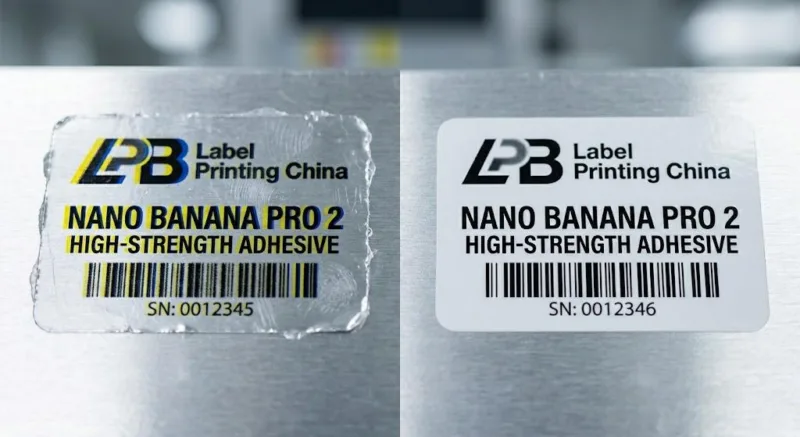
There is a common misconception that a “UV-proof laminate” can save cheap ink, a problem that is significantly amplified by continuous indoor retail light exposure.
This is false. In the printing industry, we use the Blue Wool Scale measurements to measure ink lightfastness.
- Standard CMYK: Typically a 3 or 4. It will fade in 6 months regardless of the laminate.
- Industrial Pigmented Ink: Rated 7 or 8. These are inorganic pigments that remain stable for years.
When sourcing for 2026, ensure your factory uses Automated Color Management to maintain a Delta E < 2.0 over multiple production runs, ensuring that your branding remains consistent across different batches of outdoor equipment.
6. The 3-Step “Machine-Ready” Protocol
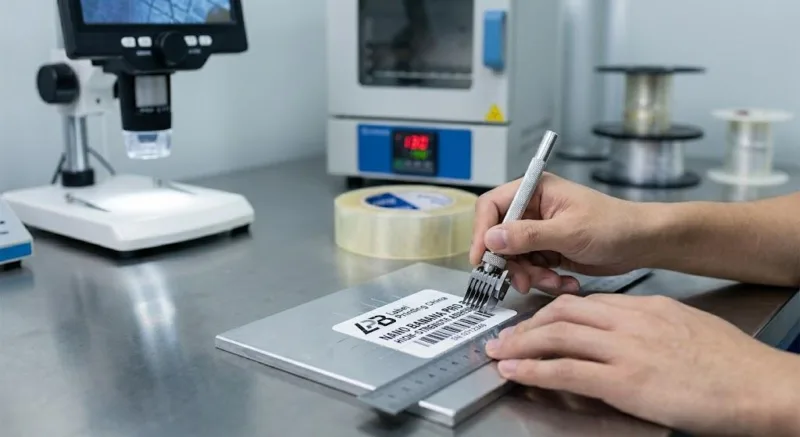
How do you verify quality before a 10,000+ unit run? Our factory engineers use a “Three-Point” check to identify potential failures before shipping. You should demand these test reports from any supplier in China.
- ASTM D3359 Cross-Hatch Test: Score a 6×6 grid into the label surface, apply tape, and pull. If any ink or UV coating lifts, the chemical bond is insufficient.
- Solvent Rub Curing Test: Perform 30 cycles with 99ww% IPA. Fading or surface “tackiness” indicates poor curing.
- Accelerated Heat Aging: Bake a sample at 60°C for 24 hours. If you see “Adhesive Ooze” at the edges, the label will attract dust and fail in the field.
7. Total Cost of Ownership (TCO): The Procurement Math
For a procurement manager, the unit price of a label is a “decoy.” The real cost is the Recall Liability.
- Cheap Label ($0.05): Fails in 12 months. Replacement cost: $200 (Labor + Travel to site).
- Engineered Label ($0.25): Lasts 5-7 years. Replacement cost: $0.
By investing 20 cents more upfront, you eliminate a $200 per-unit risk. This is why top-tier industrial brands prioritize technical data sheets over the lowest bid.
5-Year Outdoor Failure Prevention Matrix
| Failure Mode | Root Cause | Industrial Solution |
|---|---|---|
| Fading / Yellowing | UVB Bond-breaking | 98% UV Intercept Overlaminate |
| Cracking / Brittle | Photo-oxidation | Polymeric Vinyl or MDO Film |
| Edge Lifting | Modulus Mismatch | Cross-linked Solvent Acrylic |
TL;DR: If your priority is preventing cracking, choose Polymeric Vinyl or MDO Film; if you face fading, invest in a 98% UV Intercept Overlaminate.
Buyer Takeaway
A five-year outdoor claim should be tied to the actual exposure profile and evidence. Climate, UV load, chemicals, abrasion, substrate and viewing requirement all affect what needs to be tested.
Outdoor-Durability Exposure Approval Sheet
Use this record with the RFQ, sample approval and production release. It is a decision aid, not a replacement for the technical checks explained above.
| Exposure factor | Specify for the quote | Approval evidence |
|---|---|---|
| Location and climate | Sun exposure, temperature range, humidity and coastal/industrial conditions | Defined use profile |
| Substrate and surface | Material, texture, curvature and preparation | Applied sample on real substrate |
| Durability risks | UV, abrasion, moisture and chemical contact | Relevant test plan and result |
| Appearance standard | Color/legibility requirement and inspection method | Approved retained sample |
Approval and Handoff Checklist
- Avoid approving an outdoor label solely from a generic material description.
- Ask which conditions the supplier's durability statement covers and which it does not.
- Keep the approved test sample and agreed inspection method for later reorders.
Frequently Asked Questions
Does UV resistance mean a label will survive every outdoor environment?
No. Exposure duration, climate, substrate, abrasion and chemical contact determine whether a construction is suitable.
What should an outdoor label RFQ include?
Include the real application surface, exposure conditions, required life, graphics/legibility needs and acceptance evidence.
Conclusion: Protecting Your Professional Reputation
In the world of B2B manufacturing, the label is the final touchpoint of quality. A faded, peeling label signals a neglected product. By adhering to the principles of ASTM G154 testing, modulus matching, and PFAS-free chemistry, you ensure your equipment’s brand equity remains intact for years.