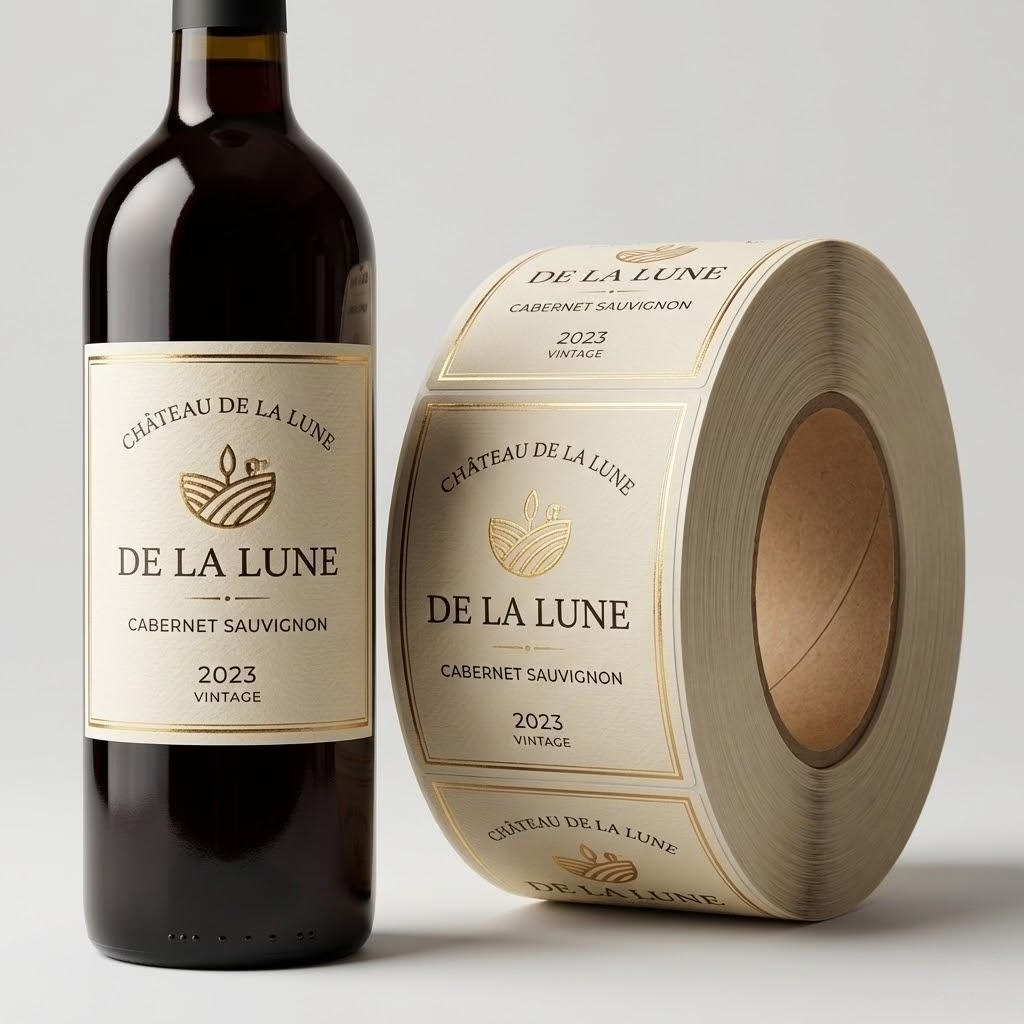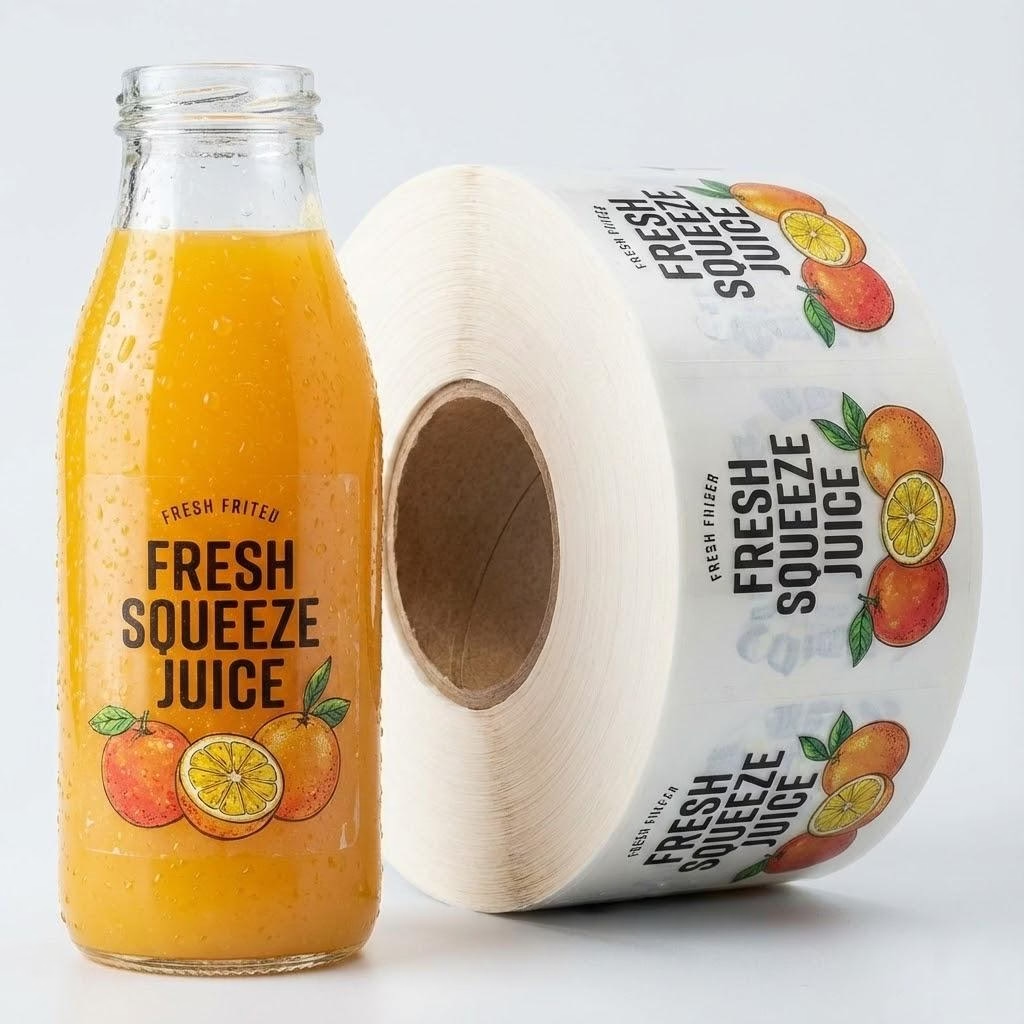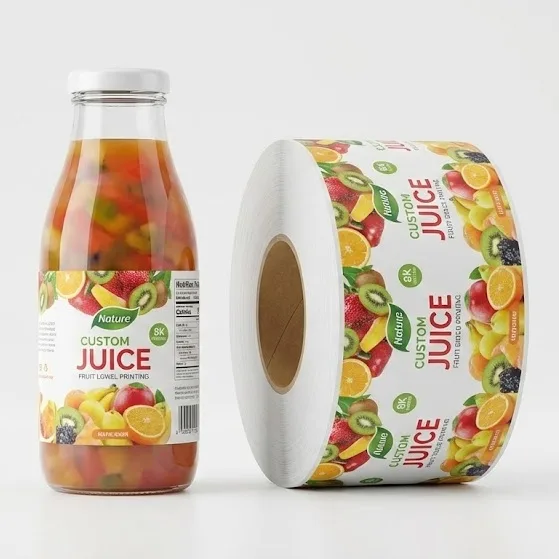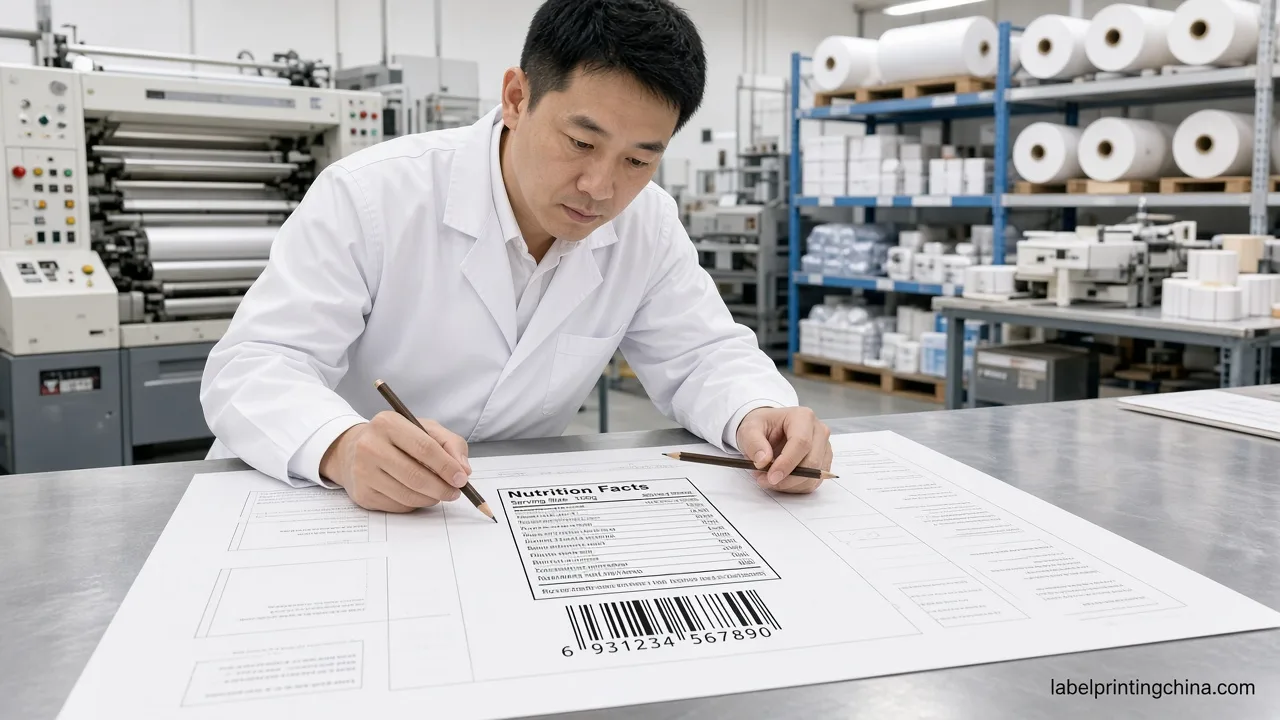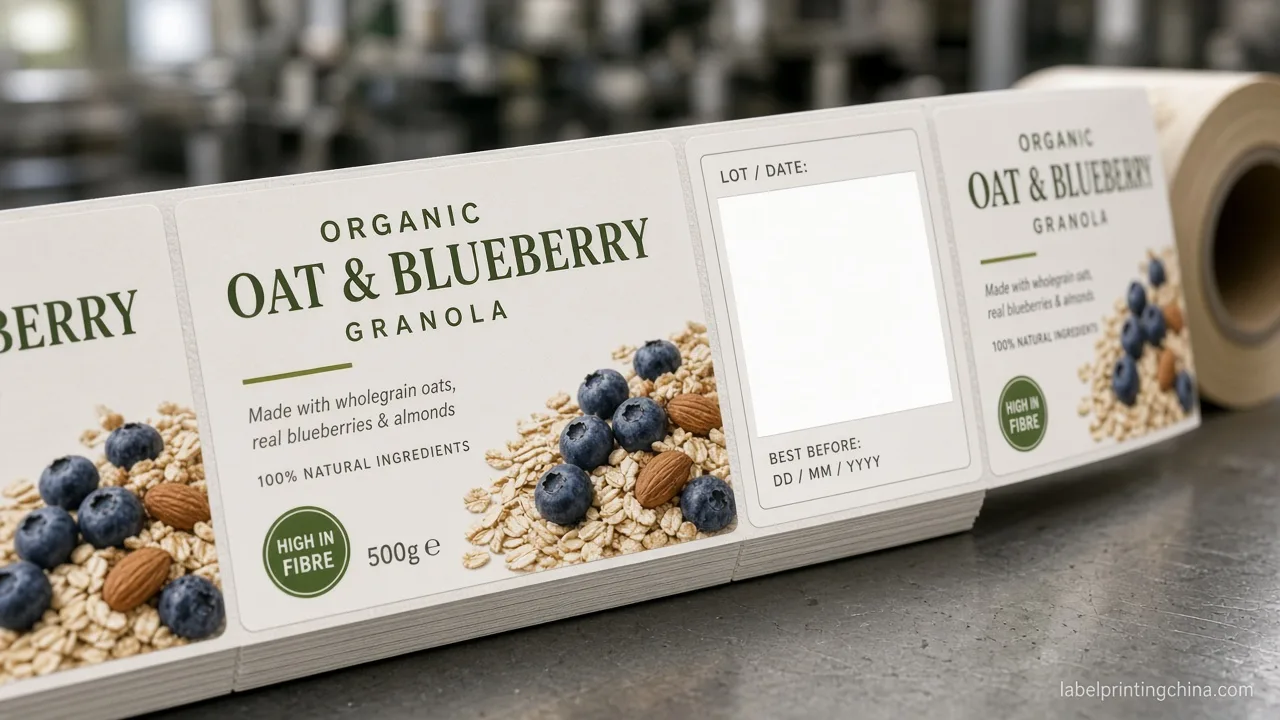
U.S. drink labels are governed by FDA or TTB depending on ABV and product category—not on how you market the brand. Choose the wrong path and customs, a retail buyer, or a port audit can force a full reprint.
Quick answer: Non-alcohol and low-ABV drinks self-certify under FDA Part 101. Beer, wine at 7%+ ABV, and spirits need a TTB COLA. Kombucha over 0.5% ABV and sub-7% wine may still need FDA panels—confirm jurisdiction before you lock artwork.
Below are a print-ready FDA/TTB routing table, mandatory panel rules for each path, typical COLA lead times, nutrition and UPC quiet-zone checks, and a pre-press checklist export brands should finish before mass production approval.
FDA or TTB
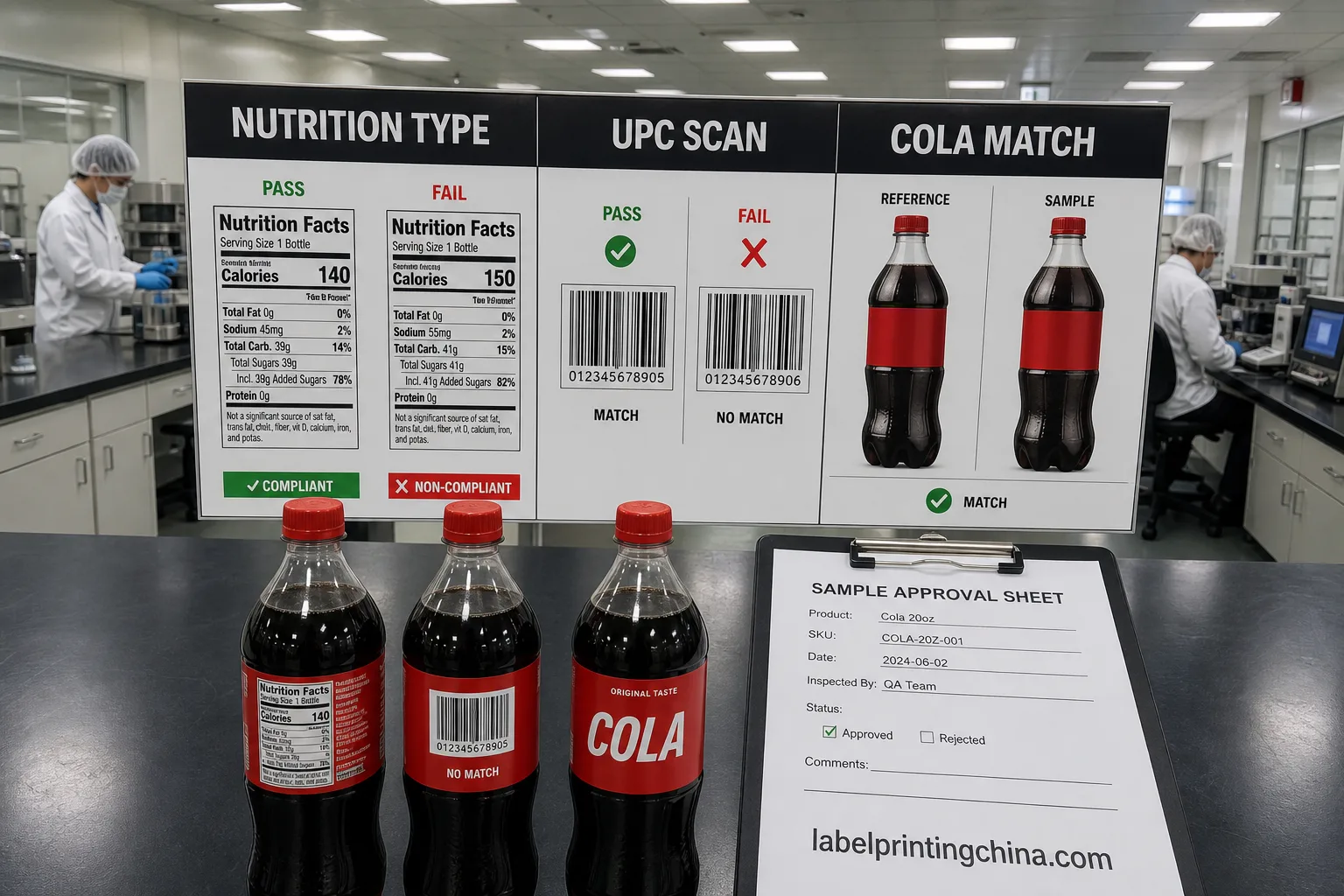
U.S. drink labels are not governed by one rulebook. The split depends on product category and alcohol content—not on how you market the brand on Instagram.
FDA holds primary labeling authority for conventional foods and beverages that are not distilled spirits, standard malt beverages, or wine at 7% ABV or above. TTB enforces the Federal Alcohol Administration Act on those alcohol categories and requires label approval through COLAs Online before interstate commerce.
The gray zone matters for exporters. Kombucha that ferments above 0.5% ABV at any point—even if you target a non-alcohol shelf—can trigger TTB jurisdiction.Wine at 6.9% ABV stays on FDA nutrition-label rules. Many sugar-fermented hard seltzers without malted barley or hops remain FDA-primary for panel content while still facing TTB excise rules on tax classification.
| Product Signal | Primary Label Authority | Pre-Market Approval | Pass / Fail |
|---|---|---|---|
| Juice, soda, energy drink, 0% ABV | FDA | Self-certify | Pass → Nutrition Facts + allergens |
| Wine below 7% ABV | FDA (nutrition/allergen) | Self-certify panels | Pass → FDA panel; verify ABV test |
| Beer, malt beverage, wine ≥7% ABV, spirits | TTB | COLA required | Pass → COLA # on print file |
| Kombucha >0.5% ABV any stage | TTB (alcohol beverage) | COLA required | Fail if treated as juice only |
| Hard seltzer (no malt/hops) | FDA (typical) | Self-certify panels | Pass → confirm formula with counsel |
Route the SKU through this table before you brief a label converter. A single wrong row forces a full artwork rebuild because FDA Nutrition Facts and TTB alcohol statements use different panel geometry and mandatory copy.
If you print custom beverage labels for multiple SKUs, split the RFQ by jurisdiction path—combined print runs only work when regulatory panels share the same approval workflow.
FDA Food Beverage Label Requirements
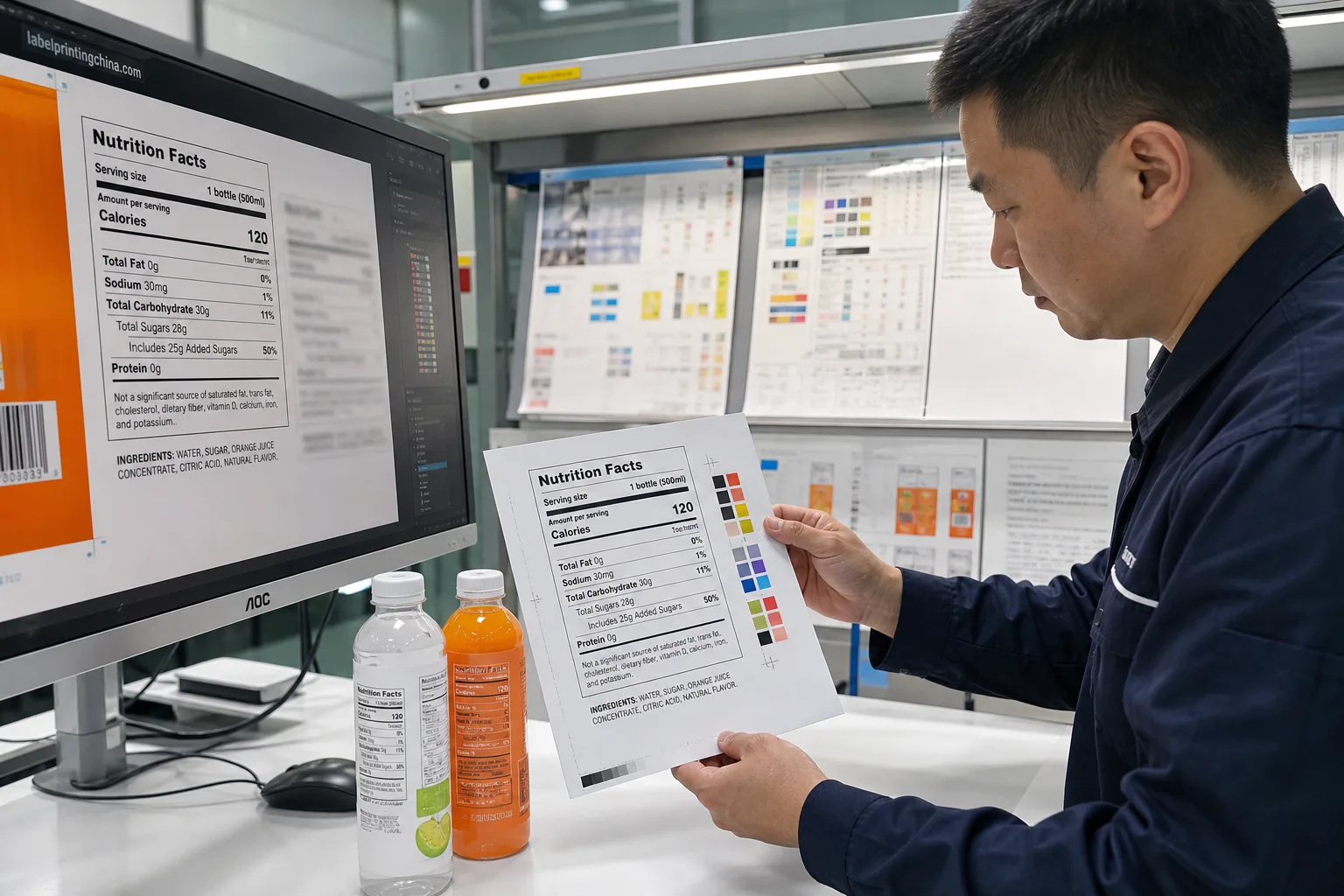
FDA-regulated beverages must comply with 21 CFR Part 101. There is no COLA-style pre-approval, but you carry legal responsibility for every statement on the label—and retailers increasingly audit panels before listing.
Mandatory elements for most FDA-jurisdiction drink labels include:
- Statement of identity (common or usual name) on the principal display panel
- Net quantity of contents in U.S. customary and metric units
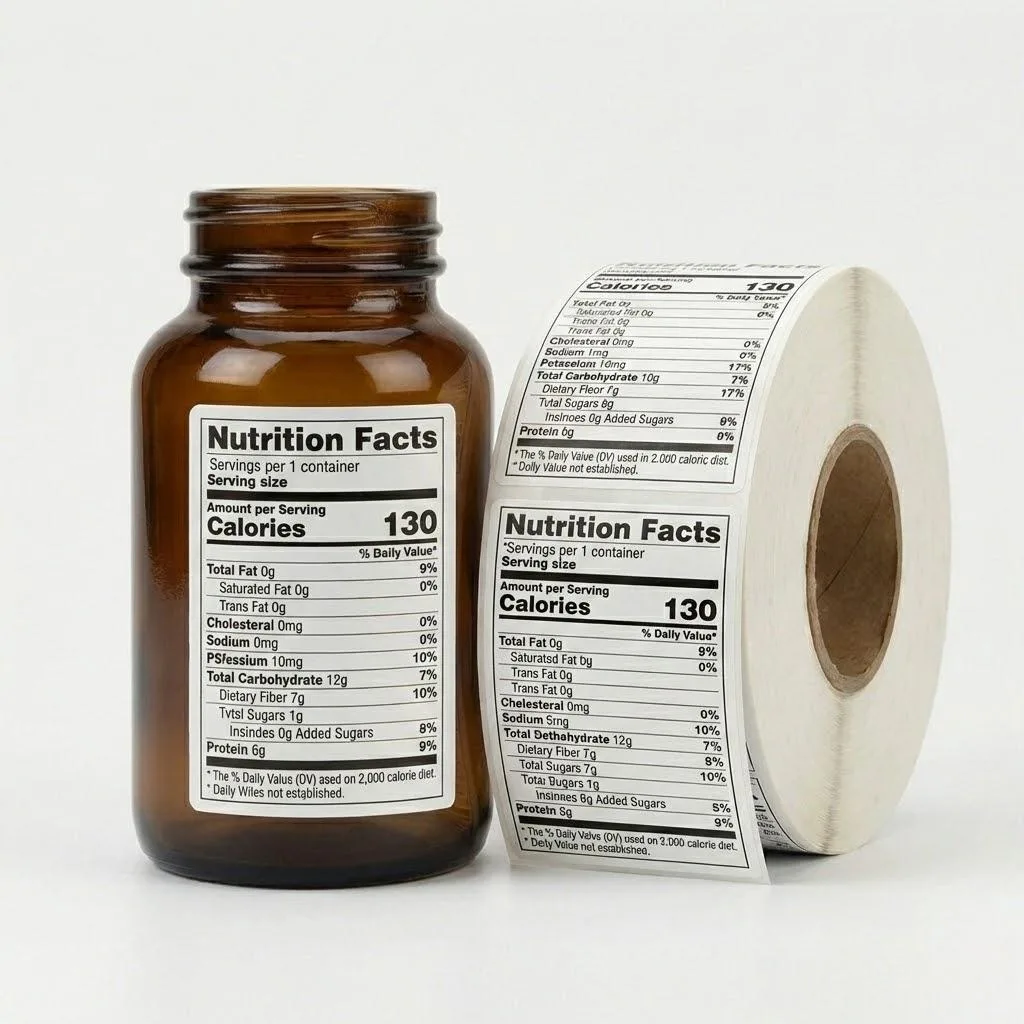
- Nutrition Facts panel in the updated format unless a narrow exemption applies
- Ingredient list in descending order of predominance by weight
- Allergen declaration for major food allergens including sesame
- Name and place of business of manufacturer, packer, or distributor
Serving size on custom nutrition labels must reflect Reference Amounts Customarily Consumed (RACC) for the beverage category—not your marketing portion. Calories and nutrients round per FDA tables; a spreadsheet error that survives PDF proofing will not survive a buyer’s third-party label review.
The FDA regulations in 21 CFR Part 101 remain the primary reference for panel layout.For adhesive and indirect food-contact layers on shrink or wrap labels, cross-check 21 CFR Part 175 compliance—the engineering audit in our FDA label engineering guide covers material stacks that must not migrate into drink contact zones.
Based on 18 years of technical expertise exporting beverage labels from China, Label Printing China requests a signed nutrition spreadsheet and allergen worksheet with every FDA-path artwork package—vector PDF alone is not enough for mass print release.
COLA, ABV, and Health Warnings
TTB-regulated products need a Certificate of Label Approval (COLA) before interstate sale. You submit label images through COLAs Online; TTB reviews identity, class/type, alcohol content, net contents, and mandatory warnings.
Core TTB label elements include brand name, fanciful name if used, class and type statement, alcohol content as percent by volume (rounded per regulation), net contents, and the government health warning statement on containers above a minimum size threshold.
Production-floor note: COLA approval locks mandatory copy and type size—any post-approval artwork edit without a new COLA submission is a compliance fail at retail audit.Freeze the approved PDF with COLA number in the file name before sending plates to press. Typical COLA review runs 5–15 business days; plan print dates from approval date, not artwork completion date.
TTB proposed rules in January 2025 would add mandatory Alcohol Facts panels and expanded allergen disclosures on FAA Act products, with a multi-year phase-in if finalized. Design today’s panels with expandable dead space for a future Alcohol Facts block if you plan a three-year SKU lifecycle.
Read the TTB consumer overview on alcohol beverage labeling for current mandatory statements. Health warning format and type size requirements are codified in 27 CFR Part 16—measure copy on curved bottles at production cylinder width, not flat dieline alone.
Nutrition Facts, Allergens, and Bar Code Placement
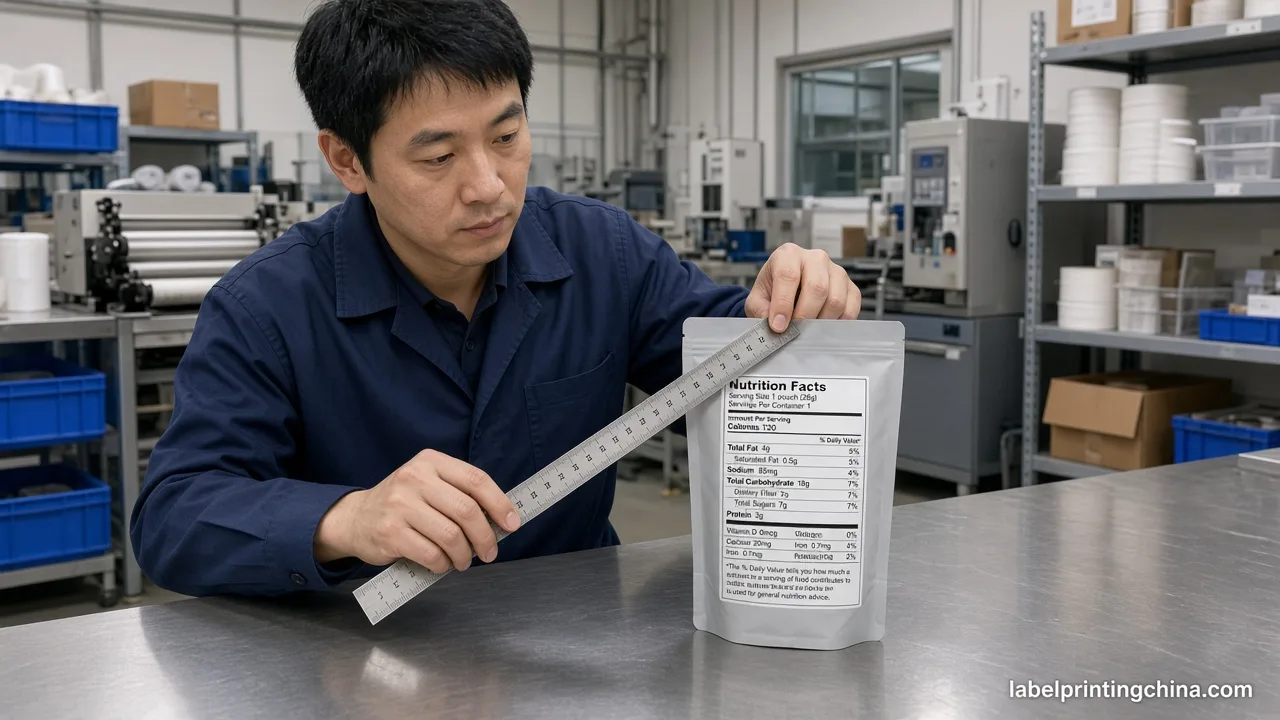
Even when panel content is legally correct, print execution fails scans and retail audits. Nutrition Facts type must meet minimum height rules; contrast between type and background must remain readable after laminate gloss.
UPC-A bar codes need quiet zones (typically 10× the narrow bar width) clear of text and graphics. On tapered beverage bottles, quiet zones compress when the label wraps—verify magnification and bar height at the smallest bottle diameter in your fill range.
| Checkpoint | Pass Criteria | Fail / Red Flag |
|---|---|---|
| Nutrition Facts type height | Meets 21 CFR minimum for package size | Fail → type shrinks to fit artwork |
| Serving size vs RACC | Matches FDA RACC for category | Fail → marketing portion used |
| Allergen statement | Contains statement or parenthetical on FDA path | Fail → omitted on shared equipment |
| UPC quiet zone | Clear margin at min bottle diameter | Fail → pattern bleeds into bars |
| TTB health warning | Matches approved COLA PDF exactly | Fail → paraphrased warning text |
Specialized custom nutrition labels for multi-SKU beverage lines should use a master spreadsheet linked to artwork layers—manual cell edits without version IDs cause the most common 10,000-unit recall trigger we see on export accounts.
Need a second set of eyes on your panel?
Send your dieline, nutrition worksheet, and jurisdiction path for a free pre-press compliance review before you approve mass print.
Compliance Mistakes That Force a Reprint
Route FDA vs TTB before panel design
Your formula lab ABV—not the marketing brief—decides whether you file a Nutrition Facts panel or a COLA-backed alcohol label. Use the Pass/Fail table above before artwork starts; your converter cannot reassign regulatory authority.
Freeze artwork when COLA is approved
Mandatory copy, ABV rounding, and health-warning placement cannot change after COLA without a new submission. Do not image cylinders until the approved COLA PDF is archived with your print file.
Proof on the bottle, not the PDF
Gloss laminate and curved wraps shrink type below legal minimums that flat proofs miss. Run a physical press proof at minimum and maximum bottle diameter before signing a 10K or 50K run.
Stop mass print if any of these show up on press check:
- Nutrition Facts type height below regulation after squeeze for brand art
- Allergen missing despite shared-equipment on the spec sheet
- TTB health warning edited after COLA approval
- UPC quiet zone broken on curved bottles
- Net contents missing metric on the principal panel
- COLA number absent from TTB-path print metadata
One unauthorized ingredient-line change between sample and mass production voids both FDA self-certification and TTB COLA—apply the same change-control you use for formulation batches.
Pre-Press Compliance Checklist for Export Brands
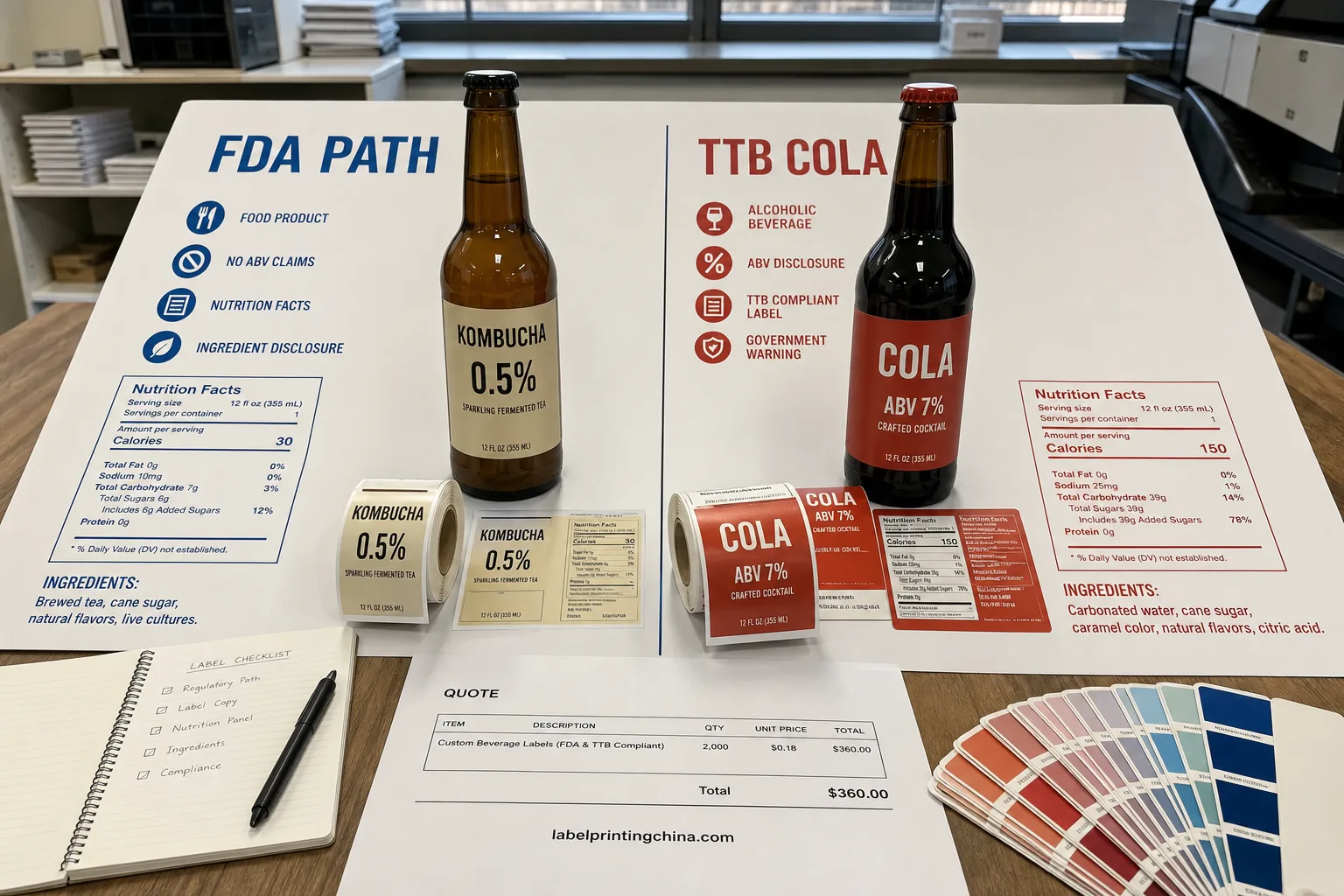
Complete the beverage label approval checklist with your converter before plate imaging. Label Printing China archives signed copies with each beverage PO for traceability.
| # | Item | Verify |
|---|---|---|
| 1 | Jurisdiction path documented | FDA self-certify or TTB COLA # recorded |
| 2 | Nutrition spreadsheet signed | RACC, rounding, dual-column if needed |
| 3 | Allergen worksheet matches formula | Contains statement or qualified facility note |
| 4 | Bar code scan report | Grade A/B at 80% and 100% magnification |
| 5 | Physical proof on bottle | Min and max diameter checked |
| 6 | TTB warning matches COLA PDF | Character-by-character compare |
| 7 | Adhesive and laminate stack documented | Indirect food-contact compliance on file |
| 8 | Artwork version ID on PO | Date + revision matches approved file |
Complete beverage compliance RFQs with jurisdiction path, COLA or nutrition files, and bottle dieline typically receive converter feedback within 12 hours. MOQ 500 remains available for trial SKUs once checklist items 1–5 pass.
Frequently Asked Questions
Who regulates beverage labels in the United States?
FDA regulates most non-alcohol beverages and many low-ABV products including wine below 7% ABV and typical hard seltzers. TTB regulates distilled spirits, malt beverages, and wine at 7% ABV or higher. Kombucha above 0.5% ABV at any production stage is generally subject to TTB alcohol beverage rules.
Does FDA require pre-market label approval for drink labels?
No. FDA-path beverages self-certify compliance with food labeling regulations. TTB-path products require COLA approval before interstate sale. Your converter should still run an independent pre-press audit before imaging plates.
What is a TTB COLA for alcohol beverage labels?
A Certificate of Label Approval confirms TTB acceptance of your label images for a specific alcohol beverage. You receive a COLA number that must match the approved PDF sent to print. Changes to mandatory statements require a new submission.
What are the most common beverage label compliance violations at print?
The highest-frequency failures are undersized Nutrition Facts type, missing allergen declarations, UPC quiet-zone violations on curved bottles, and health-warning edits after COLA approval. Each triggers buyer rejection or reprint costs above $3,000 on a 10,000-label order.
What must appear on a beverage nutrition facts panel?
FDA-format panels require serving size, servings per container, calories, mandatory nutrients, and percent Daily Value where applicable. Allergens must be declared per FALCPA plus sesame. Type size, leading, and contrast rules apply before you approve mass production.