A beer can pulled from the ice bucket, label curling, ink bleeding where condensation ran down the aluminum. The artwork was perfect. The substrate was wrong.For small breweries running 5,000 to 50,000 cans per batch, material choice is not cosmetic — it is the difference between a can that still looks like your brand after 72 hours in a wet cooler and one that arrives advertising failure.
Specify a BOPP family first, then choose the finish by retail channel. Paper fails in ice within hours; vinyl over-specs the cost by 30 to 40 percent.
For breweries managing multiple SKUs or moving from pilot runs to repeat production, route material, condensation, and roll-format decisions through our custom beverage label production page before requesting samples.
Why Material Choice Decides Whether Your Label Survives the Ice Bucket
A beer can label has one job that paper and most films cannot do simultaneously: stay flat, stay legible, and stay bonded to aluminum while water runs down its surface for hours. The ice bucket is the cruelest test in beverage premium spirit bottle finishes because it combines three failure modes at once — prolonged moisture contact, temperature cycling between 0°C and ambient, and mechanical abrasion as cans rub against each other and against ice.
Uncoated paper labels absorb water through the fiber matrix within minutes. The fibers swell, the laminate (if any) lifts at the edges, and the adhesive — typically a water-based acrylic formulated for dry surfaces — reverts and loses tack on the chilled aluminum.Field data from grocery fridge failure analysis shows paper labels beginning to curl at the 6 to 8 hour mark of continuous condensation exposure. BOPP (biaxially-oriented polypropylene) does not absorb water at all. Its moisture vapor transmission rate is effectively zero for the timescale of an ice bucket session, which means the adhesive underneath never sees liquid water — only the temperature stress.
That single property is why every craft brewery in the 275K-can inquiry set that specified BOPP for their canned lineup reported zero ice-bucket returns, while the two that downgraded to coated paper for cost reasons both came back within a quarter asking for a replacement film.The material is not a line item. It is the warranty. For a deeper look at how condensation attacks adhesives over time, see our fridge condensation survival guide.
The Three Materials That Matter
Most material guides list eight substrates and confuse the buyer. For craft beer cans, three categories cover 95 percent of real-world decisions.
White BOPP is the default. It is opaque, prints with a clean white base that makes CMYK artwork pop, accepts UV-cured ink and overlaminate, and costs less than metallic or clear variants.If you do not know what to specify, specify white BOPP — it is the answer that is never wrong for a beer can going into cold storage.
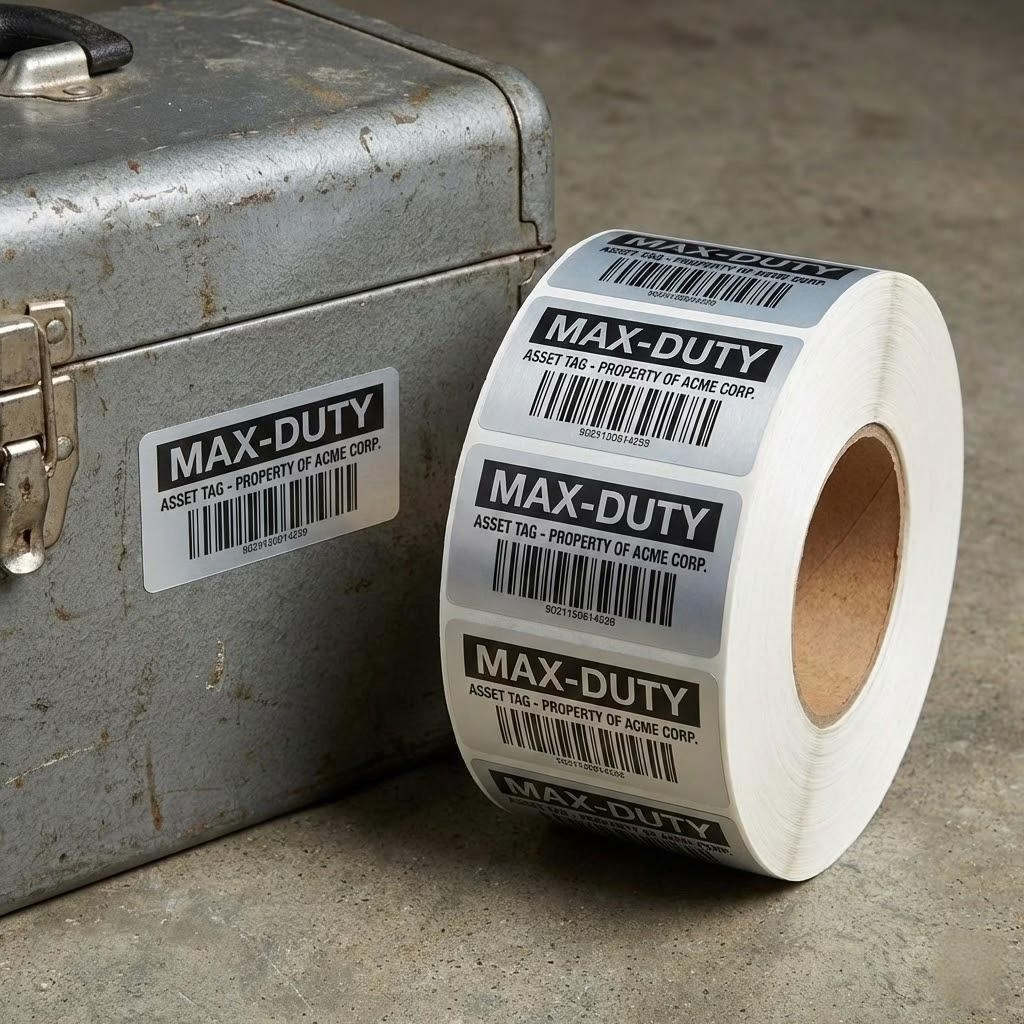
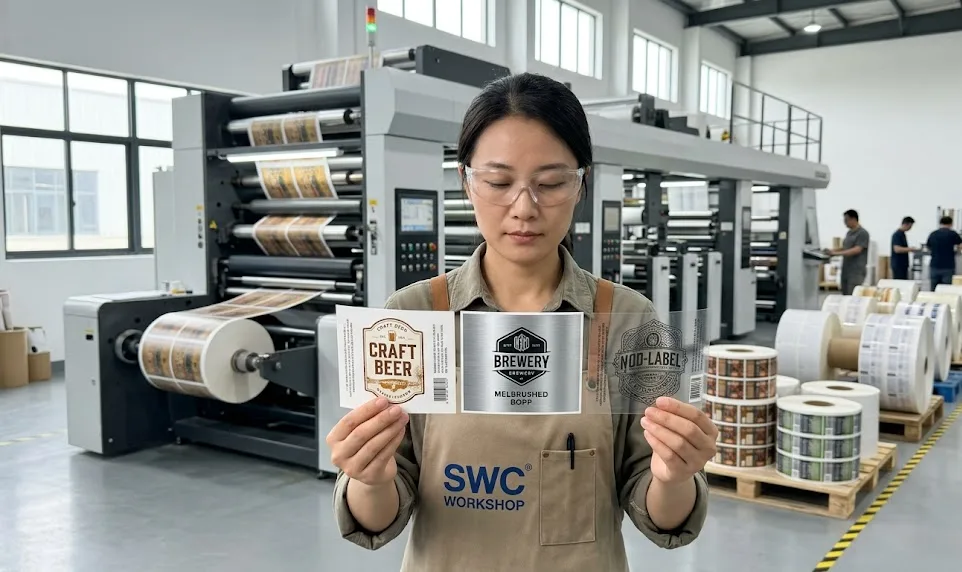
Metallic silver BOPP is the substrate that turned the most heads in the 275K-can data set. It uses a vapor-deposited aluminum layer under the printable surface, so the finished label reads as bare brushed metal where the ink is absent.For breweries whose brand identity leans industrial, retro, or premium — and most craft brands do — metallic BOPP lets the can itself become part of the design instead of a white canvas printed edge to edge. It is the closest a pressure-sensitive label gets to the look of direct-printed aluminum without the six-figure direct-print MOQ.
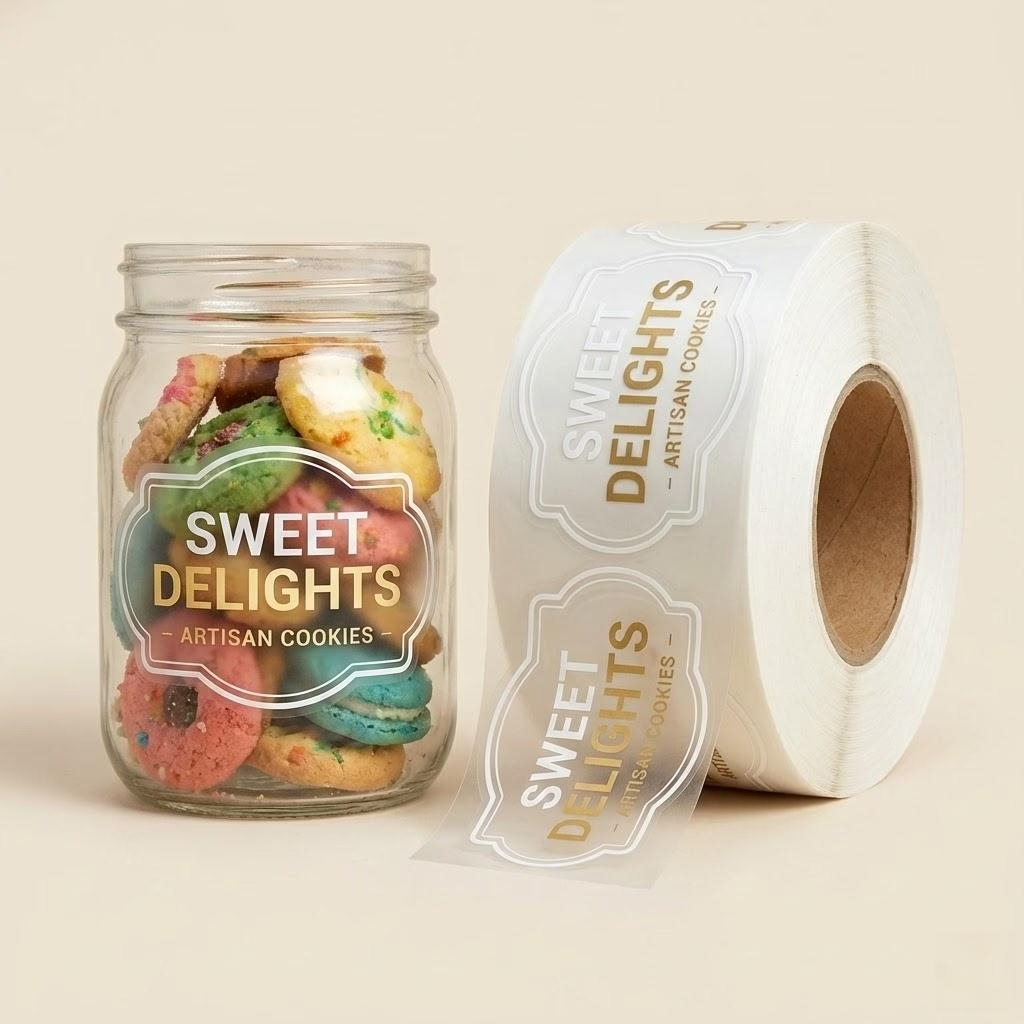
Clear BOPP is the no-label look. The film is transparent, so only the printed ink shows against the aluminum can.It suits minimalist brands and designs that want the metal to show through as a design element — the same clear BOPP no-label look in luxury packaging. The trade-off is that white ink must be laid down first wherever opacity is needed, which adds a print station and a small cost premium.
Vinyl is over-spec. It is thicker, more expensive, and designed for applications BOPP cannot handle — extreme heat, chemical immersion, multi-year outdoor exposure. None of those describe a beer can. Specifying vinyl on a beer can label is paying 30 to 40 percent more for properties you will never use.
Uncoated paper is the false economy. It is cheap per square meter and looks beautiful dry. The moment it meets ice, it stops being a label and becomes a problem.
| Material | Ice Bucket Survival | Cost Index | Best Use Case |
|---|---|---|---|
| White BOPP | 72h+ | 1.0x | Default for all cold-chain beer cans |
| Metallic Silver BOPP | 72h+ | 1.3x | Premium, industrial, retro craft brands |
| Clear BOPP | 72h+ | 1.2x | No-label minimalist designs |
| Vinyl | 72h+ | 1.4x | Avoid — over-spec for beverage cans |
| Coated Paper | 6–8h | 0.7x | Dry-shelf only, never ice |
Which Finish Sells Beer on the Shelf

Once the substrate family is locked, the finish is the second decision — and it is a marketing decision, not a technical one. The finish controls how the can reads under retail lighting and how the brand is positioned against the competitor sitting next to it in the cooler door.
Matte finish absorbs light instead of reflecting it. Under the bright, flat lighting of a craft bottle shop or taproom, matte suppresses glare and reads as quiet, deliberate, premium.It pairs well with spot-UV hits (a glossy logo printed onto a matte field) and with metallic BOPP — a matte overlaminate on metallic silver BOPP is the exact construction the 275K-can brewery reordered three quarters running, because it reads as etched aluminum rather than printed foil.
Gloss finish reflects light and creates shelf “pop.” In mass retail — grocery chains, retail drink label design — where a can competes against dozens of neighbors at three meters distance, gloss wins attention.It is also cheaper, because gloss overlaminate is the default and matte requires an additional film swap on the finishing line. For breweries whose scaling beverage label orders rather than the craft shelf, gloss is the pragmatic choice.
Brushed metallic is a variant worth naming separately. By running a directional texture into the metallic layer, the label mimics the radial brush lines of a finished aluminum can body.Up close, in hand, it is the finish that most drinker-photographers will instinctively feature in social content — which is free marketing for a small brewery.
The decision tree is simple. Taproom, craft shelf, or premium positioning: matte, ideally over metallic BOPP. Mass retail and grocery: gloss. Brand built on industrial or heritage cues: brushed metallic.
Sizing Labels for 355ml Sleek, 355ml Standard, and 473ml Cans
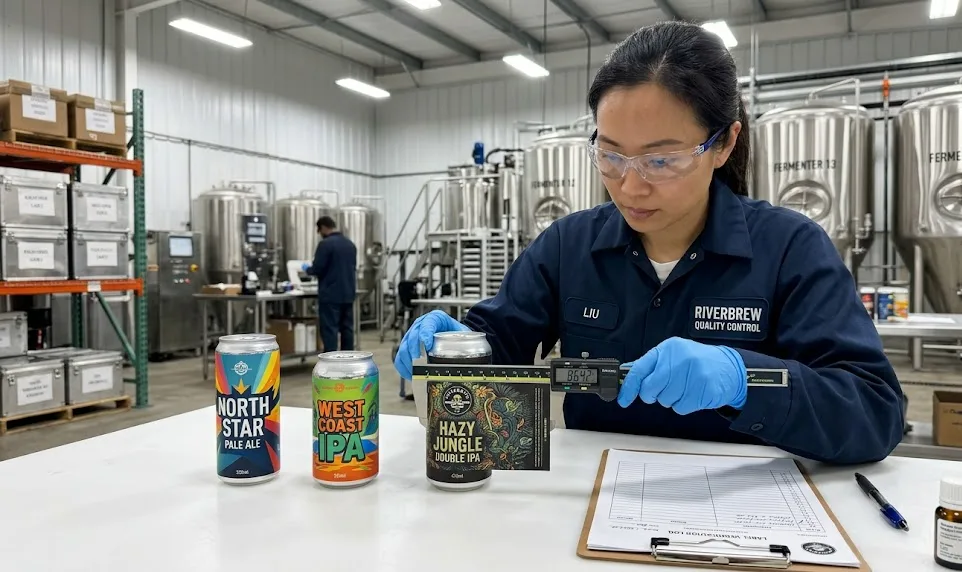
A label that is the wrong size for the can is a label that fails regardless of material.The wrap must cover the printable cylinder of the can with a small overlap (typically 3 to 5mm) for the adhesive to bond to itself, and the vertical height must sit within the can’s flat cylindrical zone — above the base curve and below the neck shoulder.
For 12 oz, 16 oz, and 19.2 oz inch charts plus diameter locks before you print, use our beer can label sizes.
The three can sizes that dominate craft beer in 2026 are the 355ml standard (the classic 12oz), the 355ml sleek (a slimmer, taller 12oz profile favored by modern craft brands), and the 473ml tallboy (the 16oz). Each has a different circumference and therefore a different label width.
| Can Format | Approx Circumference | Label Size (W x H) | Height Range |
|---|---|---|---|
| 355ml Standard (12oz) | ~205mm | 115 x 105mm | 95–110mm |
| 355ml Sleek (12oz) | ~211mm | 118 x 108mm | 105–120mm |
| 473ml Tallboy (16oz) | ~211mm | 140 x 120mm | 110–130mm |
Two sizing rules prevent the most common application failures. First, keep the wrap coverage between 95 and 98 percent of the circumference — too tight and the seam opens, too loose and the overlap creates a visible ridge.Second, hold the die-cut tolerance to plus or minus 0.15mm. Beyond that, the label walks on the can during high-speed application and the artwork registration drifts visibly. The same tolerance discipline matters when comparing MDO film vs standard BOPP for shaped containers.
A common mistake is using one label file across all three can sizes to save artwork cost. The sleek and the standard share a volume but not a geometry — a standard label applied to a sleek can leaves a gap or forces an oversized overlap that wrinkles.
The Hidden Failure Points
The substrate gets all the attention. The adhesive, ink, and overlaminate are where labels actually fail — and where small breweries most often under-specify.
The adhesive on a beer can label must be a permanent acrylic formulated for chilled, low-energy surfaces. Aluminum is a low-surface-energy metal, which means adhesives that work on glass or PET bottles will lift on cans. The operating range should cover minus 10°C to plus 80°C: the low end for ice buckets and cold trucks, the high end for pasteurization or warm-climate distribution.The food-contact compliance of these adhesives is governed by FDA 21 CFR 175.105 — always confirm your supplier’s adhesive carries a compliant letter, as we detail in our FDA food-safe adhesive guide. A rubber-based adhesive is the wrong call — it softens in heat and embrittles in cold, exactly the two conditions a beer can sees.
Ink system matters more than buyers assume. UV-cured ink is the standard for BOPP because it bonds to the film chemically and is fully waterproof once cured. Solvent-based ink is acceptable but slower to dry and increasingly regulated out of many print shops.The failure mode to watch is ink that is “dry” but not “cured” — it looks finished but has not crosslinked, and the first condensation cycle lifts it as a grey haze. A reputable supplier will specify cure energy in millijoules, not just say “UV ink.”
Overlaminate is the final defense layer. A 1.2 to 1.5 mil polypropylene overlaminate protects the ink from mechanical abrasion (cans rubbing in a six-pack carrier) and from UV fade on the retail shelf.Matte and gloss overlaminate options map to the finish decision above. Skip the overlaminate only for very short-run digital work where the can will be sold and consumed within weeks — the cost saving is not worth the fade risk for anything distributed through retail.
How to Brief Your Supplier (with the 275K-Can Benchmark)
The single biggest accelerator in the 275K-can brewery’s reorder cycle was a complete brief.Vague inquiries (“we need beer can labels, around 10,000, send price”) generated quotes that were wrong on material, wrong on size, and required three rounds of revision. Briefs that specified all seven fields below closed in one round.
The seven-field spec: can format and exact circumference; label width and height with tolerance; substrate family (white, metallic, or clear BOPP); finish (matte, gloss, brushed metallic); adhesive class (permanent acrylic, chilled-surface rated); ink system (UV-cured); overlaminate (yes/no, and finish).
Add the print run length and the application method (manual, semi-auto, or high-speed line) and the supplier can quote accurately without follow-up. For digital short runs — 500 to 5,000 cans — expect no plate costs, a per-unit premium of roughly 15 to 25 percent over flexo, and a 5 to 7 day lead.For flexo runs above 10,000 cans, plate costs apply (one-time, per color) but the unit price drops sharply and lead time extends to 10 to 14 days. The 275K-can brewery split its work: digital for seasonal and small-batch SKUs, flexo for the year-round flagship.
One final benchmark from that data set: breweries that specified metallic matte BOPP up front reported roughly 40 percent fewer post-delivery quality complaints than those that started with “whatever is cheapest” and upgraded after a failure.The cheap quote is rarely the cheap quote. According to membership growth data from the Brewers Association, the number of small and independent U.S. craft breweries keeps climbing — which means the shelf is only getting more crowded, and the can that survives the ice bucket looking like your brand is the one that earns the re-order.
Buyer Takeaway
For beer cans, the best label is the one that still looks intentional after cold handling and condensation—not simply the one with the most dramatic finish in a dry proof.
Craft Beer Can Sample-Run Brief
Use this brief with the RFQ, sample approval and production release. It turns the material discussion above into a comparable buyer decision.
| Can-label variable | What to confirm | Sample-run pass condition |
|---|---|---|
| Can format | 355 ml sleek/standard or 473 ml size and label panel | Artwork and label size match the real can |
| Cold exposure | Ice-bucket, fridge and handling conditions | No visible whitening, lift or finish damage |
| Material and finish | BOPP construction, adhesive, varnish/foil and scuff expectation | Approved sample meets the visual reference |
| Scale release | Run quantity, application method and pack-out | Quote and production spec use the same revision |
Brewery Production-Release Checklist
- Approve the label on the actual can size and finish, not only on a flat proof.
- Test the sample after representative cold and wet handling.
- Freeze artwork, material construction and the visual acceptance reference before a production release.
Request Free Beer Label Samples
Material decisions should not be made from a spec sheet alone. The fastest way to know whether white, metallic, or clear BOPP is right for your brand is to hold all three against your can, drop them in ice, and see what survives.
Request Free Beer Label Samples →
We will send a material swatch pack covering all three BOPP families, pre-applied to aluminum substrate, so your team can run the ice bucket test in-house before committing to a production run.
Frequently Asked Questions
What is the best material for craft beer can labels?
White BOPP is the safe default for any beer can entering cold storage or ice.Metallic silver BOPP is the premium upgrade for brands that want an etched-aluminum look. Clear BOPP suits minimalist no-label designs. Avoid paper (fails in ice) and vinyl (over-spec and over-priced for beverage cans).
How long do BOPP beer can labels survive in an ice bucket?
Properly specified BOPP labels with a permanent chilled-surface acrylic adhesive and UV-cured ink survive 72 hours or more of continuous ice bucket immersion with no delamination, ink bleed, or adhesive failure.Paper labels begin failing at 6 to 8 hours under the same conditions.
What size label fits a 473ml tallboy can?
A 473ml (16oz) tallboy typically takes a label approximately 140mm wide by 120mm high, with a 3 to 5mm overlap and a die-cut tolerance of plus or minus 0.15mm. Always confirm the exact circumference of your specific can, as tallboy geometries vary slightly by manufacturer.
Is metallic BOPP worth the cost premium over white BOPP?
For brands positioned as premium, industrial, or heritage craft, yes.Metallic silver BOPP with a matte overlaminate reads as bare brushed aluminum and is the construction most frequently reordered by the high-volume craft breweries in our data. For value-tier or mass-retail brands, white BOPP with a gloss finish is the more cost-effective choice.