Tired of damaged roll edges shutting down your automated applicators? You are about to learn the exact industrial packaging protocols that guarantee your custom labels arrive completely machine-ready. Here is everything you need to eliminate global transit damage for good.
To prevent scuffed labels during transit, enforce strict mechanical rewinding tension to stop internal layer friction. Furthermore, secure all rolls using rigid 3-inch core plugs, vacuum-sealed moisture barrier bags, and K=K 5-ply corrugated cartons to block moisture shock and crushing.
But proper rewinding tension is just the first step. Let’s dive into the bulletproof PO checklist and the exact 3-minute incoming inspection protocol that will permanently secure your automated production line.
Why Scuffed Edges Equal Applicator Downtime
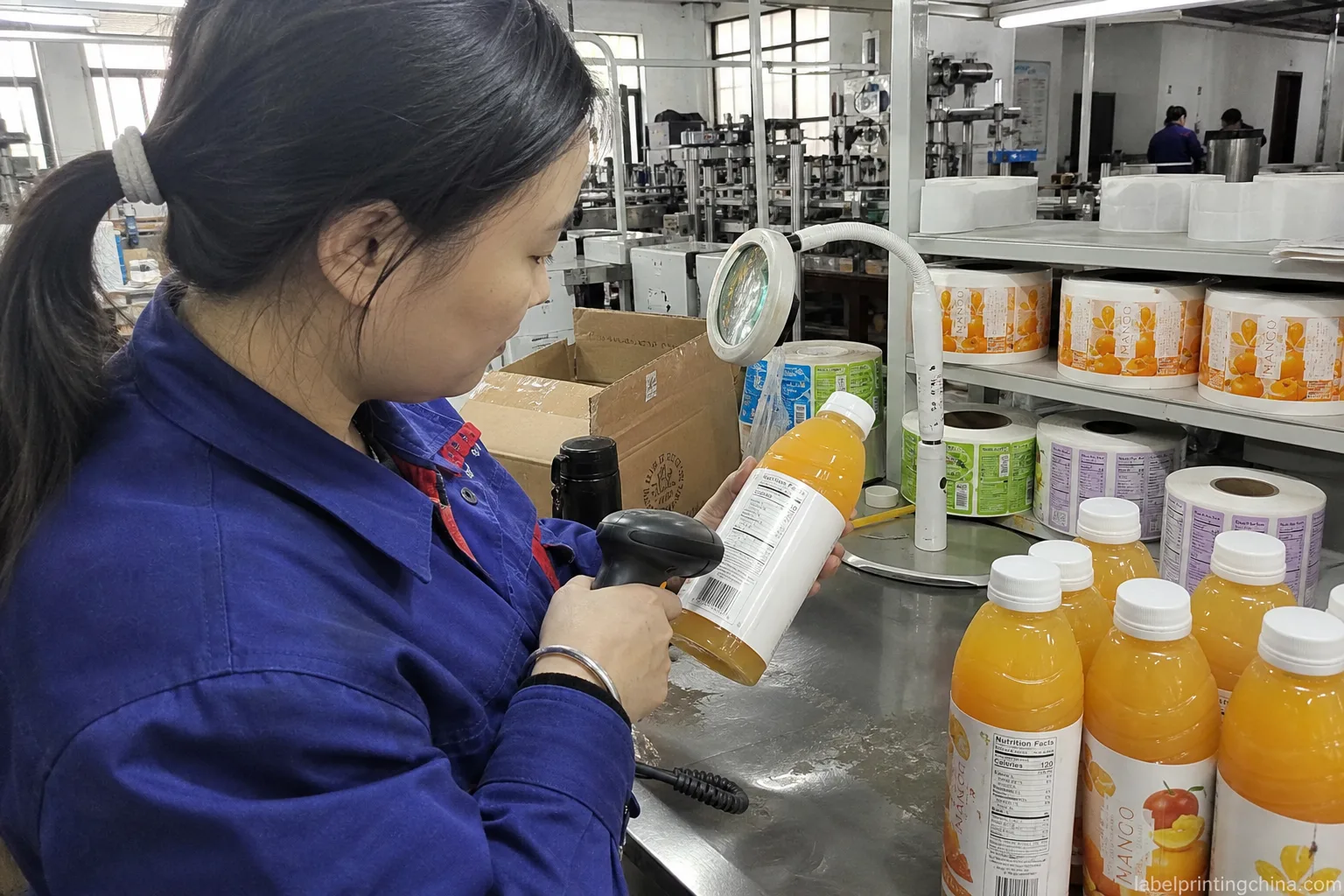
The true cost of a damaged label roll is never just the price of the printed paper. When you are sourcing high-volume recurring orders, you are feeding automatic applicators that process between 200 to 300 units per minute.These high-speed production lines rely entirely on highly calibrated optical sensors to read the precise gap between each individual label.
The physical tolerance for these industrial sensors is incredibly tight—often strictly less than 1.5 millimeters. An optical sensor works by shooting a beam of light through the backing liner to detect changes in opacity.
If the edge of a label is even slightly frayed or scuffed from transit friction, the sensor receives a fuzzy, scattered reading. It can no longer accurately detect the starting point of the next label.
The automated failure sequence begins with sensor blindness, where the optical eye misreads the scuffed edge as a continuation of the backing liner.This triggers timing desynchronization, meaning the applicator misfires, placing the label crookedly or entirely off-target on the bottle. Ultimately, this causes web breakage as the machine attempts to overcompensate, snapping the tensioned label web entirely and causing immediate line stoppage.
“A failed label stops the entire manufacturing line. When a scuffed edge blinds an optical sensor, it is not a cosmetic flaw; it is a severe applicator downtime crisis.” — *Dan Muenzer, Former President of the Tag and Label Manufacturers Institute (TLMI)*
This shifts the procurement conversation from visual aesthetics to operational survival. Delivering machine-ready label manufacturing process rolls with pristine edges is the only metric that guarantees your production security and protects your internal reputation.
The Total Cost of Ownership (TCO) Illusion
Many buyers fall into the trap of aggressively negotiating the upfront unit price without calculating the total cost of ownership regarding packaging integrity. When an overseas supplier uses cheap, domestic-grade cartons to save a few dollars, you pay the price on the factory floor.
Consider the real financial impact of a single line stoppage. If your automated line produces 200 units per minute, a standard 30-minute recalibration delay results in 6,000 lost production units.If your profit margin is just two dollars per unit, that single scuffed label roll just cost your company $12,000 in lost revenue. This is why conducting a comprehensive label printing cost analysis before finalizing contracts is vital for long-term operational health.
Procurement Model Comparison
| Operational Metric | Traditional Broker Model | Industrial Precision Model |
|---|---|---|
| Primary Focus | Cheapest unit price, basic surface coatings | 100% Machine-Ready, strict transit engineering |
| Packaging Protocol | Standard single-wall cartons, loose tension | K=K 5-ply cartons, vacuum-sealed barrier bags |
| Transit Friction | High risk of telescoping and edge scuffing | Zero internal kinetic energy; locked layers |
| Applicator Uptime | Unpredictable; high risk of sensor rejection | Seamless integration; zero downtime guaranteed |
| True Cost | High hidden costs due to line stoppages | Save 30% upfront with absolute production security |
Quick Guide: If your priority is long-term total cost reduction and continuous applicator uptime, choose the Industrial Precision Model over a lower initial unit price.
You cannot afford to view labels as mere printed consumables. They are precision mechanical components that dictate the rhythm of your entire factory.
The Physics of Roll Tension in Preventing Scuffs
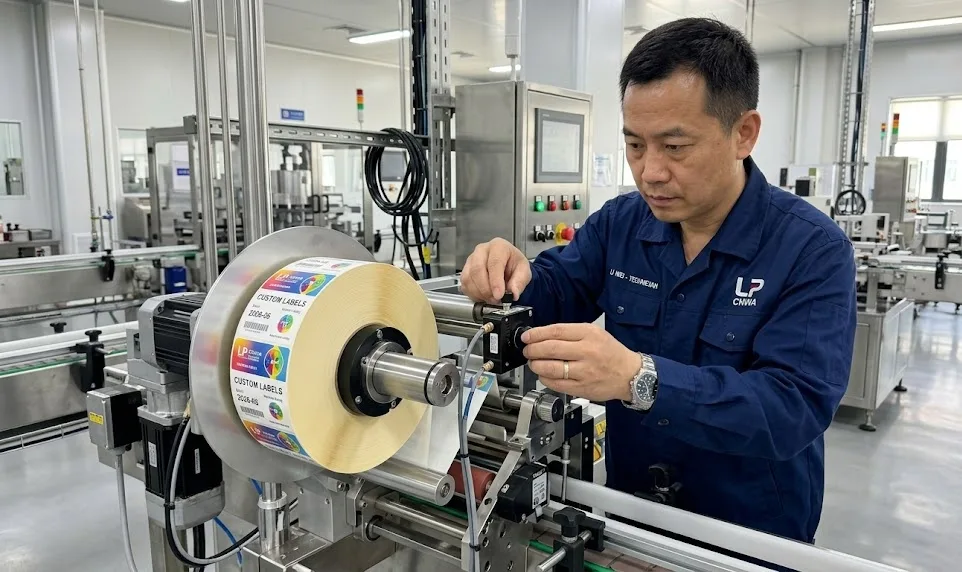
If you ask an intermediate broker how to protect your shipment, they will almost always advise you to add a thick layer of PET lamination. This is a dangerously superficial defense.While lamination protects the top surface from external contact, it does absolutely nothing to prevent the internal kinetic energy that destroys a custom label roll from the inside out.
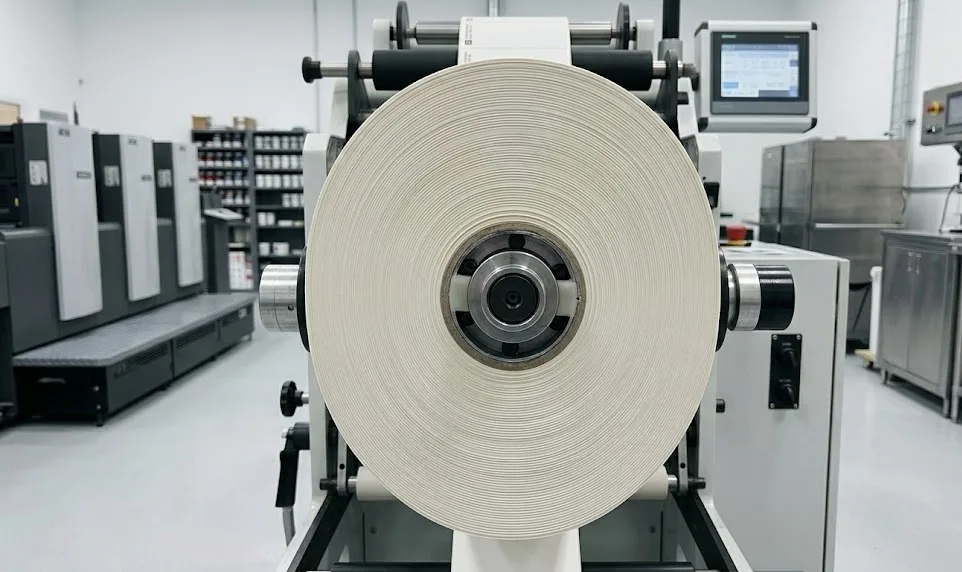
The true operational threat during a month-long ocean transit is a physical phenomenon known as telescoping. An industrial label roll is essentially thousands of layers of film or paper wound tightly together around a core.If the rewinding tension is set too loosely at the factory, those layers are not fully locked together. When that loosely wound roll is subjected to prolonged ocean freight vibration spanning days or weeks, the individual layers begin to slide against each other.
Imagine holding a thick phonebook loosely and shaking it; the pages will naturally slip outward.This constant, micro-level internal friction will physically grind off protective coatings and destroy the edges of the labels, no matter how premium your surface laminate is. Selecting an appropriate finish requires an understanding of varnish vs. lamination scuff protection based on the mechanics of your specific application line.
“As packaging dynamics expert Dr. S. Paul Singh’s research has shown, sustained low-frequency ocean vibrations cause internal abrasion. This is exactly why our engineers enforce strict rewinding tension—to lock the label layers and eliminate the internal friction that leads to scuffing.”
A major beverage brand ordered 500,000 BOPP labels from a standard supplier. To guarantee safety, they paid extra for a heavy 12-micron PET lamination. However, the supplier neglected mechanical rewinding tension, meaning during transit, the rolls telescoped severely.The displaced layers subjected the label edges to continuous sliding friction against the carton walls, resulting in a microscopic 0.5-millimeter fray. This tiny defect triggered optical sensor rejection, completely crashing their automated line. Our engineering team took over the account, enforced a strict mechanical tension threshold on our slitting machines, and locked the physical displacement of every single layer into a solid, unmoving mass to completely neutralize internal scuffing.
The ultimate line of defense against transit damage is not a surface chemical coating; it is industrial-grade physical tension control during the slitting process.
Defeating Moisture-Induced Carton Collapse
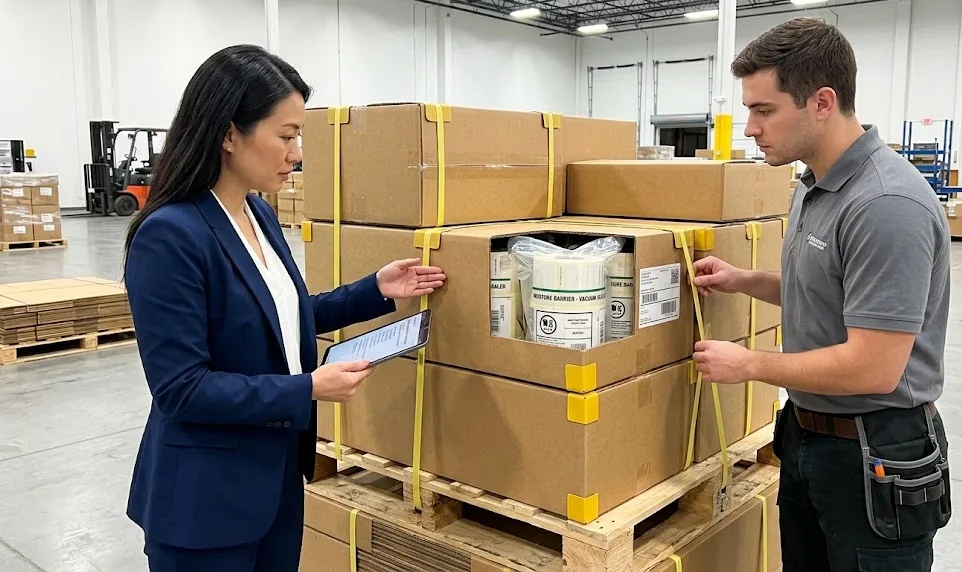
Many domestic buyers confidently trust the standard corrugated carton strength reports provided by their overseas suppliers. The critical flaw in this logic is that those laboratory-generated reports are conducted in perfectly climate-controlled environments.
In the reality of global transit, the micro-climate inside a steel shipping container routinely sustains 80% to 90% relative humidity. When exposed to this high-moisture environment, the plant cellulose fibers in standard corrugated board act like a sponge.As water molecules penetrate the board, they disrupt the hydrogen bonds holding the fibers together, causing the compressive strength of corrugated board to degrade rapidly by up to 50% within two weeks at sea.
Once the bottom layer of a pallet softens and collapses, the massive weight of the stacked cartons above crushes directly onto the label rolls inside.This vertical dynamic pressure forcefully deforms the rolls into an oval shape, grinding the label edges against the rough, weakened carton walls. Relying on generic warning stickers is not a viable supply chain strategy.
Ready to Secure Your Industrial Production Lines?
Stop risking applicator downtime from crushed cores and humidity-degraded packaging. Secure your zero-downtime automated run with heavy-duty engineered labeling protection.
Our logistics team enforces a strict multi-layered isolation protocol to ensure absolute environmental defense for trans-Pacific shipments:
- K=K 5-Ply Corrugated Cartons: Utilized as a fortified outer shell engineered to withstand extreme vertical stacking forces under dynamic sea shipping conditions.
- Double-Sealed Vacuum Barrier Bags: Every single label roll cluster is isolated inside an airtight protective bag that blocks atmospheric moisture exchange entirely.
- Industrial Desiccant Packs: High-absorption drying agents are enclosed within the sealed barrier bags to instantly capture any microscopic ambient humidity trapped during packing.
By building an isolated micro-climate, we ensure the cartons retain their maximum compressive strength, protecting your custom rolls from crushing and ensuring they function perfectly alongside standard 3″ core and max roll diameter automatic dispensing configurations.
Why 3-Inch Core Plugs Are Non-Negotiable
When stacking pallets for international freight, the bottom-tier cartons bear hundreds of kilograms of vertical dynamic pressure. Inside those cartons, the standard paper core of your custom label roll is inherently vulnerable.It is, fundamentally, a hollow paper cylinder. Under sustained heavy loads and the sudden vertical impacts of ocean swells, an unprotected paper core will compress and warp into an oval shape.
If the core deforms, the inner layers of the label web will permanently wrinkle. More critically, an oval-shaped core will no longer fit onto the perfectly round steel spindle of your automatic applicator, rendering the entire roll completely useless, regardless of the print quality.For automatic production systems, utilizing the correct 1-inch vs. 3-inch cores engineering standard is vital, but physical reinforcement remains the true deciding factor for transit safety.
To combat this structural failure, we mandate the insertion of rigid plastic core plugs into both ends of every core for bulk orders.This creates a solid internal brace that fights external compression, locking the core into a perfect circle. It is a non-negotiable structural requirement to ensure your rolls remain perfectly intact.
Bulletproof Your Next PO & Incoming Inspection
To establish absolute production security on your next overseas order, you must dictate the physical packaging parameters before production begins. Do not leave transit protection open to interpretation. Copy and paste these exact constraints into the remarks section of your Purchase Order:
- Outer Packaging Specification: Mandatory use of heavy-duty K=K 5-ply corrugated cartons for all individual roll containers.
- Moisture Defense Specification: All rolls must be enclosed inside double-sealed vacuum moisture barrier bags accompanied by active industrial desiccants.
- Structural Core Specification: High-impact rigid plastic core plugs must be physically inserted into both open ends of every core prior to boxing.
When a pallet arrives at your facility, execute this rapid three-minute incoming inspection protocol before the rolls ever reach the production floor:
- The Compressive Pressure Test: Apply heavy downward pressure to the corners of the bottom-tier cartons on the pallet. If the cardboard feels soft, mushy, or yields easily, moisture penetration has occurred, and the internal contents must be evaluated for edge deformation.
- The Flushness Sight-Line Scan: Once the protective barrier bags are removed, view the label roll from a flat, horizontal side profile angle. The surface should be entirely flush, resembling a solid wood table. Protruding layers indicate a failure in tension control, meaning edge friction has compromised machine compatibility.
If the print face looks hazy while edges stay flush, open the face scuff shipping guide for face-scuff triage and pack-interface checks.
- The Core Circularity Probe: Inspect the inner paper core for any signs of oval deformation. If the core is visibly warped, test its fit on an applicator spindle immediately before signing off on the warehouse receipt.
Catching a packaging transit failure at the loading dock takes exactly three minutes; resolving a jammed applicator line mid-production costs thousands of dollars per hour.
Conclusion
Protecting your supply chain requires a systematic, uncompromising engineering approach. By mastering rewinding tension, fighting moisture shock with isolated barrier systems, and physically reinforcing the roll cores, you completely eliminate the hidden costs of machine downtime.Utilizing 18 years of China manufacturing experience, our industrial precision standards ensure that your custom roll orders arrive flawlessly intact. We provide more than just a reduction in unit costs; we deliver the absolute certainty that your labels will not jam your machines. Preventing scuffed labels is the ultimate guarantee that your automated production line remains profitable, efficient, and 100% machine-ready.