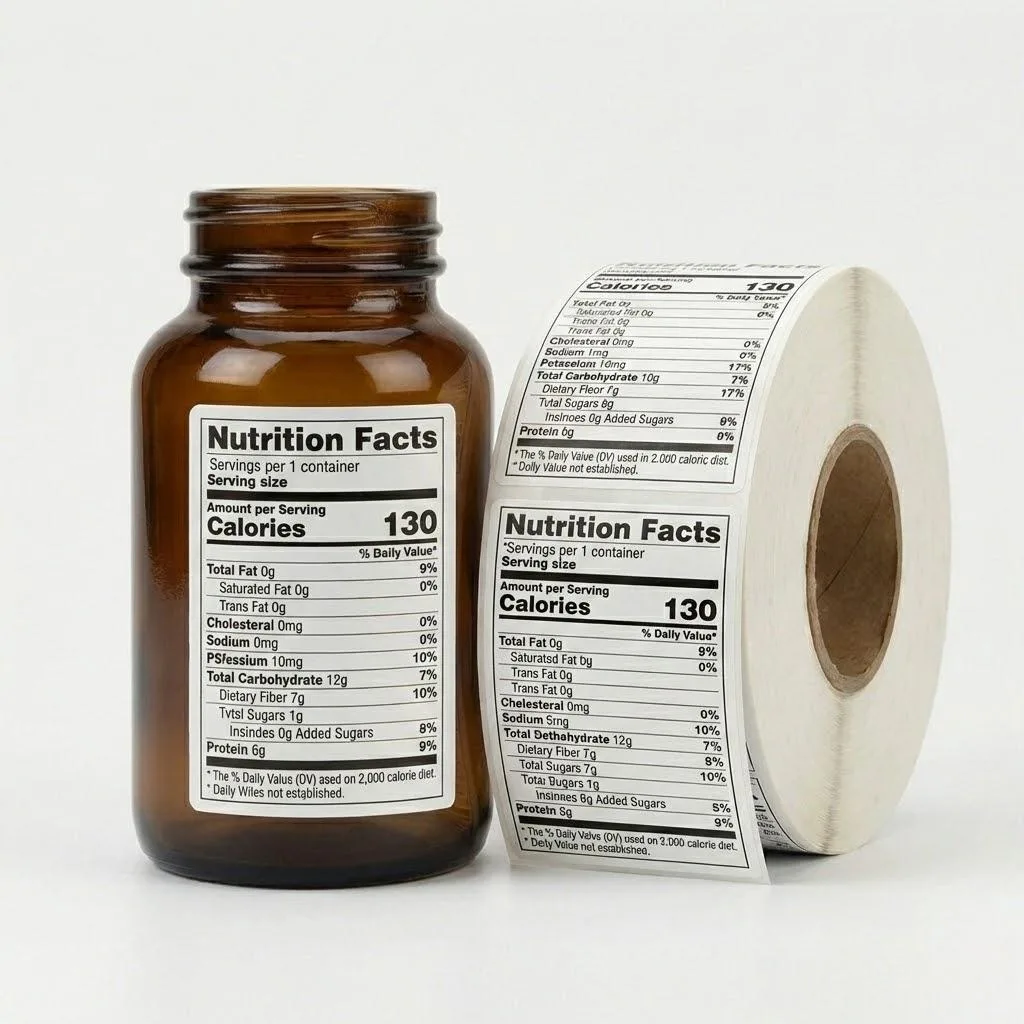
Shipping heavy industrial label rolls to Amazon FBA shouldn’t be a costly gamble. Securing your supply chain requires 18 years of technical manufacturing expertise distilled into precise physical parameters. Here is the definitive guide to engineering your custom water bottle labels to survive multi-state shipping and cut costs by 30%.
To safely ship bulk roll labels to FBA, replace soft bubble wrap with rigid suspension packaging. Use ECT-48 dual-wall corrugated boxes equipped with heavy-duty plastic core plugs (over 5mm thick) and corrugated cross-partitions to prevent core deformation and ensure 100% machine-ready delivery.
Want the exact tension control metrics that prevent adhesive oozing during extreme FBA climate shifts? Or the pallet dimension strategies that stop you from paying to ship dead air? Keep reading to completely bulletproof your inbound logistics.
Why Standard FBA Packaging Fails Fixed Assets

Optimizing your bulk label packaging for overseas FBA fulfillment presents a high-stakes calculation. Transitioning your industrial label production to a technical manufacturing facility in China can immediately reduce your operational costs by 30%.Yet, that initial margin remains highly fragile. When shipping heavy, high-density industrial label rolls across multi-state Amazon FBA routes, the primary threat to your ROI is not the unit price of the paper. It is the relentless physical stress of the transit environment.
In B2B supply chain management, readability translates to survivability. If you cannot quickly identify the structural vulnerabilities in your inbound logistics, your production line will suffer.This technical briefing deconstructs the exact physical and economic parameters required to safeguard your supply chain. We will replace standard shipping assumptions with rigorous anti-crush engineering, ensuring that your inventory arrives completely intact and fully machine-ready.
If you research standard fulfillment guidelines, the most common advice is to fill box voids with bubble wrap. For lightweight consumer goods, this works perfectly. For industrial materials, executing this advice is a catastrophic operational error.Roll labels are essentially dense cylinders of paper and industrial adhesive. A single carton of high-capacity rolls easily approaches the 50-pound FBA weight limit. When these dense objects are subjected to the continuous, low-frequency vibrations of a cross-country freight route, soft cushioning compresses and flattens entirely within the first few hundred miles.
Continuous transit vibration is significantly more destructive to dense, cylindrical cargo than a sudden drop, creating severe friction within the distribution environment hazards that disrupt load stability. — Dr. S. Paul Singh, Professor Emeritus of Packaging Dynamics.
Once the internal void fill collapses, kinetic energy transfers directly to the label’s center. If the standard 3-inch paper core absorbs this sustained pressure and deforms by just 1 to 2 millimeters, the roll will violently jam your high-speed auto-applicator.You do not just lose a box of labels; you trigger thousands of dollars in facility downtime and face immediate Amazon inbound compliance penalties.
The California Aggregator Crisis
To understand the sheer scale of this vulnerability, consider a recent recovery project involving a California-based sports nutrition aggregator.Their procurement team sourced a massive volume of BOPP synthetic labels, designated for direct fulfillment to a Texas FBA distribution center. The previous supplier packed these 45-pound cartons using standard ECT-32 single-wall boxes, heavily padded with industrial bubble wrap.
The shipment departed the Port of Long Beach and entered the interstate trucking network. Over four days, the cargo absorbed continuous highway vibration inside a trailer baking at 50°C. This environments exposure quickly exacerbated the structural limits of the generic packing materials used.
The physical breakdown manifested rapidly across three distinct phases:
- The extreme weight instantly crushed the bottom-tier bubble wrap, eliminating all shock absorption capacity.
- The bottom ECT-32 cartons buckled outward under the sheer vertical load of the pallet, shifting the center of gravity.
- Without rigid internal support, the 3-inch cores on the bottom rows collapsed, narrowing to an unmountable 74 millimeters.
When the shipment arrived in Texas, Amazon FBA instantly rejected the entire leaning pallet as a safety hazard. The few cartons that were salvaged were rushed to the client’s co-packing facility.However, the deformed cores refused to mount onto the applicator spindles. The automated line halted for six hours, incinerating the initial procurement savings and severely damaging the procurement director’s internal credibility.
The Suspension Framework
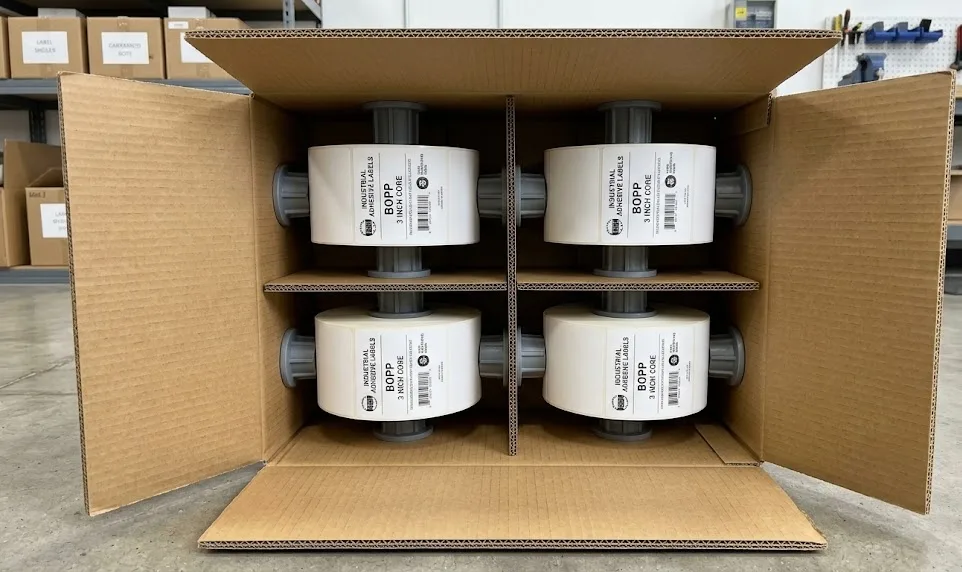
Based on 18 years of technical expertise in industrial manufacturing, the solution to this crisis requires a fundamental shift in perspective.You must stop treating packaging as an afterthought and start treating it as structural engineering. You must replace flexible cushioning with rigid suspension packaging to ensure an optimal 3″ core and max roll diameter standard.
To achieve a 100% machine-ready delivery, your packaging architecture must isolate the product from all external kinetic forces. This relies directly on implementing a engineered three-part system:
- The Outer Skeleton (ECT-48): You must mandate ECT-48 dual-wall corrugated boxes. The dual-flute structure acts as a microscopic steel frame. It disperses vertical compression outward, preventing the box from bulging when loaded with 50 pounds of dense paper.
- The Internal Armor (Plastic Core Plugs): A cardboard core cannot defend itself. Your factory must hammer heavy-duty plastic core plugs—exceeding 5 millimeters in thickness—directly into both ends of the roll. This forces the core to maintain a perfect geometric circle under extreme lateral pressure.
- The Suspension Grid (Cross-Partitions): Rigid corrugated cross-partitions must surround the plugged rolls. This suspends the label roll in physical space. External impacts are absorbed by the outer box and the partitions, never reaching the premium label finishes itself.
Aligning package configuration with physical stress vectors is essential to master the complex packaging technology fundamentals required for heavy freight. — Walter Soroka, Certified Packaging Professional.
Structural Material Performance Matrix
| Component | Standard B2C Approach | Industrial Precision Standard |
|---|---|---|
| Box Strength | ECT-32 (Single Wall) | ECT-48 (Dual Wall Heavy Duty) |
| Void Fill | Bubble Wrap / Kraft Paper | Rigid Corrugated Partitions |
| Core Protection | None (Exposed Paper) | >5mm Rigid Plastic Core Plugs |
| Load Bearing | Rests on the product | Rests on the box structure |
Quick Guide: If your priority is ensuring zero machine downtime, mandate rigid internal suspension over simple void fill methods every time.
Dynamic Tension Control
Physical crush resistance solves only one half of the FBA transit equation. The other half involves complex physical reactions triggered by extreme micro-climate shifts.When shipments travel from humid coastal ports to the dry, blistering heat of inland fulfillment centers, procurement directors frequently face inventory ruined by adhesive oozing.
Inexperienced buyers often blame the ambient temperature or assume the glue formula is defective. The actual failure occurs weeks earlier, directly on the factory floor during the winding process.
If a machine operator attempts to maximize daily output by increasing the rewind speed, the web tension spikes. The label web is wound so tightly that it becomes an inflexible brick. When inevitable thermal expansion occurs inside a sweltering truck trailer, the high-tack hot melt adhesive physically softens.Because the roll is wound too tightly, the expanding adhesive has zero internal space to occupy. Seeking the path of least resistance, it forces its way out through the edges of the roll, a catastrophic issue that can be prevented by sourcing from an experienced custom industrial labels manufacturer.
An over-tensioned label roll converts thermal energy directly into hydrostatic pressure, forcing the softened adhesive out of the margins and permanently bonding adjacent layers together.
In our extensive experience with global supply chains, combating this requires strict mechanical discipline during the final production stage. First, the factory must utilize automated sensors to lock the rewind tension precisely between 1.5 and 2.5 pounds per inch.This mechanical threshold provides the exact microscopic buffer the adhesive requires to expand safely without leaking. Second, immediately after rewinding, the rolls must be vacuum-sealed inside heavy-duty moisture barrier bags. This locks in a localized micro-climate, entirely isolating the paper fibers and adhesive chemistry from multi-state temperature and humidity swings.
Ready to Secure Your Production Line?
Stop risking automated labeling jams and costly FBA rejections. Get an engineered, 100% machine-ready structural packaging solution built for extreme transit conditions.
DDP Logistics and Dimensional Weight Economics
Engineering the perfect box is highly effective for product safety, but optimizing its exact dimensions directly impacts your Total Cost of Ownership (TCO).In DDP (Delivered Duty Paid) fulfillment, shipping empty air is the fastest way to erode your profit margins. Amazon strictly caps inbound pallets at a maximum height of 72 inches and a gross weight of 1500 pounds. Relying on off-the-shelf box sizes inevitably leaves one or two inches of dead space per carton.
By calculating the exact outer diameter of your custom label rolls, you can engineer bespoke ECT-48 box dimensions that fit the cargo flawlessly. This precise spatial density ensures that the bottom-tier boxes never collapse.More importantly, it maximizes the dimensional weight of every pallet, allowing you to hit the 72-inch height limit safely without violating the 1500-pound threshold, a core consideration covered in our comprehensive label sourcing checklist.
B2B buyers who manage procurement via physical dimensions rather than simple unit costs consistently prevent pallet rejection while maximizing volumetric transport value.
Financial Impact of Engineered Packaging
| Cost Category | Standard Packaging Routing | Engineered DDP Packaging |
|---|---|---|
| Material Cost | $0.005 per label | $0.005 per label |
| Transit Damage Rate | 8% to 12% | Near 0% |
| FBA Penalty Risk | High (Leaning/Crush) | Eliminated |
| Applicator Downtime | $5,000+ per incident | $0 (100% Machine Ready) |
Quick Guide: If your priority is long-term shipping budget protection, look beyond unit costs and implement a bespoke volumetric sizing model.
The Procurement Director’s Execution Blueprint
You cannot leave structural integrity to chance, and you cannot rely on vendor goodwill.You must lock down your supply chain by writing specific physical parameters directly into your corporate purchasing contracts, protecting your operational workflow from common labels peel off bottles and application structural issues.
Immediately remove vague language like “pack securely for ocean freight” from your documentation. Replace it with non-negotiable engineering mandates across your procurement orders:
- Require dual-wall ECT-48 corrugated cartons for any shipment exceeding 30 pounds to maintain vertical load security.
- Mandate the insertion of heavy-duty plastic core plugs on all rolls destined for automated application systems.
- Specify that internal corrugated cross-partitions must be used to eliminate lateral shifting during sea transit.
- Require written confirmation that rewind tension is calibrated between 1.5 and 2.5 lbs/inch for the destination climate zone.
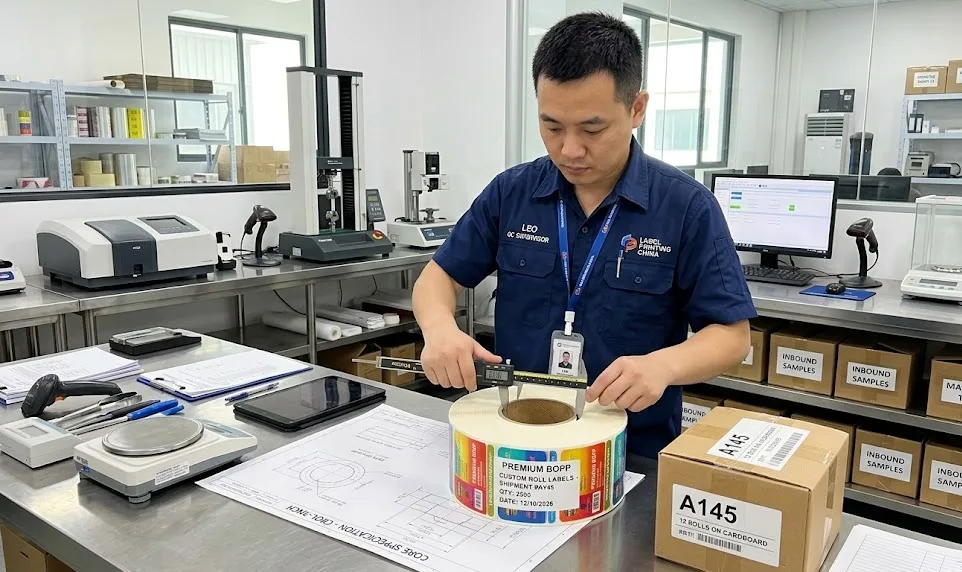
When your engineered shipment arrives at your facility or 3PL warehouse, instruct your receiving team to execute a strict quality control sequence before authorizing payment. This verification checklist represents your final defensive line against structural supply chain failures.
First, inspect the bottom-tier cartons to confirm physical structural health. Reject the pallet if the bottom corners show vertical compression exceeding 1 inch. Second, use industrial calipers on the 3-inch inner core to measure geometric distortion.Reject the specific roll if the variance from a perfect circle exceeds 0.5 millimeters. Third, firmly swipe your thumb across the flat edges of the roll to test tension success. Reject the batch if you feel any sticky adhesive resistance, which indicates a failure in climate control isolation.
Securing Your Supply Chain Advantage
Surviving in the 2026 B2B manufacturing landscape requires absolute certainty. A supplier capable of meeting these strict anti-crush engineering standards delivers significantly more than just printed paper. They deliver the mechanical assurance that your automated lines will never stop running.
By demanding 18 years of China manufacturing experience and uncompromising physical parameters, you protect your company from hidden transit disasters.You transform an unpredictable overseas procurement process into a highly engineered, deeply reliable asset. Implementing these exact structural standards for your bulk label packaging ensures that every unit arrives at Amazon FBA perfectly intact, compliant, and unconditionally machine-ready.