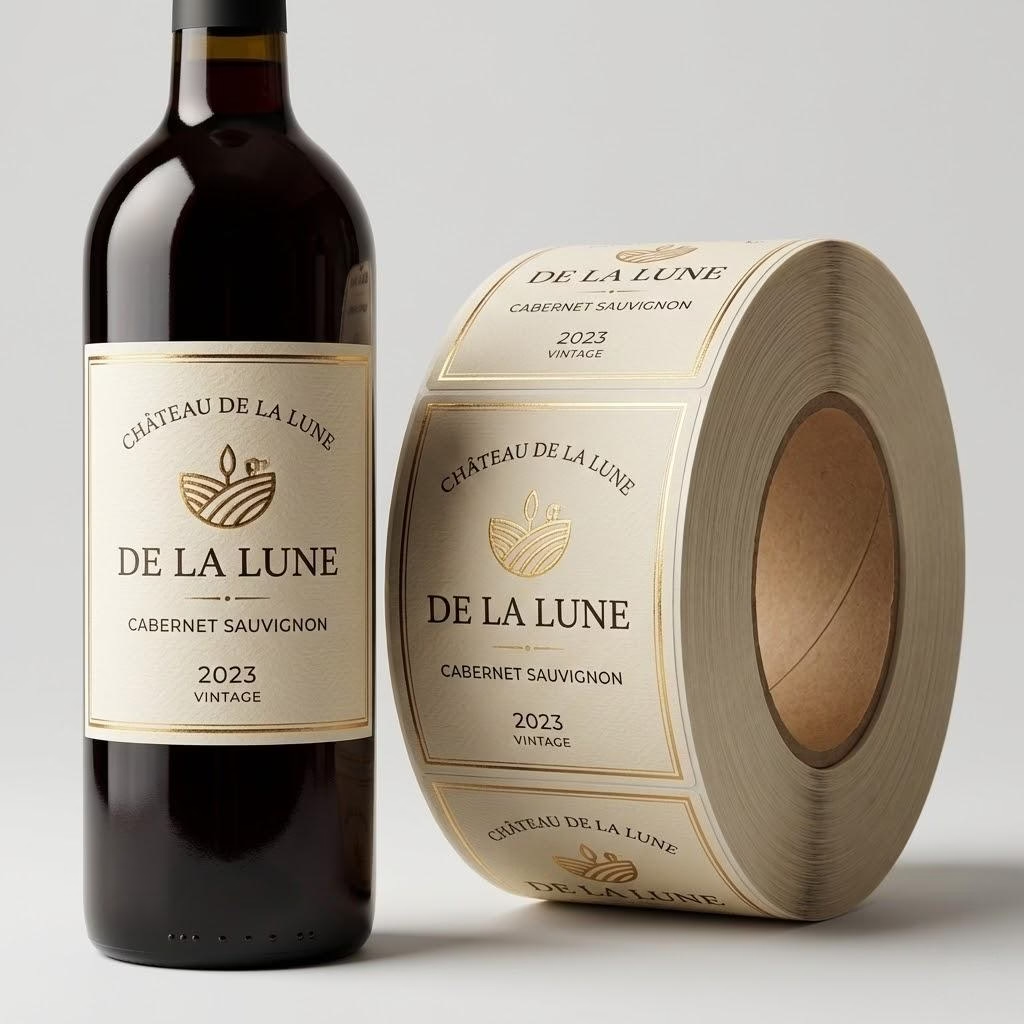
When a whisky brief only says “gold foil,” the press still has to guess which warm metal you meant. You can turn that vague shine into a named foil, stock, and proof path before the die is cut.
To specify antique gold foil labels for whisky, lock a named foil tone or supplier code, the face stock, any black underprint, a physical foil swatch under retail light, and first-article color limits before you release the production die and mass quantity.
Keep reading and you will leave able to brief and sign antique gold the same way every time—so the next whisky run matches the bottle you approved, not a brighter stock gold from the shelf.
Name the Antique Gold Tone You Want to Match
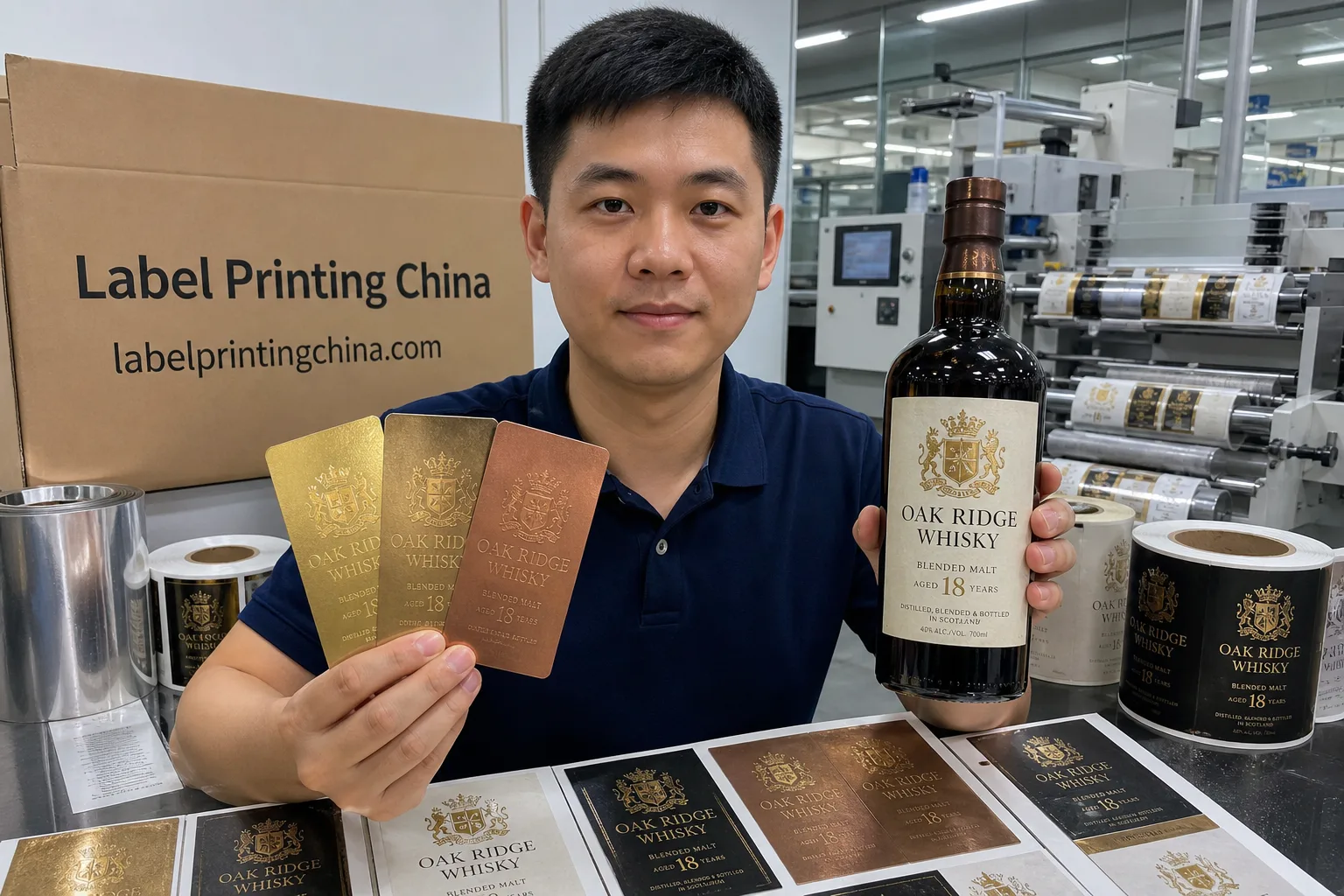
When you write “gold” alone, factories default to the brightest foil on the rack. Antique gold usually means a warmer, softer metal—closer to aged brass than mirror chrome—so you must name it.
| What you send | What the plant can lock |
|---|---|
| “Gold foil” with no code | Guesswork—often bright yellow gold; Hold the die until you name a tone |
| Supplier foil-book code + warm/cool note | Same reel family across proofs and mass; write the code on the PO |
| Reference bottle photo or physical metal chip | Direction only—still pair with a foil code so reorders stay stable |
When a craft whisky line once approved a mood-board gold on a laptop, the first stamped batch came back cooler and louder than the heritage story. Your fix is boring and powerful: pick a foil-book number, say “antique / warm,” and attach one reference image under store LED.
If the supplier cannot show a foil book, ask for three stamped chips on your chosen stock—bright gold, antique gold, and bronze—then circle one within 2 days. Do not open a brass die until that circle is dated and saved with the artwork. A common red flag is approving gold from RGB mockups alone.
Check foil registration within 0.2 mm on the crest before you sign. For short whisky runs under 2K labels, still lock the same foil code you will use at higher MOQ later so reorders match.
For the wider finish menu (hot foil vs cold foil, emboss stacks), keep the spirit label finishes guide as background. This page stays on naming the antique gold you will actually buy.
Put the foil code in the filename of your die art as well as the PO. When a second plant quotes later, they inherit the same metal language instead of inventing a new “close gold.”
Choose Paper and Underprint Before You Chase Shine
When you chase shine first, you skip the surface that changes how antique gold reads. Dark wine bottle label materials and textured stocks swallow metal unless you plan an underprint.
| Your face stock | What you specify with the foil |
|---|---|
| Deep red, black, or navy paper | Black (or opaque white) underprint under foil areas so antique gold stays warm, not muddy |
| Cream or uncoated art paper | Often stamp direct; watch fine type—fibers can break thin strokes |
| White or clear BOPP film | Expect cleaner edges and higher shine; antique look may need a warmer foil code, not just “less gloss” |
When you once stamped antique gold straight onto a burgundy whisky wrap, the crest looked dull and slightly green under bar light. Adding a solid black pad under the foil zone brought the warmth back without changing the foil reel. Verify the underprint covers every foil knock-out before you measure edge shine.
Write stock name, gsm or film type, and underprint yes/no on the same line as the foil code. If two quotes only say “gold on paper,” they are not comparable yet—ask each plant what sits under the metal. Inspect a wet-strength sample for 24 hours if bottles will see ice buckets.
Hot foil still needs heat, pressure, and a die that reaches into textured stocks; cold foil favors smoother films. You only need that split after stock and underprint are frozen—not as a substitute for naming antique gold.
If your whisky bottle will sit in ice or wet bars, say so early—wet-strength paper plus foil is a different build than a dry display wrap. You still prove antique gold on that wet-rated stock, not on a dry office mock.
Approve Gold on a Physical Foil Swatch
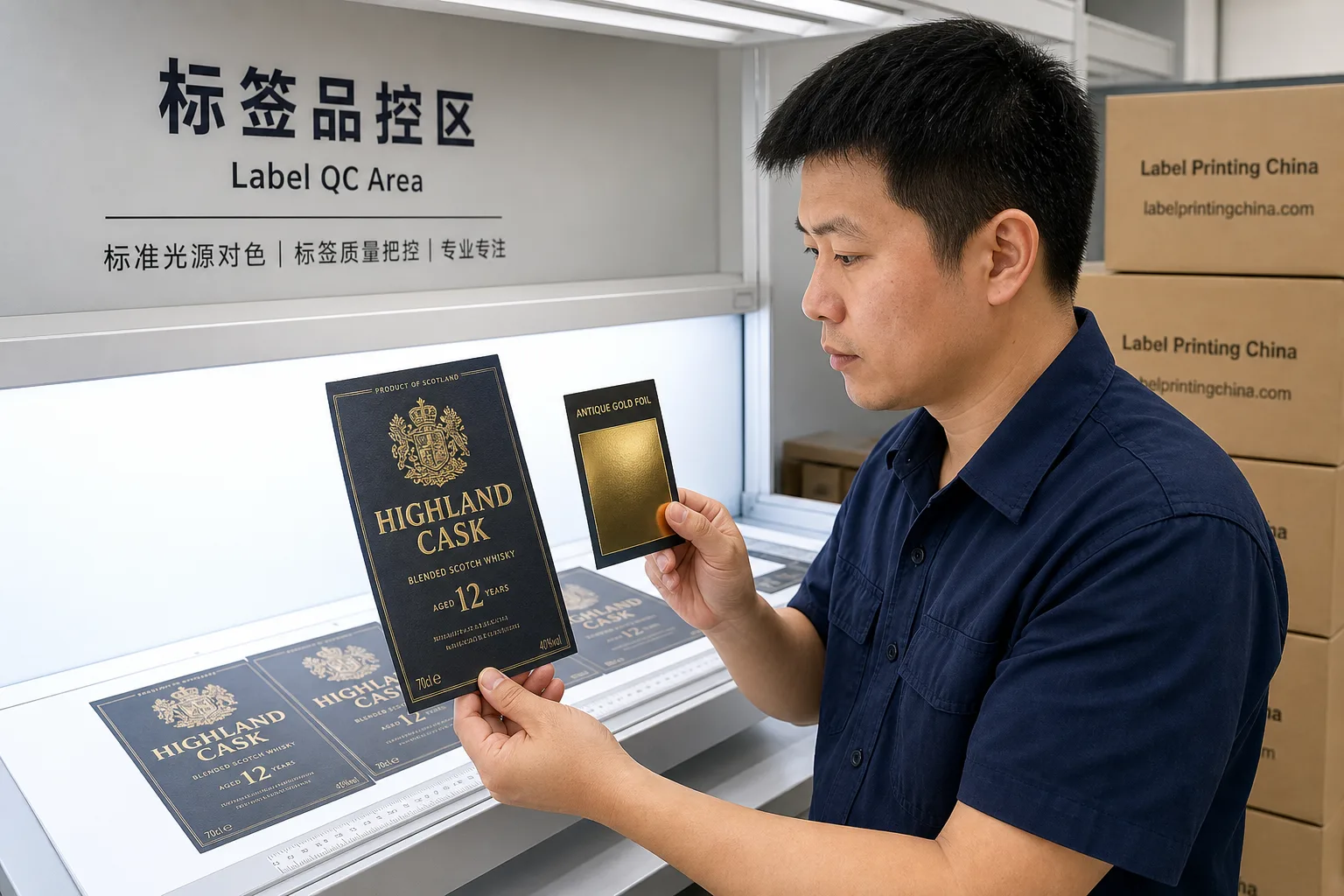
When you sign gold from a PDF mockup, you are approving pixels, not stamped metal. Antique gold foil labels only lock when you see foil on the real face stock under the lights shoppers use.
- Stamp or transfer the chosen foil code onto your production stock (with underprint if specified)
- View under retail LED and near a window; note warm vs cool shift in one sentence
- Photograph the swatch next to your reference bottle or chip; save with the PO date
- Sign only when brand owner and packaging agree the tone matches the whisky story
When a small-batch whisky brand once “approved” gold from a designer’s screen capture, the press proof looked two shades brighter and killed the aged look. Your swatch rule ends that loop: no die money until metal sits on stock.
If you need the wider soft-vs-hard proof map, skim the physical proofing guide after you freeze this foil swatch step—then come back and sign metal, not RGB.
Keep the swatch in a sleeve away from fingerprints. When a reorder six months later looks “off,” you compare new chips to the signed piece, not to memory.
Ask the plant to stamp the foil code lightly on the swatch back or on a companion chip. Future you should not rely on a sticky note that falls out of the sample bag.
Ready to proof antique gold for your whisky label?
Send artwork, preferred gold tone, substrate, quantity, and a reference image for a foil-proofing review.
Set First-Article Limits for Acceptable Gold Shift
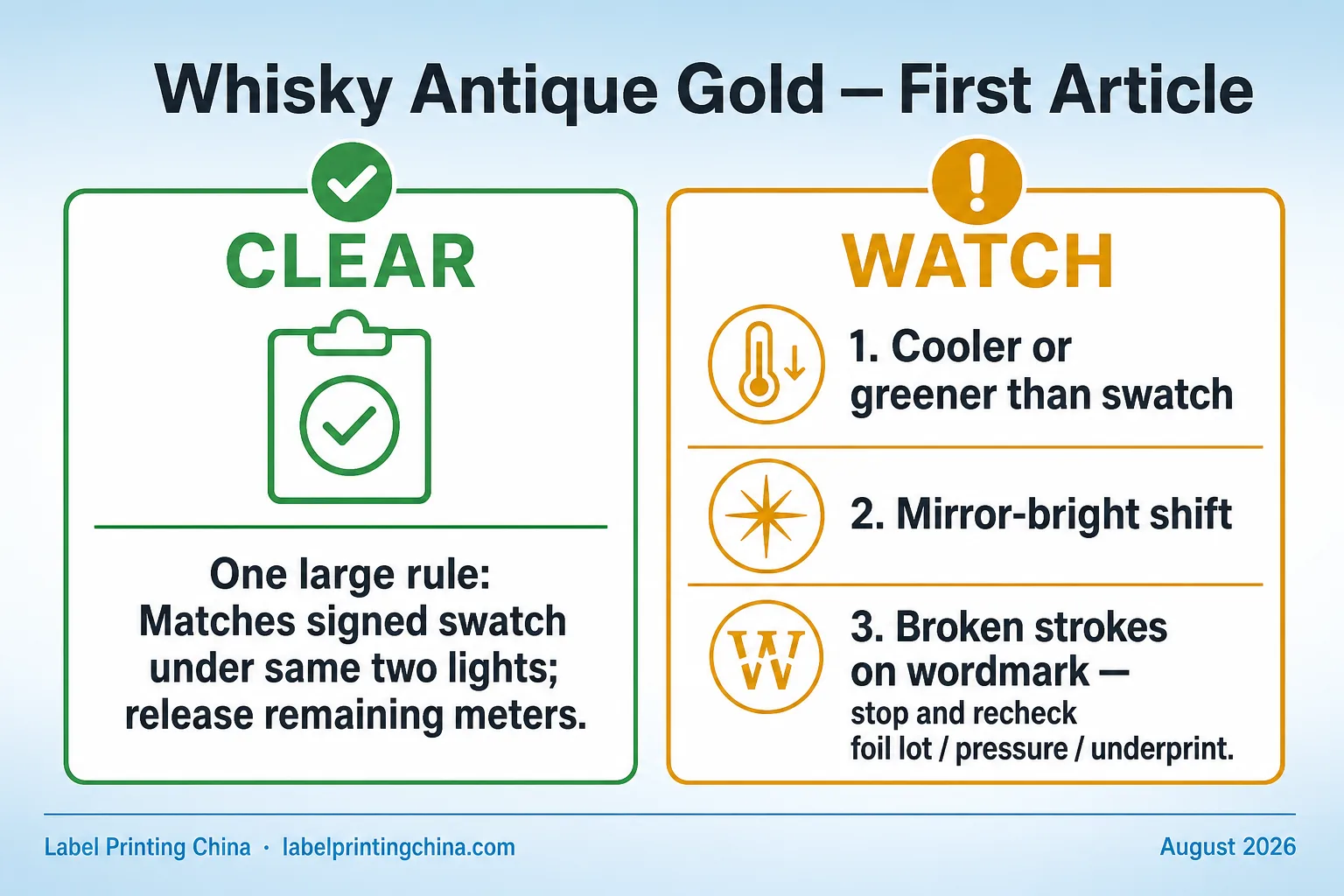
When the swatch is perfect but the mass roll drifts cooler, you still lose the shelf story. Put a first-article gate between proof and volume so antique gold cannot wander without a signature.
| Signal on the first whisky labels | Your call |
|---|---|
| Tone matches signed swatch under the same two lights; edges clean; registration holds on crest | Clear — sign first article and release the remaining quantity |
| Noticeably brighter, cooler, or greener than the swatch; foil breakout on fine lines; die crush on paper | Watch — stop the run; recheck foil lot, pressure, underprint, and die wear before more meters |
Write the limit in plain language on the first-article sheet: “no cooler than signed chip; no mirror-bright shift; no broken strokes on the wordmark.” You do not need a lab speech—you need a shared stop rule.
When a distillery once waved through a “slightly yellower” first roll, the full pallet looked like a different SKU beside last year’s bottles. Your Clear line is the signed swatch; anything that makes you re-explain the brand story is Watch.
For a plant-wide run protocol beyond foil color, keep the label run sign-off guide nearby—then still force this gold-specific first-article line onto the whisky PO.
Hold a few signed first-article bottles or labels in your brand kit. When marketing asks why the new batch “feels different,” you compare metal to metal instead of arguing from Instagram filters.
Keep Fine Type and Logos Out of Fragile Foil Zones
When you foil micro type and hairline crests, antique gold can fill in or flake and the brand mark goes soft. Give metal the bold shapes and keep legal lines in ink.
- Foil large crests, borders, and short wordmarks with stroke widths the die can hold
- Print ABV, batch, and tiny legal copy in opaque ink—not foil
- Avoid foiling barcodes or quiet zones; glare and breakout kill scans
- If the logo is intricate, foil a simplified badge and print the fine version nearby
When you once foiled a full address block on a whisky necker, half the serifs vanished after stamping. Your layout rule is simple: metal for impact, ink for information.
Industry write-ups of the hot foil stamping process still start from heat, pressure, and a die—your artwork must respect that physics, not fight it with six-point metallic text.
Before you release files, ask the plant which foil strokes are below their safe width on your chosen stock. If they hesitate, thicken the metal art or move detail to ink.
Leave a small non-foil quiet zone around barcodes and batch windows so glare from antique gold does not bounce into the scan path on curved glass.
Lock Your Whisky Foil Spec Before You Scale
Antique gold only stays “your” gold when the PO carries a foil code, stock, underprint note, signed swatch, and a first-article Clear line. That packet is what turns a whisky mood into a repeatable label.
Once those five locks sit in the same folder, releasing the die and the remaining meters is a controlled step—not a hope that the next reel feels premium enough.
When artwork, gold tone, substrate, quantity, and a reference image are ready, start from custom spirit bottle labels with that foil-proofing pack attached—so your next whisky run ships against a named antique gold, not a guess.