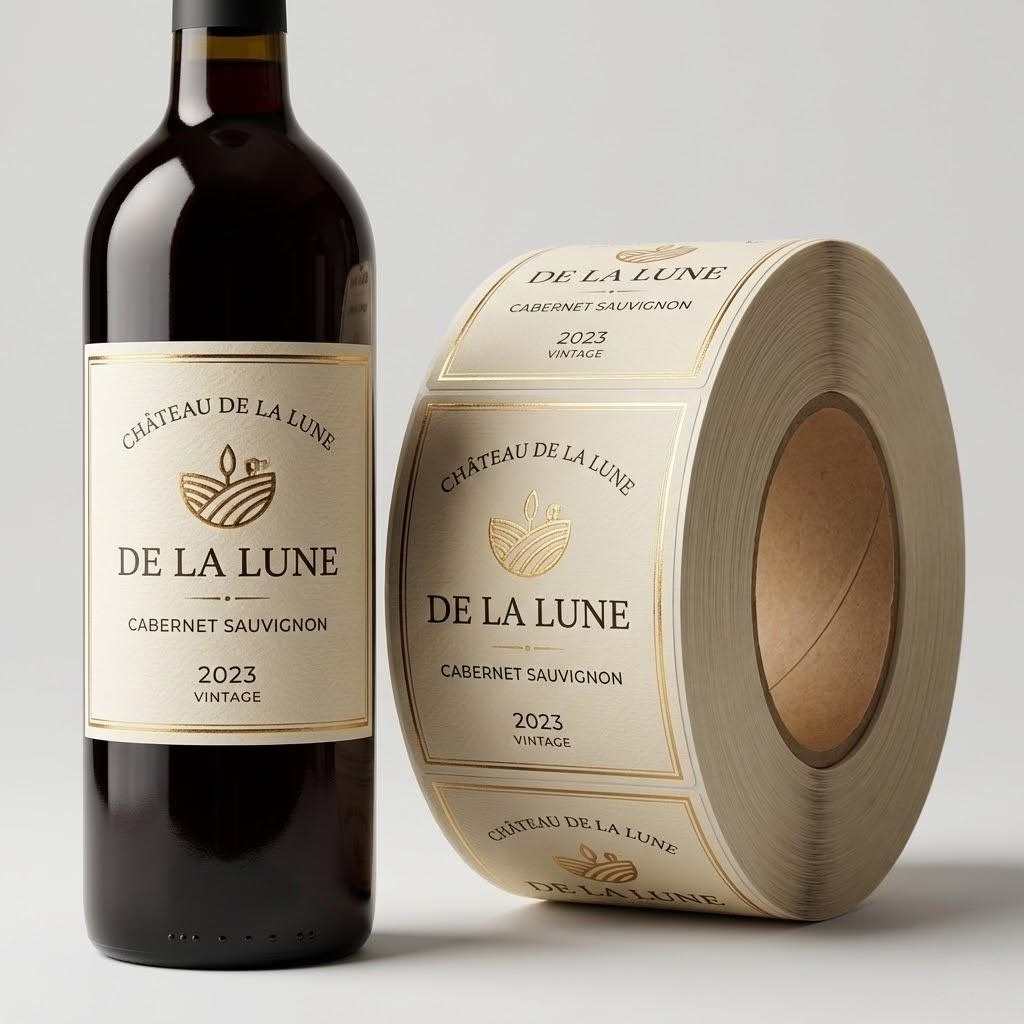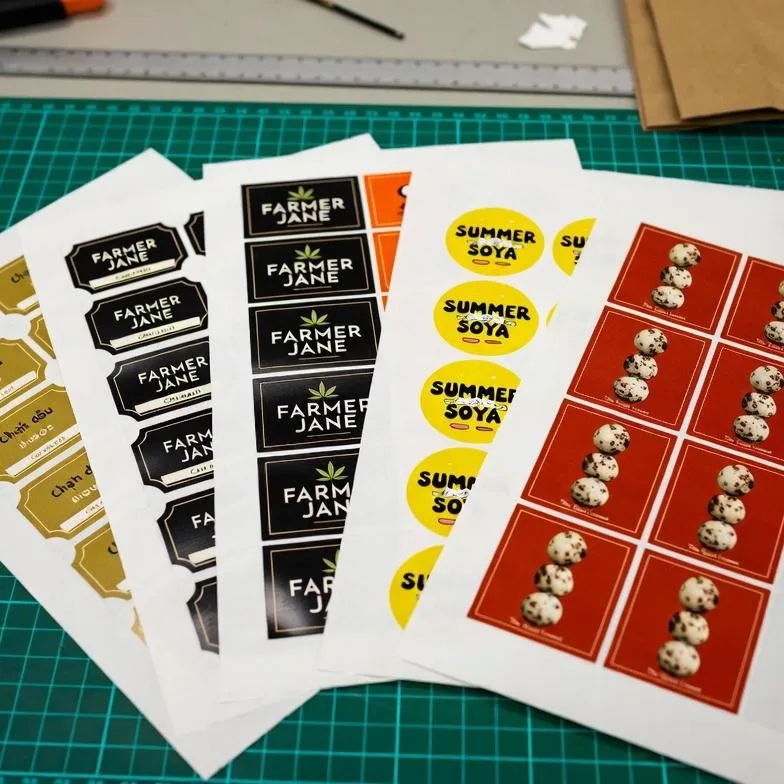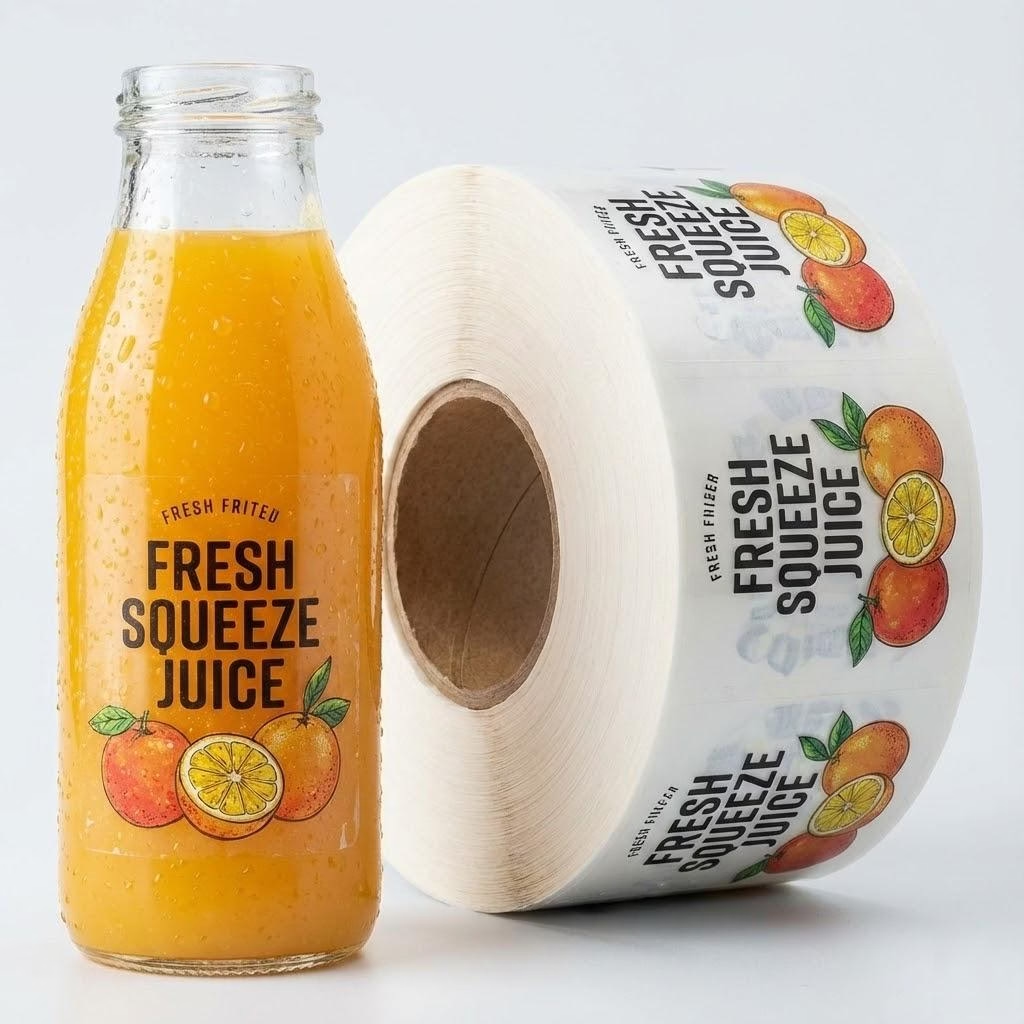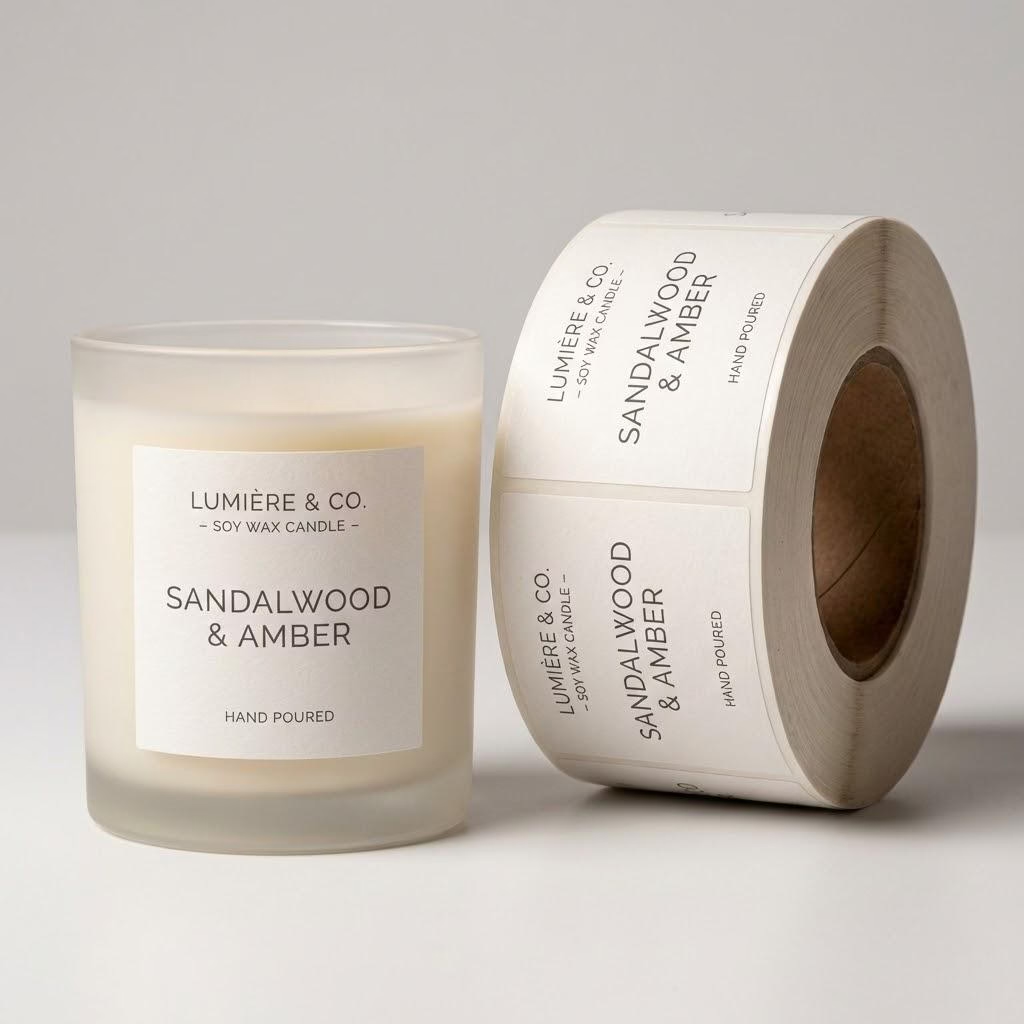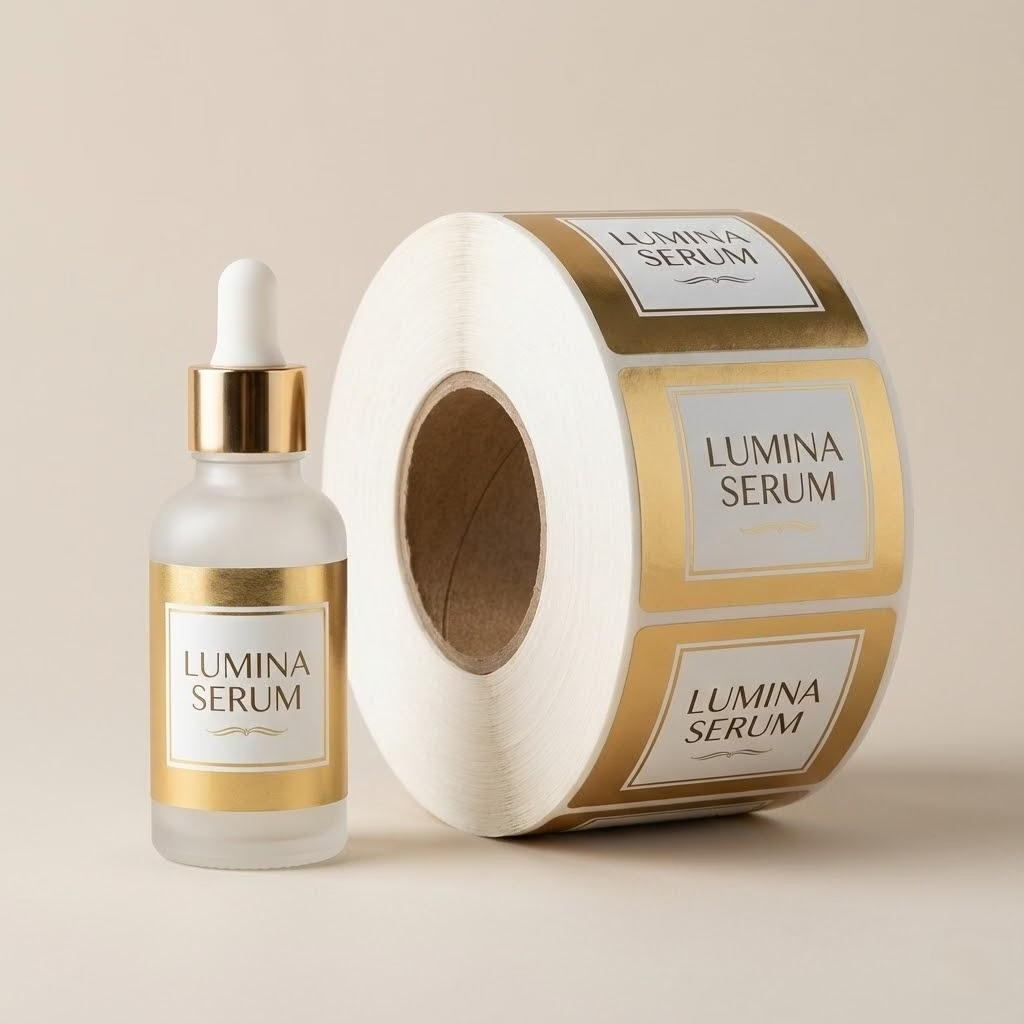
When you line up several fragrance-oil fill volumes for the same launch, label size stops being a template download and becomes a measurement job on real bottles. Curved shoulders, dropper caps, and oil on the rim punish guesswork fast.
Measure each bottle’s straight wall, then size the label to that zone—not a generic chart.
You will leave able to record millimeter fields per SKU, shortlist an oil-ready film stack before artwork is frozen, and pack multi-size RFQs so pricing matches how your bottles actually look—not how a blog chart assumes they look.
Measure Straight Wall Zone for Label Size
Fragrance oil bottle label size decisions start on the container, not in a spreadsheet of popular inch formats.Suppliers publish example rectangles for 5 mL, 10 mL, and 30 mL bottles, but those tables assume straight walls and a specific mold. Your 10 mL amber dropper from one glass vendor can measure differently from another brand’s “same” capacity.
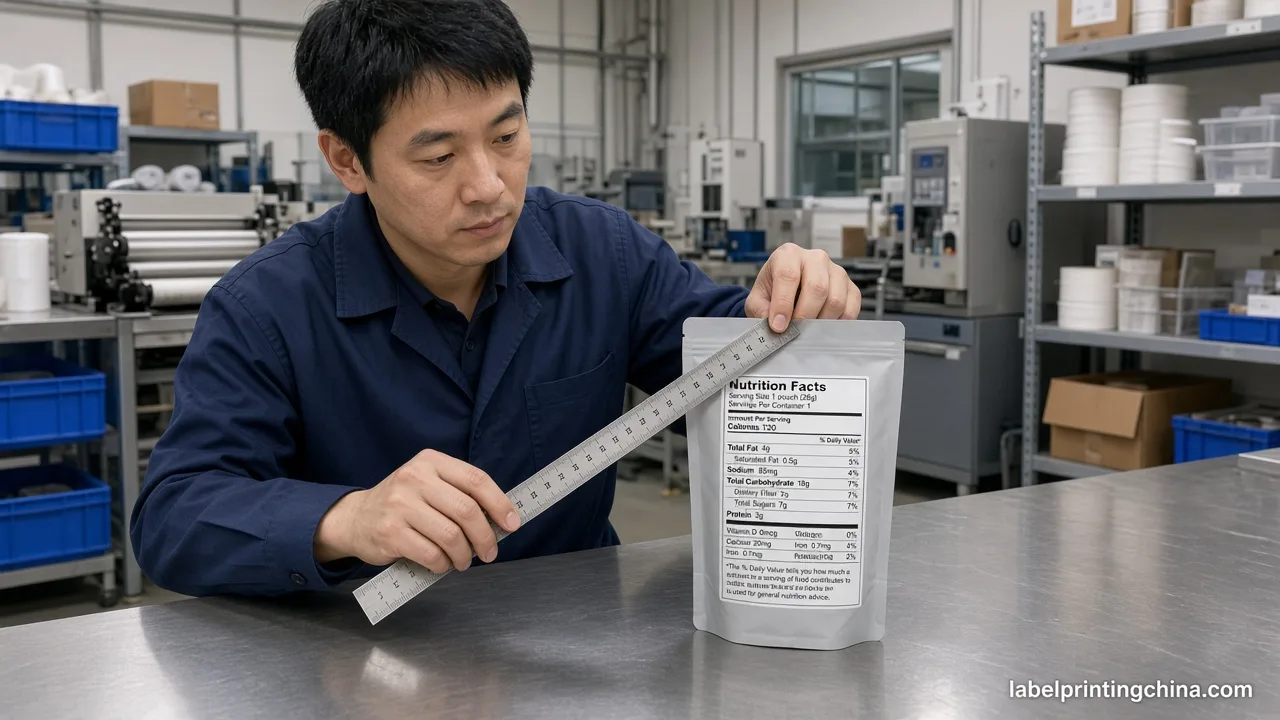
Measure the straight wall height and wrap width on each bottle, skip curved shoulders, and subtract a small gap so the label does not bridge the shoulder curve.
Use this when you label 5–100 mL dropper, roll-on, or cylinder fragrance oil bottles with curved shoulders.
These fields replace a universal size chart; two 10 mL bottles from different suppliers can still need different millimeter dimensions.
If the same launch also includes cream jars, use cream jar label layout to plan front, lid, and bottom panels with the same millimeter RFQ habit.
| Field to record | How to measure |
|---|---|
| Straight-wall height (mm) | Tape measure on the flat cylinder between shoulder and base radius—do not wrap over the curve |
| Wrap width (mm) | Circumference of the straight section divided by π, or strip of paper around the flat wall only |
| Shoulder clearance (mm) | Leave gap above and below the label so edges do not climb the shoulder or sit in the base well |
| Cap / dropper interference | Note collar height and whether the label can run under a crimp or safety seal |
Wrap a strip of paper around the straight wall, mark the overlap, and measure that length before you convert to label width. Record millimeter wrap width on every SKU—two “10 mL” molds rarely share the same field.Photograph the bottle next to a ruler for the RFQ pack. If you only send mL and a Pinterest template size, the printer is extrapolating—and extrapolation is where edge lift on oil bottles begins.
Size Ranges for 5–100 mL Fragrance Oil Bottles
Public guides list starting-point rectangles by fill volume. Treat them as sanity checks after you measure, not as die sizes you can reuse across molds.
| Bottle style (typical mL) | Starting-point label shapes (verify on your bottle) |
|---|---|
| Dropper / cylinder (5–15 mL) | Narrow rectangles near 32 × 38 mm up to 38 × 51 mm in supplier charts—remeasure every mold |
| Dropper / cylinder (30 mL) | Wider panels near 51 × 76 mm in common guides; tall narrow layouts if you rotate copy for sideways read |
| Roll-on / slim cylinder (5–10 mL) | Tall narrow formats near 32 × 51 mm; confirm cap collar does not overlap artwork |
| Short cylinder / splash (50–100 mL) | Larger wrap panels; watch shoulder curve on squat bottles where “wide” labels flag early |
Industry size pages for essential and fragrance oils often recommend polypropylene facestock for oil handling at the same time they publish inch templates. That pairing is the point: material choice and printable width must be decided together once your millimeter wrap is known.
If your line includes both 10 mL roll-ons and 30 mL droppers, resist forcing one label width because the brand color is shared.Shoulder height and diameter change the safe rectangle even when the front artwork looks identical. Shower-humidity packs follow a different failure path; see the humid bathroom label guide when the product lives on a shelf, not in a vanity oil tray.
Choose Oil-Ready Film When Fragrance Oil Contacts the Label
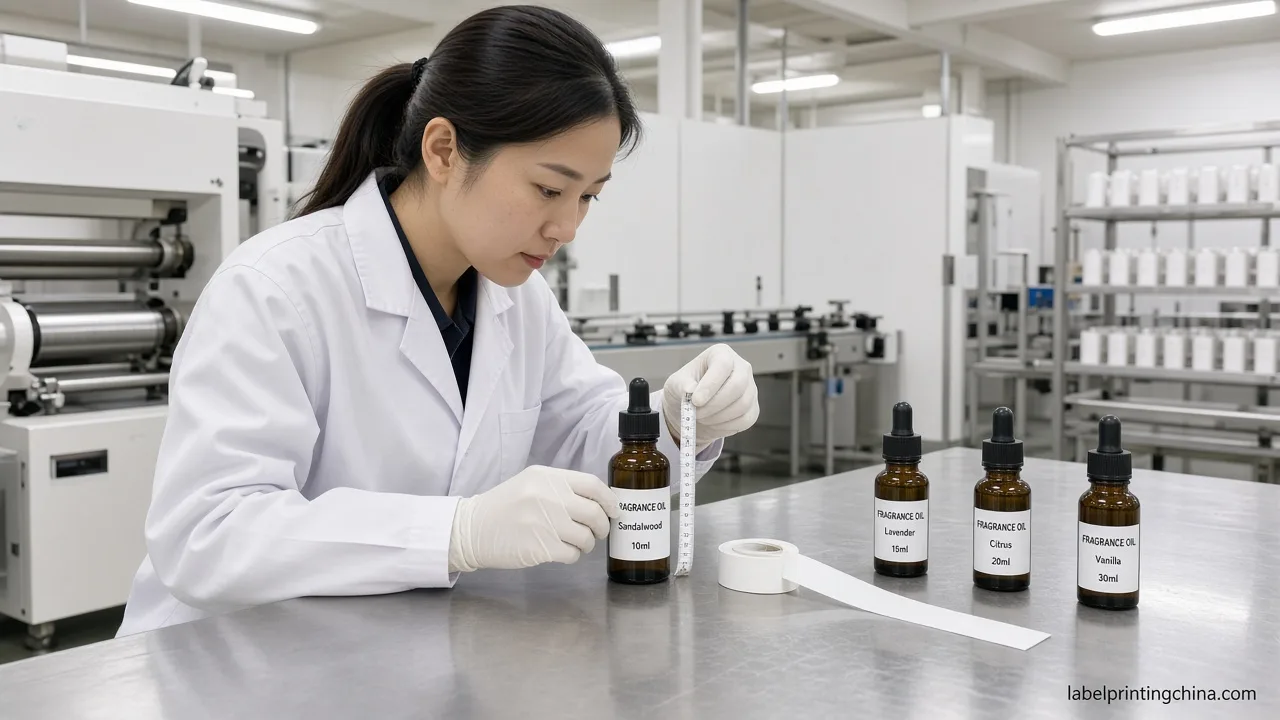
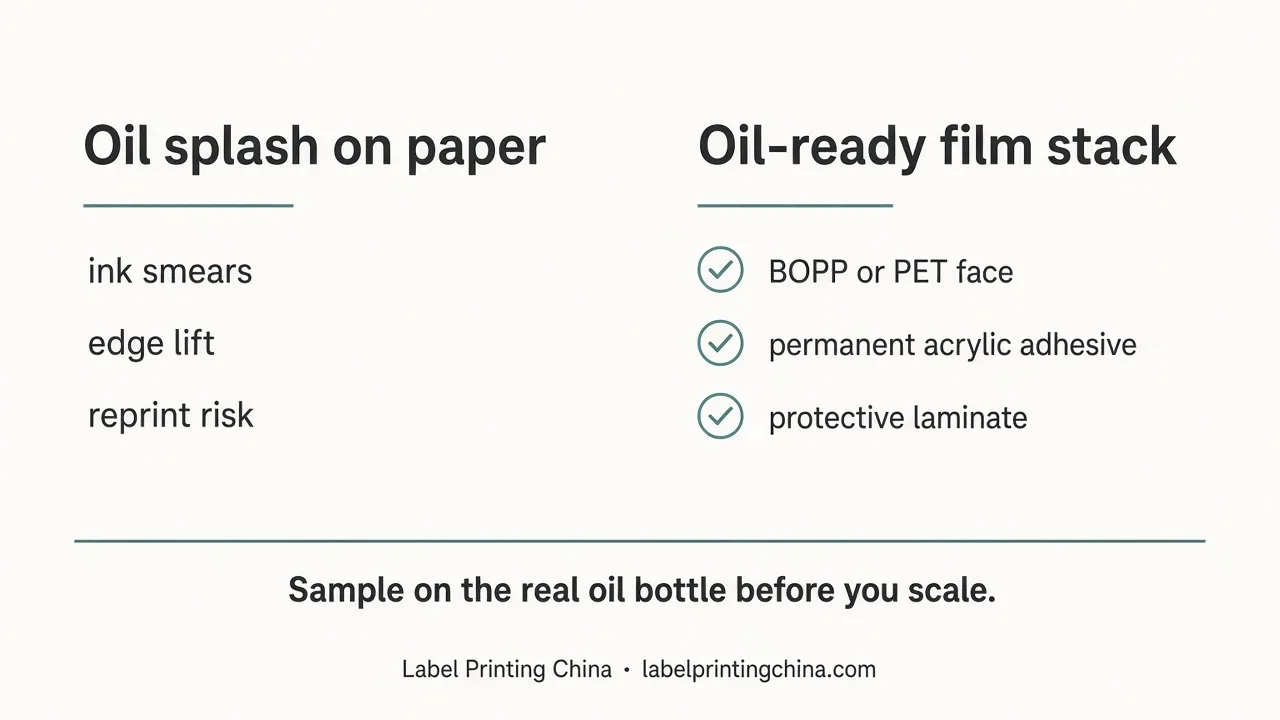
Fragrance oil bottle labels fail in two different places: the print face smears when oil sits on the laminate, and the edge lifts when adhesive wets out under the same oil. A facestock marketed as “oil proof” still needs the adhesive and laminate line to match how the bottle is filled and handled.
When fragrance oil can wet the label edge or cap line, shortlist film facestock such as BOPP with an oil-tolerant adhesive and a compatible laminate rather than unprotected paper display stock.
Use this when oil bleed, roll-on handling, or dropper fill lines can touch the label.
This does not certify permanent waterproof performance; adhesive grade and laminate still decide how long the label lasts on your bottle.
| Pack situation | Keep / Choose |
|---|---|
| Retail carton only; oil rarely touches the label edge | Paper with laminate can stay if you accept a film upgrade when end users handle open bottles |
| Dropper fill, roll-on swipe, or oily hands at the rim | Choose white or clear BOPP (or comparable film) + oil-aware adhesive + matte or gloss laminate |
| Matte luxury look on amber glass for oils | Choose matte laminate on film; confirm matte face still resists oil wipe in a sample |
| Buyer asks for “waterproof forever” language | Keep marketing copy realistic—specify oil-ready construction and filled-bottle test instead |
Oil on the rim always beats paper—shortlist film before you lock artwork.
Oil-ready film helps, but no facestock alone promises permanent oil-proof performance—adhesive grade, laminate, and a filled-bottle sample still decide what lasts on your pack.
Use this when buyers ask for oil-proof or waterproof fragrance oil labels without a sample plan.
This does not publish lab pass rates or certify any single brand film for unlimited oil exposure.
For the full cross-material and finish map beyond this oil shortlist, use the cosmetic label material checklist. Standards such as the ASTM peel adhesion method help QC teams benchmark pressure-sensitive stocks on your bottle resin—pair any peel reading with a filled-bottle oil wipe test.
Watch-out: a matte paper mock-up that looks premium in photos is not an oil-contact sample. If product wipe smears ink or lifts an edge on the filled bottle, hold volume and change the stack before reprint.
Clear Labels on Dark Glass Need Contrast and Print Protection
Clear labels on dark glass need light ink or underprint contrast plus a laminate that protects the print from oil wipe—otherwise the brand name disappears into the bottle color.
Use this when you want a no-label look on amber, cobalt, or black glass while the product inside is still an oil.
Clear facestock does not remove the need for an oil-tolerant adhesive and laminate; it only changes how much bottle color shows through the artwork.
White ink backer, knock-out type, or a tight frosted panel under the logo are common fixes. Spec those layers in the RFQ instead of assuming the printer will “make it pop” on site. If you need a deeper clear-film construction path after oil load is locked, compare notes with the clear BOPP label guide.
Plan Multi-SKU Sizes Without Sharing One Die for All Fill Volumes
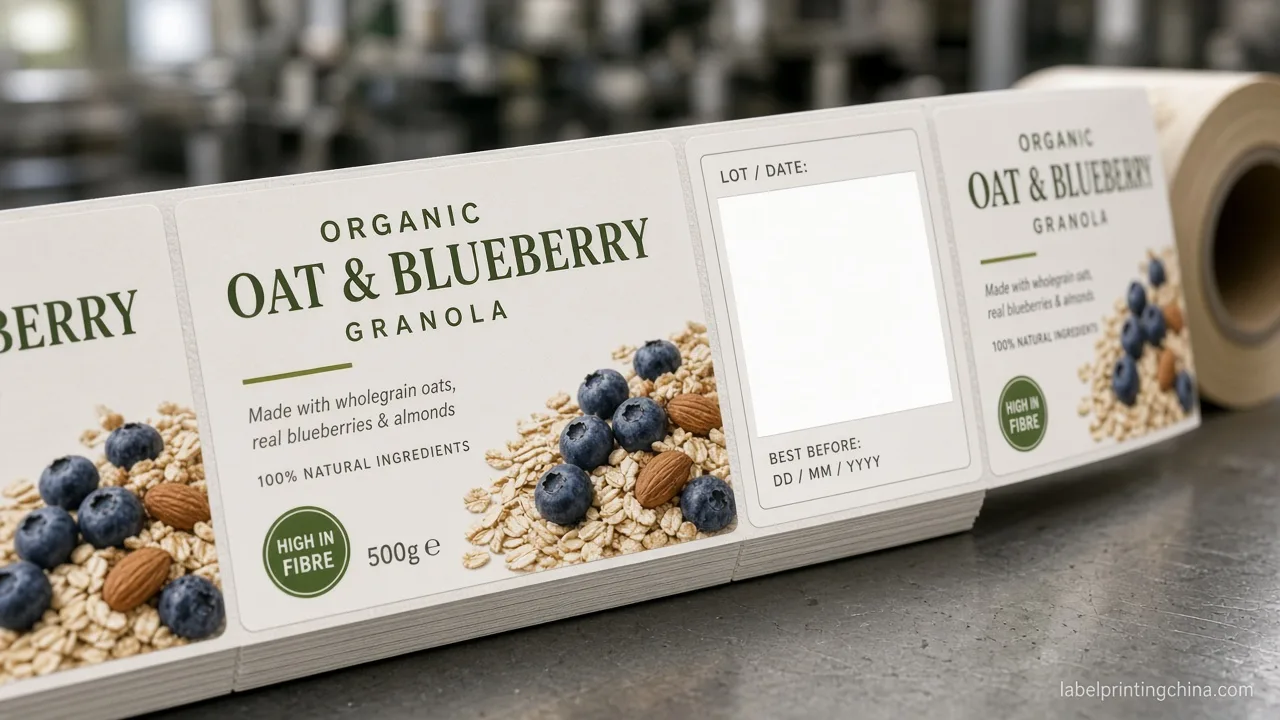
Launching four fill volumes in one season is where fragrance oil bottle label size planning breaks. A single shared rectangle saves art time for a week and costs rework when the 30 mL shoulder catches the bottom edge of the label.
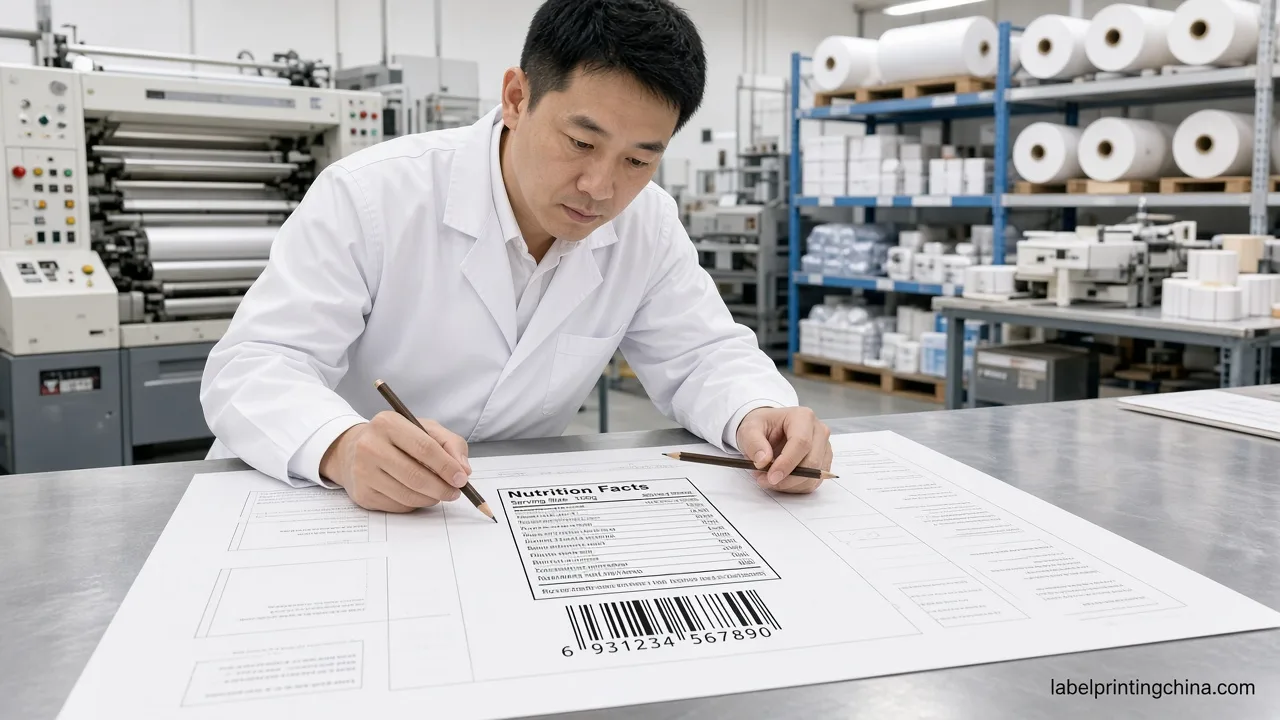
List each mL SKU with its own measured wrap width and straight-wall height, one shared oil-ready material spec, and quantity per size so one RFQ does not collapse unlike bottles into one die.
Use this when you launch several fragrance-oil fill volumes in the same production wave.
Sharing one label size across unlike bottle shapes still risks flagging and oil creep at the edges.
Real fragrance-oil RFQs often bundle several bottle sizes in one message, each with its own width-by-height fields—not one shared label for every mL.
Use this when explaining why multi-SKU mm lists belong in the same quote pack.
This describes a buyer RFQ pattern only; it is not proof of factory capability or lead time.
| SKU row (example) | What to write |
|---|---|
| 10 mL roll-on | mL, wrap mm, height mm, qty, same BOPP + matte laminate as other SKUs |
| 30 mL dropper | Separate wrap/height mm; note taller shoulder clearance; qty |
| 50 mL splash | Separate die; flag if artwork scales or needs new layout |
When roll application and sequence matter across many SKUs, read how production teams batch variable sizes on the multiple custom label SKUs page—then bring the per-bottle mm list from this article into that conversation.When the line is primarily essential-oil positioning and oil-proof wording, compare scope on custom essential oil labels.
RFQ Fields That Speed Small-Bottle Label Quotes
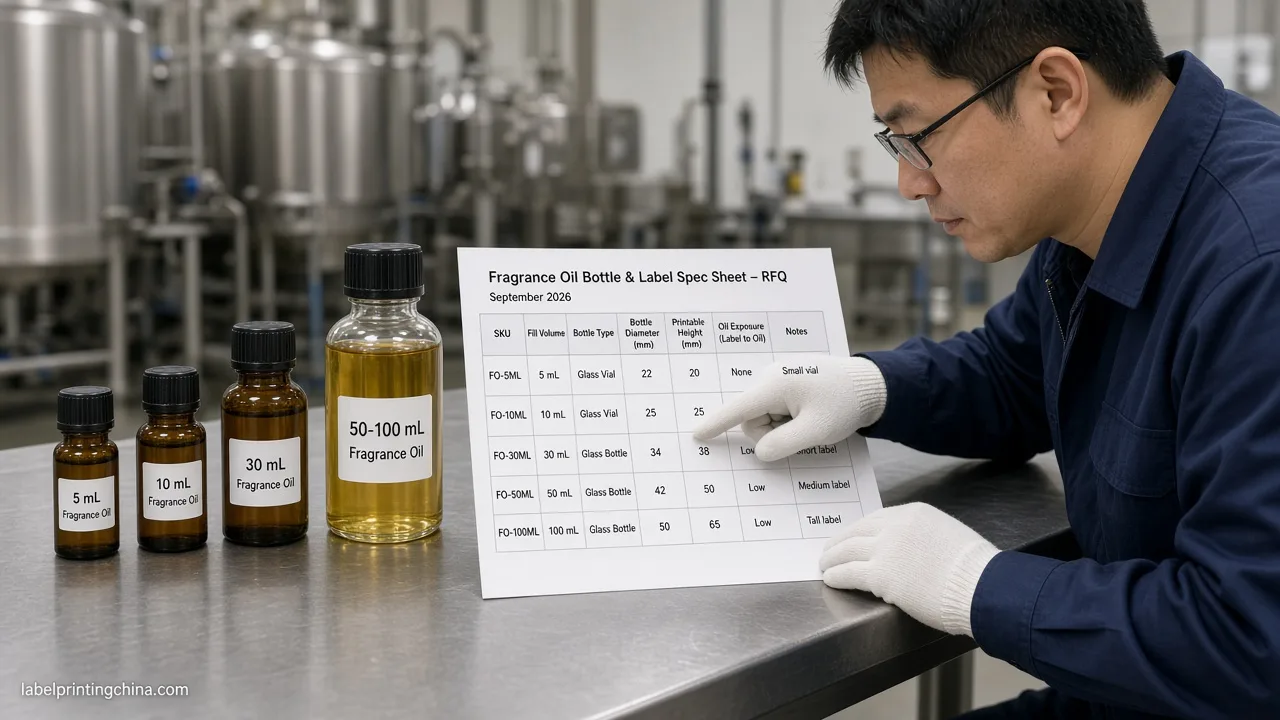
Send measured millimeter wrap and height per SKU with your artwork—buyers who quote small oil bottles rarely get accurate pricing from mL alone.
Use this when preparing RFQ field lists for small-bottle label quotes.
This reflects aggregated inquiry patterns; not every RFQ includes CAD-level drawings.
Before you scale fragrance oil bottle labels, treat a filled-bottle sample as the gate: apply labels to oiled rims, wipe once with product, and flex the wall if customers squeeze the pack.
| Signal | Ready or Hold |
|---|---|
| Film + oil-aware adhesive + laminate match the pack table | Ready to request labels on filled bottles |
| Edge lift or ink smear after oil wipe on the sample | Hold—change facestock, adhesive, or laminate before reprint |
| Only mL rating sent—no measured wrap or height mm | Hold until millimeter fields are recorded per SKU |
- Red flag: one shared die forced across unlike shoulder heights.
- Red flag: approving volume from mockups with no oil-contact sample.
- Red flag: quoting “waterproof forever” without filled-bottle test notes.
- Bottle photo per SKU (straight-on and shoulder view).
- mL rating and measured wrap width + straight-wall height in millimeters.
- Bottle material (glass, PET, PP) and finish (gloss, matte, soft-touch).
- Oil-exposure notes: dropper fill height, roll-on swipe path, leaks in transit.
- SKU list with quantity per size and shared oil-ready material spec.
- Artwork file (or draft) and desired matte or gloss look after durability is locked.
Need a supplier path after sizing is documented? For broad cosmetic label production, start at custom cosmetic labels.
Need a small-bottle label review before production?
Send bottle sizes, bottle material, oil-exposure details, SKU list, and artwork for a small-bottle label review.
Frequently Asked Questions About Fragrance Oil Labels
What is the best fragrance oil bottle label size for a 10 mL dropper?
There is no single best size—measure the straight wall on your 10 mL dropper and record wrap width and height in millimeters. Compare your numbers to supplier starting points near 38 × 51 mm only after you measure.
Do fragrance oil bottle labels need oil-resistant material?
When oil can touch the label edge or users handle bottles with oily hands, choose film facestock such as BOPP with an oil-tolerant adhesive and laminate. Unprotected paper is a poor default for open-bottle use.
Can I use one label size for every mL in my line?
Only when bottles share the same mold and straight-wall dimensions. Different fill volumes usually need separate dies even if the brand artwork matches.
Where can I find cosmetic bottle label printing services after sizing is done?
Once mm fields and oil-ready material are documented, request quotes through a cosmetic label printing quote partner with your SKU list and artwork attached—commercial “print my labels” searches are easier to evaluate when the brief is complete.
Lock Fragrance Oil Label Size Before You Reorder
When each SKU has measured millimeter fields, an oil-ready film stack, and a sample that survived contact with your formula, fragrance oil bottle label size is no longer a guess pulled from a blog chart.You have a reorderable spec per bottle and an RFQ pack that survives the next mL extension without collapsing every variant into one die.
That lock is what keeps the next fill volume from inheriting a label that fit the mock-up glass but not the production mold. If resin, shoulder shape, or oil exposure changes, rerun the measure-and-sample path before you reuse last season’s dimensions—and only then push the batch into full cosmetic label production.