Soft tubes wrinkle, lift, and flag for reasons glass jars almost never see: the pack flexes every time a shopper squeezes product out. You can still lock a production-ready label plan before artwork freezes if you pick a conformable film, map the squeeze zone, and set overlap and crimp rules on the real tube.
Use conformable PE or PO film—not paper or rigid PP—for squeeze tube labels, then lock wrap overlap and crimp-edge rules before print. Map the high-flex squeeze zone so edges are not parked where repeated compression lifts the face.
You will leave able to choose film by squeeze behavior, place edges away from failure zones, run a filled-tube squeeze sample, and send a tube-ready RFQ—so the next cosmetic soft-tube reprint does not restart from wrinkled scrap.
Choose Cosmetic Tube Label Material for Squeeze Flex
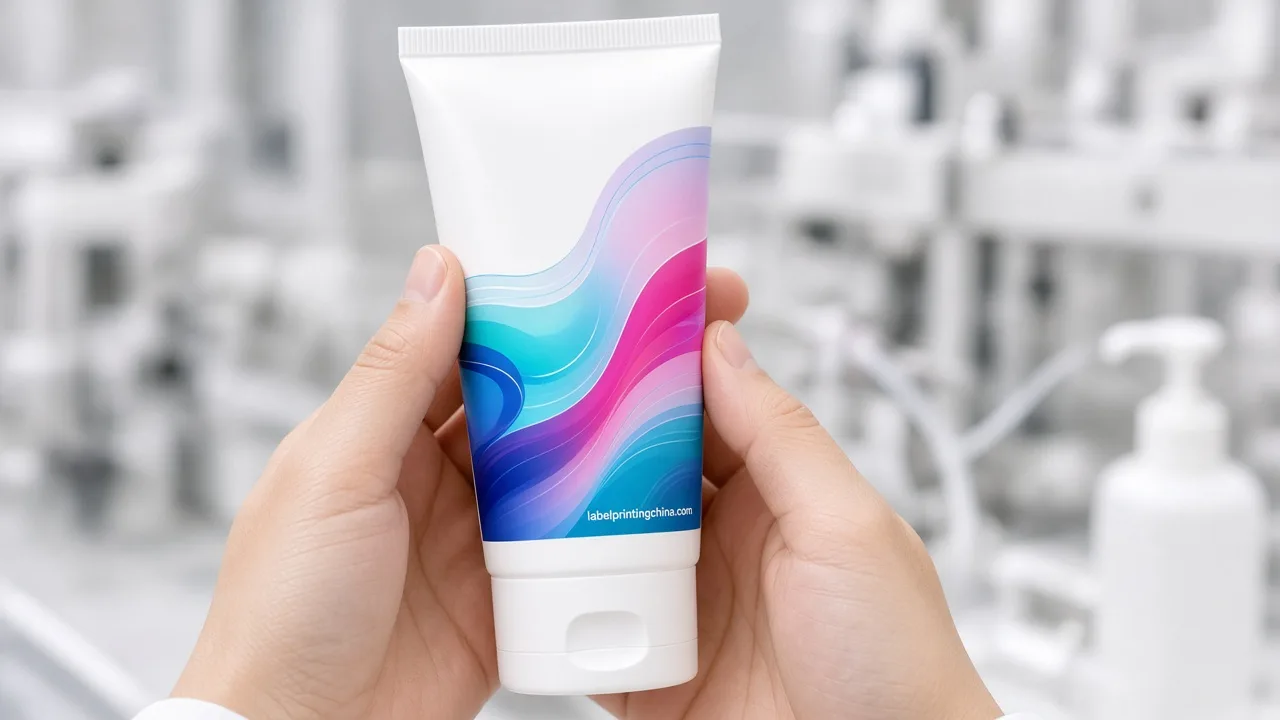
Choose PE or PO film for full-squeeze tubes; reserve stiffer PP for rigid jars, and match adhesive to the tube resin.Use this when the tube is repeatedly compressed in normal use and the face must recover without permanent wrinkles. This does not certify one brand film for every oil formula or claim waterproof performance forever.
| Face stock | When it fits soft tubes | Pass / Fail cue |
|---|---|---|
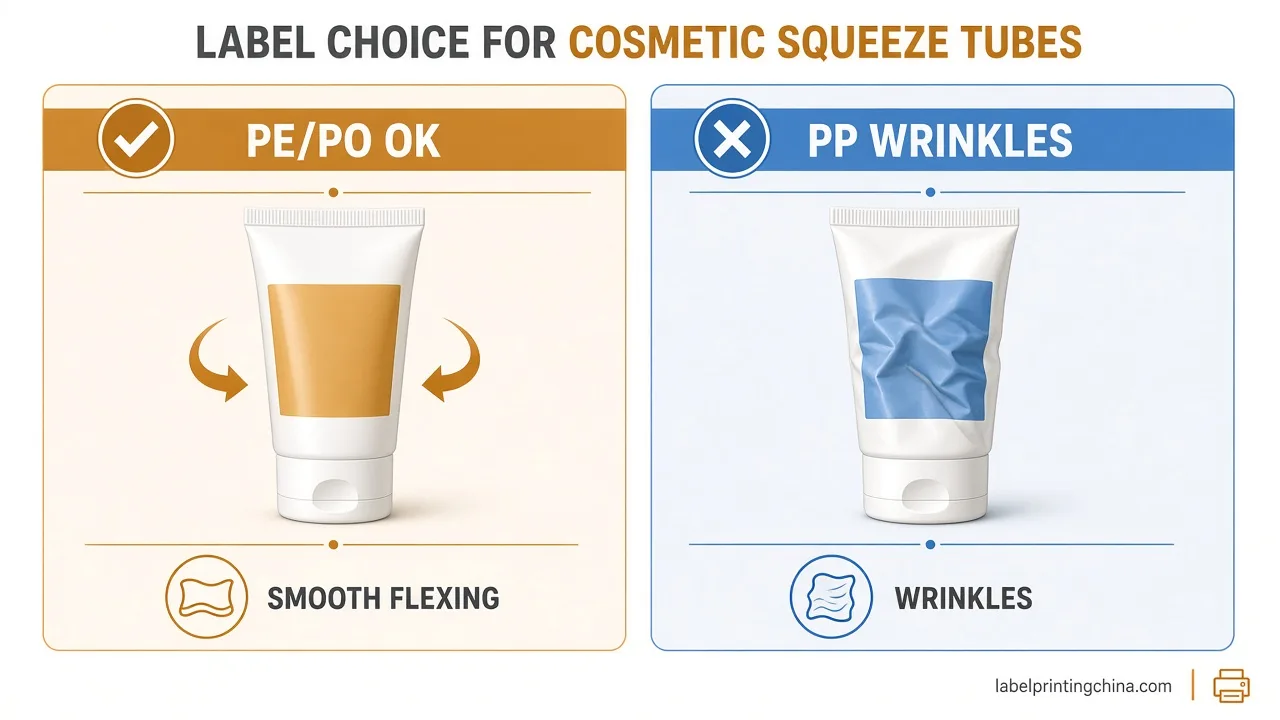
| PE / PO film | Full-squeeze cosmetic tubes that recover after compression | Pass if sample recovers flat after 20 squeeze cycles |
| Rigid PP | Usually jars/bottles, not soft tubes | Fail if permanent ridges appear after squeeze |
| Paper | Avoid on oily or high-flex tubes | Fail if face softens, tears, or lifts at edges |
Paper faces fight curvature and absorb product seepage—see also industry notes on best squeeze tube labels.Rigid PP often looks crisp on a jar, then darts or tunnels when a soft tube collapses. PE and many polyolefin constructions are built to flex with the pack; clear PE can look hazier than a “no-label” PO aim, so confirm the visual target with a physical sample—not a PDF swatch alone.
Adhesive follows the tube surface, not the category name “cosmetic.” PE and PP tubes are low-surface-energy plastics: a generic permanent acrylic that holds on glass can still flag on untreated polyolefin.State resin, any soft-touch overcoat, oil/water exposure, and application temperature on the RFQ so the adhesive grade is tested against that stack.
If you are comparing finishes across bottles, jars, and tubes in one brand family, keep the general path on the cosmetic film finish path, then return here for tube-only flex and crimp rules.
PE vs PP Film Labels When Tubes Wrinkle
Wrinkles usually mean a face that is too rigid; flagging usually means weak adhesive or edges sitting in the high-flex squeeze zone. Use this checklist when samples already wrinkle, lift, or flag after hand squeeze tests. This is a diagnostic starting point, not a measured factory failure rate or lab certificate.
| Symptom | Likely cause | First fix to test |
|---|---|---|
| Permanent ridges after squeeze | Face too stiff (often PP or paper) | Switch to PE/PO conformable film |
| Corners lift / flag | Weak adhesive or edge in high-flex zone | Raise tack for LSE tube; move edge off squeeze band |
| Tail peels at overlap | Overlap too short or varnish on underlap | Widen overlap; keep underlap unvarnished |
Watch-out: a label that looks fine on an empty mandrel can still fail after fill—product oils and a softer wall change both adhesion and flex. Test on a filled or representative tube, not only a dry sample.
Set Label Shape, Overlap, and Crimp Edges
Plan about a quarter-inch wrap overlap, leave the underlap edge unvarnished, and place the label relative to hot versus cold crimp rules.Apply this when the label wraps the tube circumference and the tube will be sealed at the crimp. Exact overlap still depends on diameter and tooling—confirm on the physical tube before mass production.
- Measure tube diameter in millimeters at the labeling band and compute wrap length ≈ π × diameter.
- Add about 6 mm (≈1/4 inch) overlap and keep the underlap edge unvarnished for bond.
- Ask whether sealing is hot crimp or hot-air cold crimp before the knife line freezes.
- Mark the high-flex squeeze band and keep sharp die edges off that band when a partial panel works.
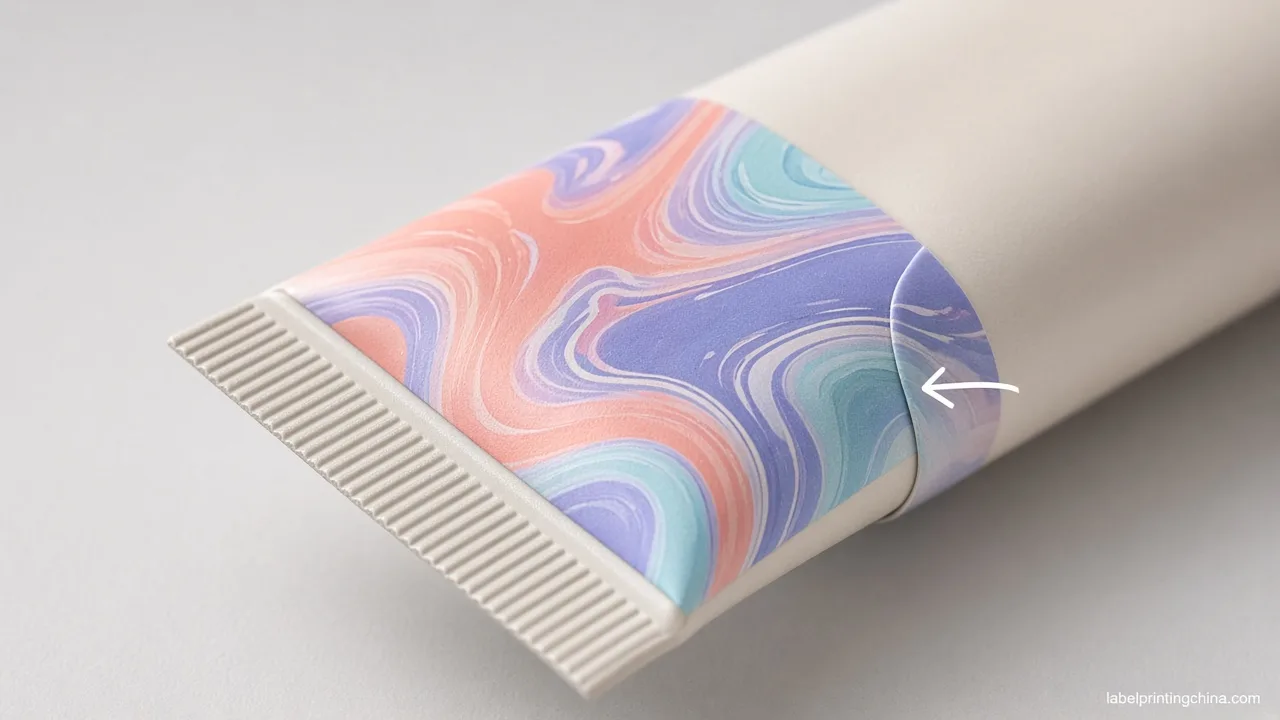
Most cosmetic soft tubes need a full or near-full wrap. Undersized panels leave a free edge that peels when the wall collapses. Converter guidance commonly targets about 1/4 inch (≈6 mm) of overlap; the underlap edge must stay free of heavy varnish so the tail can bond to film, not to a glossy coat.
Crimp method changes where the label may sit. Hot crimping uses very hot jaws; film that rides into that heat can lift, so artwork often stops short of the crimp.Hot-air sealing with cold jaws is more common and can allow the label to extend through the crimp zone when the process allows. Ask how the tube is sealed before you freeze the knife line—converter notes on tube label crimp rules spell out hot versus cold crimp placement.
When the same SKU also ships in tubs or cartons and you need color consistency across those packs, coordinate with tube and tub labels matching—after the tube flex construction is locked.
Map the Squeeze Zone Before You Place Edges
Mark where fingers compress the tube in normal use, then keep primary label edges out of that band when the artwork allows. Short hero panels can sit on a calmer wall segment; full wraps must survive flex with film and adhesive, not by hoping a stiff face holds.
Write the squeeze-area map on the RFQ the same way you write diameter—otherwise the printer only sees a flat die line.
Red flags before you approve production art:
- Specifying “cosmetic label” without tube resin or diameter
- Copying a jar PP construction onto a soft PE tube
- Parking a sharp die edge on the highest flex band
- Approving artwork before a filled-tube squeeze sample
Run a Filled-Tube Sample Squeeze Test
Apply candidate constructions to the real tube, fill or weight it representatively, then squeeze and release through a normal use cycle while you watch for darting, edge lift, and overlap peel. Record ambient temperature and whether product oil contacted the face.
Blank sample labels are enough to kill bad stacks early. On the sample log, record: (1) tube resin and diameter in millimeters, (2) face/adhesive lot codes, (3) number of full squeeze-release cycles, (4) whether product oil contacted the face, and (5) ambient temperature during the test.Keep one pass that mirrors line conditions: application pressure, dwell, and any orientation mark. If the sample only passes on a clean dry tube but fails after oil wipe, change adhesive before you change brand colors.
For a 35 mm diameter tube, wrap length is about 110 mm before overlap; adding 6 mm overlap brings artwork near 116 mm—verify with a paper wrap mockup before you cut film.If the applicator uses a mandrel, check registration marks within a 1–2 mm tolerance so the overlap lands on the unvarnished underlap every cycle. When you test, verify edge lift after at least 20 squeeze-release cycles at room temperature, then repeat a short oil-wipe check if the formula is greasy.
Ready for a tube-label review?
Send tube material, diameter, squeeze area, use environment, and artwork for a tube-label review.
Next Step for Your Tube Label Spec
For multi-panel jar planning instead of soft tubes, see cream jar label zones. Keep bathroom bottle humidity durability and fragrance small-bottle sizing on their own guides so this page stays on squeeze-tube flex.
FAQ
what label material for squeeze tubes
Start with conformable PE or PO film and an adhesive rated for the tube resin. Avoid paper and rigid PP on full-squeeze cosmetic tubes unless a sample proves otherwise on your exact pack.
how much label overlap on a tube
Plan about a quarter-inch wrap overlap as a starting target, keep the underlap unvarnished, and confirm the final length on the physical diameter and applicator before you freeze the die.
should tube labels cover the squeeze area
Prefer to keep sharp edges off the highest flex band when a partial panel is enough. Full wraps must use a film and adhesive that survive compression—covering the squeeze zone with a stiff face is what creates wrinkles and flags.
how do I test squeeze tube labels before production
Apply candidate constructions to a filled or weighted tube, run at least 20 squeeze-release cycles, and check for wrinkles, flagging, and overlap peel before you approve mass artwork.