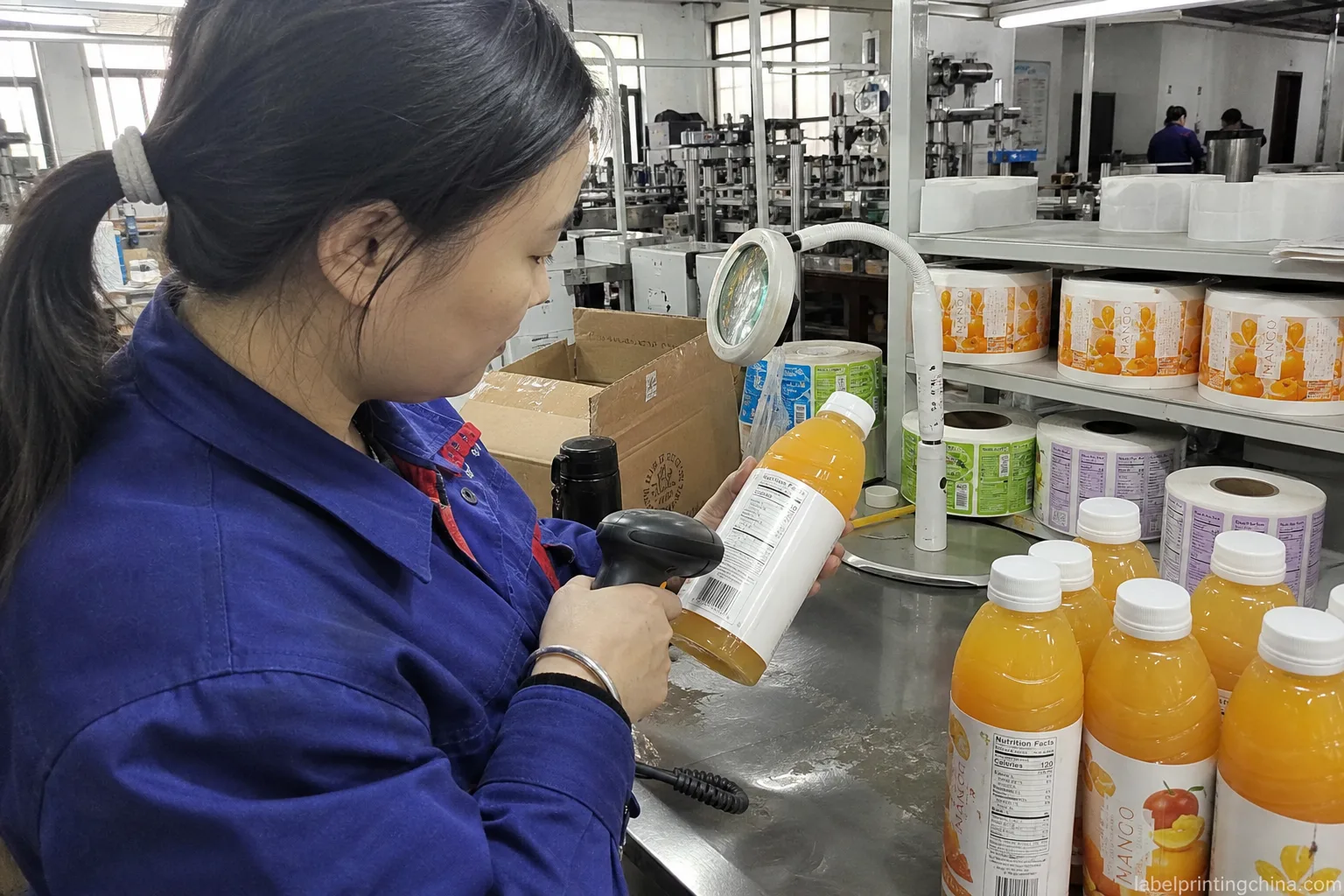
Your 10 mL dropper sample looked sharp on day one, then oil crept around the neck and the label turned cloudy at the edge—while leadership still wants three SKUs at about 1,000 labels each.You do not need another CBD label sales page; you need a roll-label spec that locks an oil-ready build and a small-batch format before the PO leaves your desk.
For CBD oil and supplement bottles, specify an oil-resistant film face (BOPP or vinyl) with permanent adhesive rated for glass or plastic and oil wipe exposure, then lock small-batch roll format—size, core, unwind, and about 1,000 labels per SKU—before you approve art or place the PO.
Keep reading and you will see how to separate face-stock failures from adhesive or wipe conditions, how to choose builds for 10 mL, 30 mL, and capsule packs, and how to write a ~1,000-per-SKU roll RFQ that does not force you into dead inventory.
What Fails First on Oily Bottle Labels
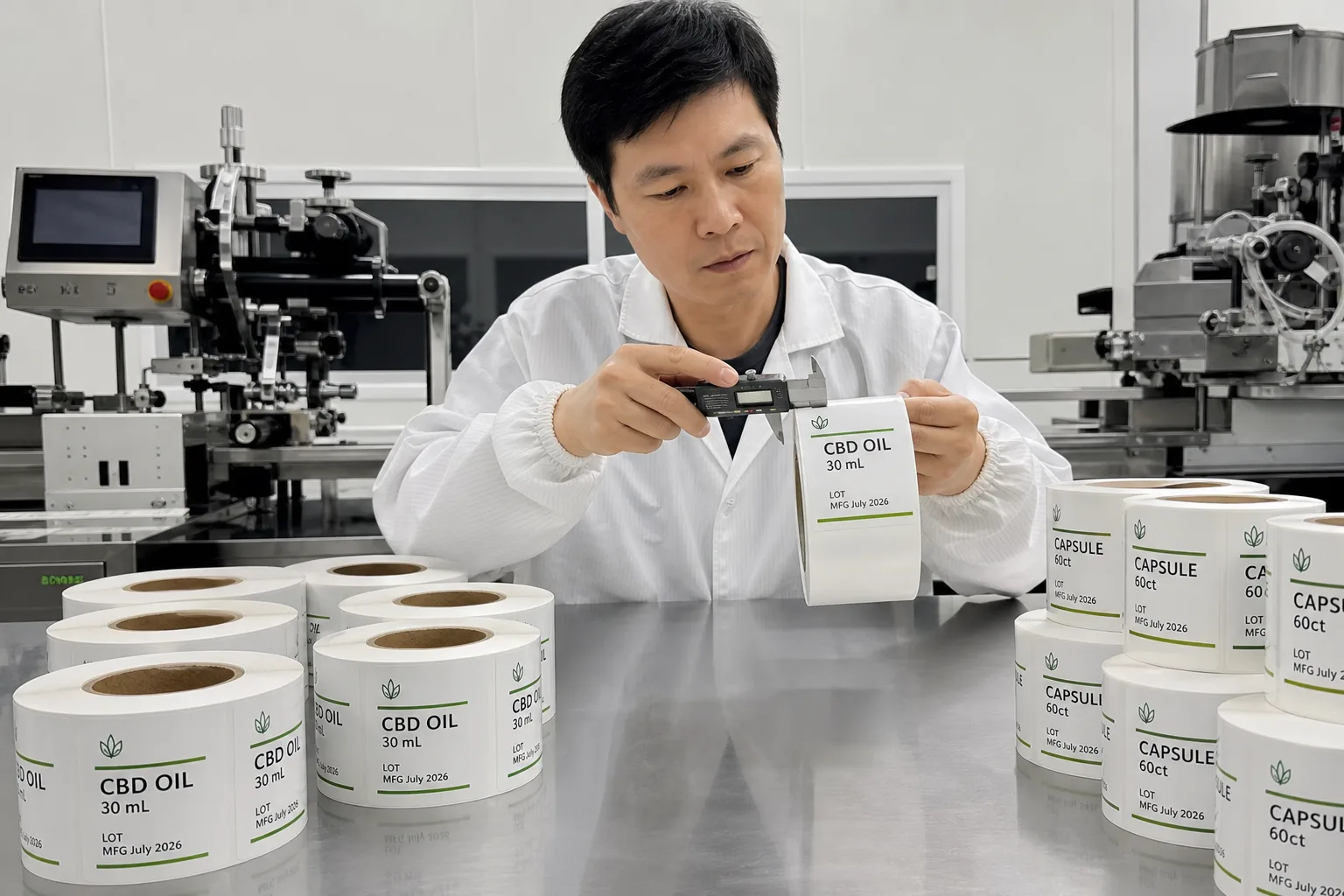
When you only say “use waterproof film,” your team still argues about the wrong failure. Name what fails first on oil-contact bottles so your next sample request matches the real leak—not a generic upgrade.
| What you see | Clear signal | Watch / next move |
|---|---|---|
| Edges lift or cloud where oil wipes the neck; print still readable elsewhere | Adhesive / oil mismatch | Specify oil-capable permanent adhesive; trial on real oiled glass, not dry cards |
| Ink smears or varnish dulls after oil wipe; adhesive still holds | Print / topcoat weakness | Add oil-resistant ink or laminate; do not only “upgrade glue” |
| Paper face wrinkling or fiber swell near drip zone | Wrong face stock | Move to film (BOPP/vinyl); avoid uncoated paper on oil SKUs |
| Hand samples pass; line fails after wipe-and-fill | Apply-condition miss | Record wipe chemistry, fill temperature, and rest time in the RFQ |
When you once swapped to a thicker “premium” paper after edge clouding, oil wicked faster into the face. Your Clear row was wrong face stock—not a call for more caliper.A common watch-out: chasing thicker paper when the real red flag was oil contact on a porous face. Measure the wipe zone after 24 hours and again at 72 hours before you call the sample “pass.”
If dry samples pass but filled bottles fail after one wipe, treat that as adhesive or topcoat mismatch before you reopen artwork. Your vendor conversation should start with oil contact and wipe method—not unit price.
Before you blame the applicator alone, photograph the failure zone and note whether oil dripped, wiped, or soaked overnight. When you can point to one Clear row, your next sample cycle stops burning two variables at once.
Shared lab language such as FINAT test methods helps you talk adhesion with your converter—use it as a checkpoint language, not a substitute for locking your own oil-contact trial.
Prefer or Avoid — Builds for 10 mL, 30 mL, and Capsule Packs
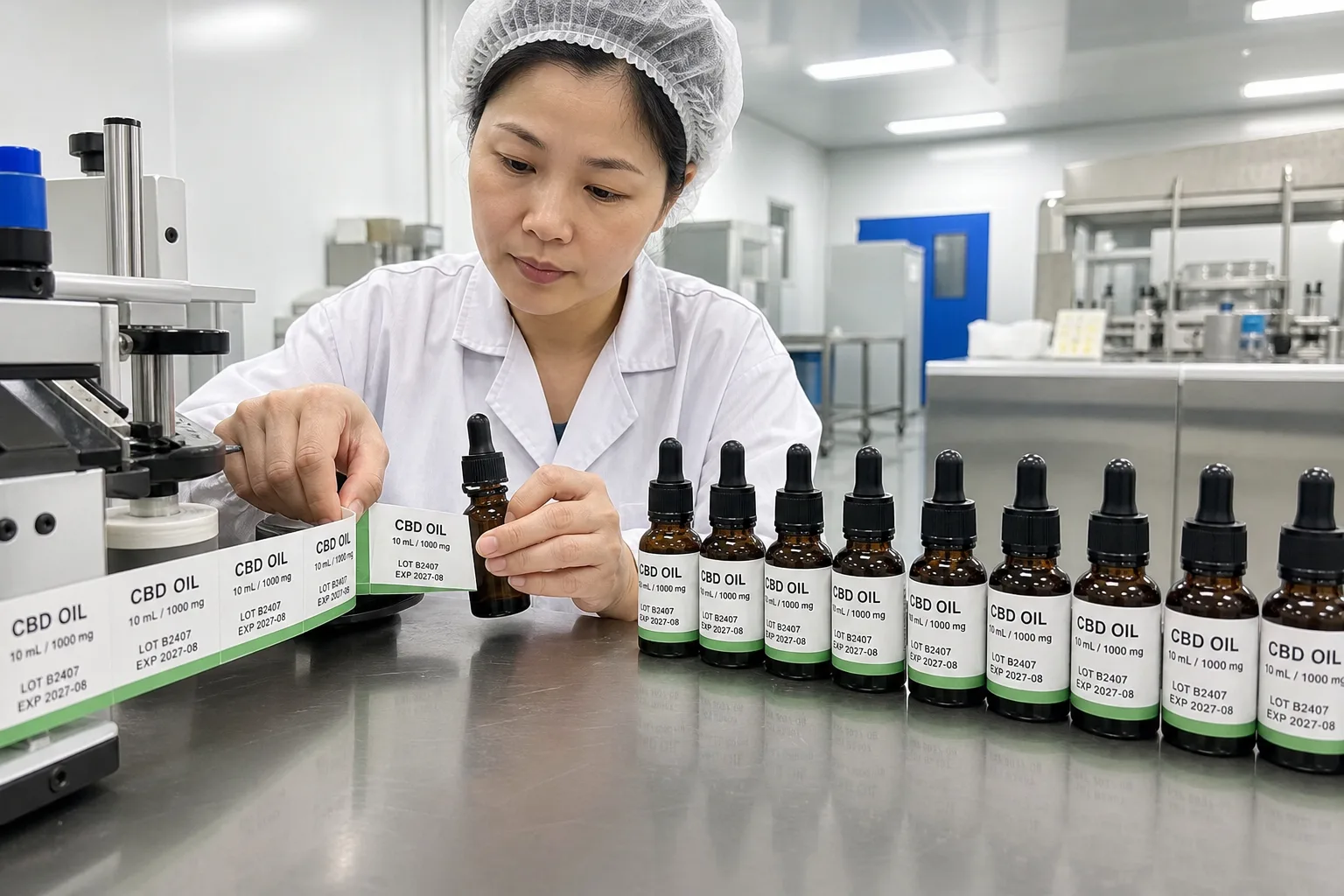
When you copy one “durable CBD label” onto every packout, you often buy a build that works on a dry capsule jar and fails on a greasy 10 mL neck. Choose face stock and adhesive against each bottle’s real oil and handling load.
| Your pack | Prefer | Avoid |
|---|---|---|
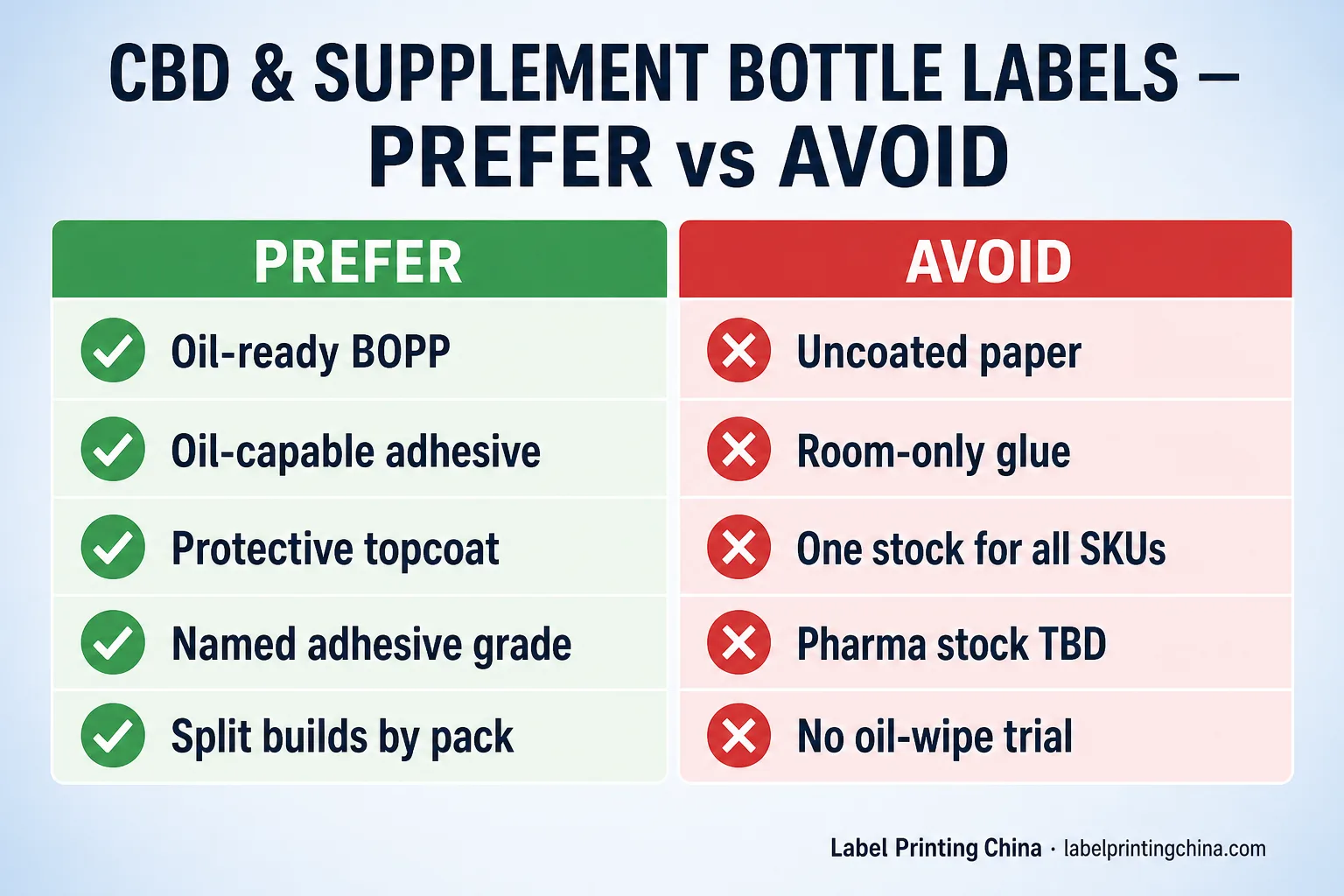
| 10 mL oil dropper (tight curve, frequent neck wipe) | Conformable BOPP or thin vinyl + oil-capable permanent adhesive + protective topcoat | Uncoated paper; room-only cosmetic glue; no wipe trial |
| 30 mL oil / tincture bottle | Same oil-ready film build; confirm die size and wrap; trial after fill | Copying a dry capsule art build “to keep one material” |
| Capsule / tablet bottle (less oil, more scuff) | Durable film or coated face matched to scuff; permanent adhesive for plastic/glass | Over-spec cryogenic adhesives you do not need—or paper that scuffs in shipping |
| Shared art family across oil + capsule | Same visual system; separate material lines on the quote | One stock code forced onto every SKU “for simplicity” |
When you previously ordered “BOPP permanent” with no oil-wipe note, your converter filled gaps with a general-purpose build. Your Prefer row must name oil contact—or you will re-learn cloudy edges on the next 10 mL lot.
If you need a shared definition of how pressure-sensitive constructions work, skim pressure-sensitive adhesive basics, then force your quote to name face, adhesive grade, and liner—not just “CBD label stock.”
Before you pay for a full die set across three packs, run a short oil-wipe trial on real bottles with the candidate construction. Verify adhesion after a 10-minute rest and again the next day. Your Avoid list exists to stop you from approving art on a build that already failed in your hand.
When your capsule SKU only needs scuff resistance, Prefer a durable film without overbuying an oil-rated adhesive you never stress. Split builds on the quote even if branding stays consistent—details that also show up in the essential oil durability guide for related oil-contact cases.
Lock Small-Batch Roll Specs Without Overbuying
When you freeze material but order like a national flexo launch, you still risk dead rolls of a SKU you will revise next month. Lock a ~1,000-per-SKU path with the same rigor you use for face stock—especially when you are still testing 10 mL, 30 mL, and capsule packs.
- Quantity logic: Start near 1,000 labels per SKU (tune to your sell-through)—treat that as a soft MOQ for unproven flavors, not a single MOQ averaged across winners and tests.
- Print path: Prefer short digital or hybrid lots while art and claims still move; do not force every SKU onto a long flexo buy.
- Core / Max OD / unwind: Match your applicator; small dies change labels-per-roll math fast.
- Shared die, separate qty: Keep sizes aligned when possible; still split quantities by SKU velocity.
- Rev lock: Any claim, potency, or brand refresh freezes reorder until art Rev is signed.
When you once bought 10,000 of every new flavor “because the unit looked cheap,” two SKUs died and the rolls sat. Your next RFQ should size each SKU to coverage—not vanity round numbers.
If your applicator needs a 3″ (76 mm) core, write it beside the material line so a small digital lot still arrives machine-ready. Check Max OD against your guard clearance—often 12 inches (305 mm)—before you “save” freight with one giant roll. You want changeovers you can live with—not a hero roll nobody can mount.
Before artwork approval, write quantity per SKU, core, Max OD, and unwind on the same page as face stock and adhesive. Your pressroom cannot invent the correct rewind after the job is already wound the wrong way.
Need small-batch oil-ready rolls quoted to your bottles?
Send bottle type (10 mL / 30 mL / capsule), oil-wipe conditions, core, Max OD, unwind, and target labels per SKU—we will return a build you can trial before you scale.
Clear or Watch — Pre-PO Spec Fields for Oil and Capsule Labels
When your quote only lists size and quantity, you invite silent substitutions. Run these fields Clear before you release purchase money—Watch means you pause, not “hope the converter guesses oil contact.”
| Field | Clear if… | Watch / Hold if… |
|---|---|---|
| Bottle type + OD | 10 mL / 30 mL / capsule named with measured OD and label size | Only “CBD bottle” with no OD or die drawing |
| Face + adhesive grade | Named film + adhesive rated for oil or dry as needed | “CBD label stock” with no grade |
| Oil wipe / fill conditions | Wipe method and fill temperature stated | Ambient dry assumption on an oil dropper line |
| Qty per SKU + roll format | ~1,000 (or your target) + core / Max OD / unwind | One blanket MOQ across unproven SKUs |
| Sample plan | Oil-wipe trial on real bottles before mass PO | Art approved with zero bottle trial |
When you leave oil contact as TBD, you often discover cloudy edges only after freight. Put the wipe method on the PO line—not in a side chat.
If any Watch row is still open, Hold the mass order and run the missing trial. Your cheapest reprint is still more expensive than a one-page Clear checklist.
Before you sign the proof, read the quote aloud against this table. Inspect a packed-roll photo for unwind orientation. If your vendor cannot name adhesive grade and labels-per-SKU in the same email, you do not yet have a machine-ready supplement bottle labels PO.
Freeze the Spec Before Your Next 1,000-Label Run
When you treat the next sample as “just artwork,” you restart the oil-edge lottery. Freeze face stock, adhesive, quantity logic, core, Max OD, and unwind as one package—then print the ~1,000-label trial on that frozen build.
If your team still debates materials after the die is cut, pause and reopen the Clear/Watch fields instead of adding another ink tweak. Your CBD and supplement bottles win when the oil-wipe trial and the applicator mount both pass on the same construction.
Freeze oil-ready face stock, adhesive grade, and ~1,000-per-SKU roll format on one page before you release mass quantity—your bottle trial and spindle mount must pass on the same construction.
Send that locked pack when you request custom roll labels so the quote returns a build you can approve once—not a series of silent substitutions. Your next filled 10 mL bottles should still show clean edges, and your cage should not fill with unused SKU rolls.